
We propose a distillation scaling law that estimates distilled model performance based on a compute budget and its allocation between the…
On-Policy Distillation
On-policy, dense supervision is a useful tool for distillation
Dataset Distillation
Model distillation aims to distill the knowledge of a complex model into a simpler one. In this paper, we consider an alternative formulation called {\em dataset distillation}: we keep the model fixed and instead attempt to distill the knowledge from a large training dataset into a small one. The idea is to {\em synthesize} a small number of data points that do not need to come from the correct data distribution, but will, when given to the learning algorithm as training data, approximate the model trained on the original data. For example, we show that it is possible to compress $60,000$ MNIST training images into just $10$ synthetic {\em distilled images} (one per class) and achieve close to original performance with only a few steps of gradient descent, given a particular fixed network initialization. We evaluate our method in a wide range of initialization settings and with different learning objectives. Experiments on multiple datasets show the advantage of our approach compared to alternative methods in most settings.
What is Knowledge distillation? | IBM
Knowledge distillation is a machine learning technique used to transfer the learning of a large pre-trained “teacher model” to a smaller “student model.”

distil labs – Cut LLM Costs by 80% with Custom SLMs
Your LLM costs are eating your product margins. distil labs trains a specialized model layer on your workload and serves it behind one OpenAI-compatible endpoint.
241. Distillation Is Not Anti-American, Weaponizing It Is
Recent attempts at pursuing government intervention in distillation of AI models are short-sighted and technically weak arguments to attempt regulatory capture

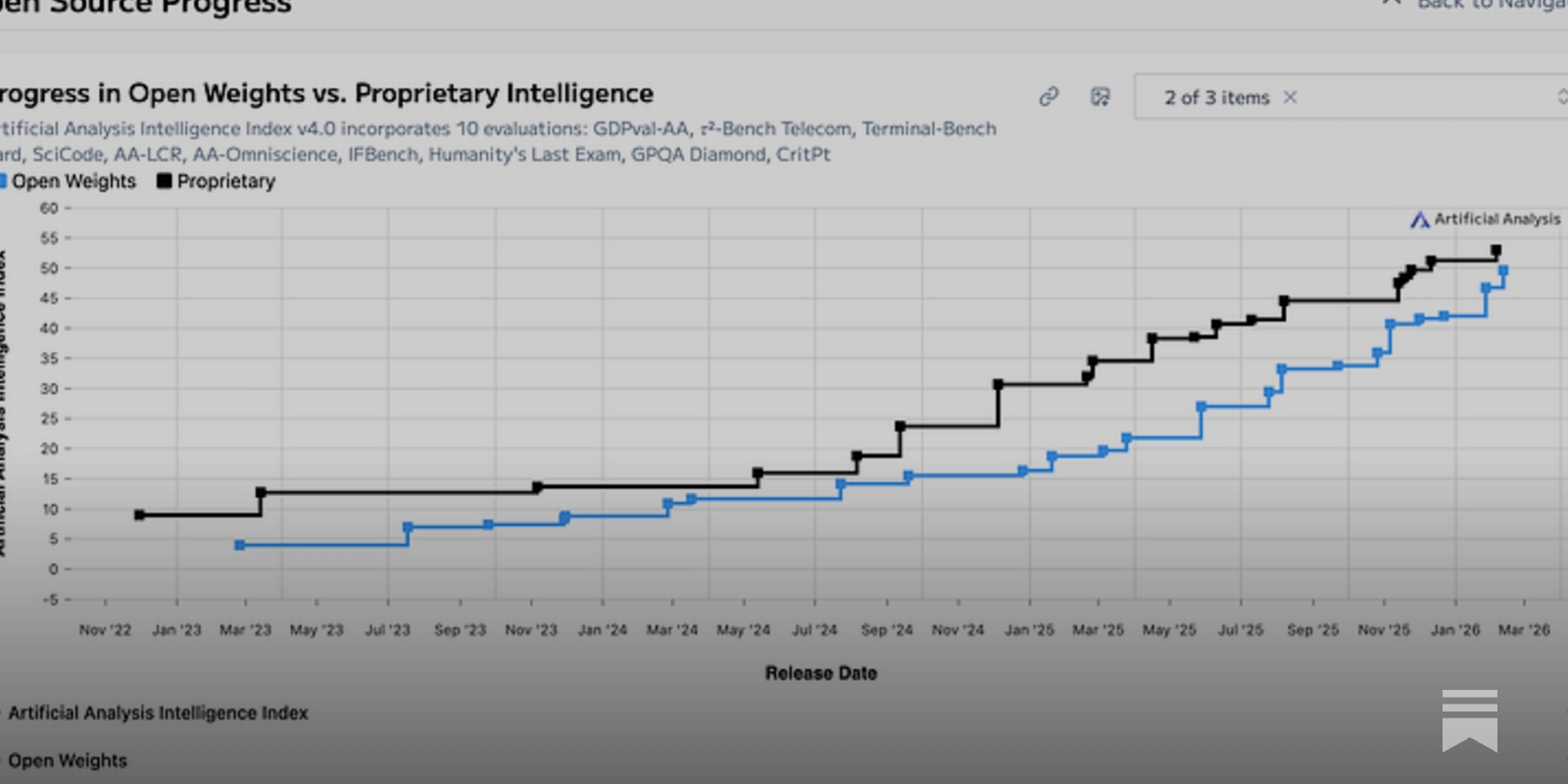
Open models in perpetual catch-up
The open-closed gap, distillation, innovation timescales, how open models win, specialized models, what’s missing, etc.
Models & Pricing | DeepSeek API Docs
The prices listed below are in units of per 1M tokens. A token, the smallest unit of text that the model recognizes, can be a word, a number, or even a punctuation mark. We will bill based on the total number of input and output tokens by the model.
Scaling Laws for Autoregressive Generative Modeling
We identify empirical scaling laws for the cross-entropy loss in four domains: generative image modeling, video modeling, multimodal image$\leftrightarrow$text models, and mathematical problem solving. In all cases autoregressive Transformers smoothly improve in performance as model size and compute budgets increase, following a power-law plus constant scaling law. The optimal model size also depends on the compute budget through a power-law, with exponents that are nearly universal across all data domains. The cross-entropy loss has an information theoretic interpretation as $S($True$) + D_{\mathrm{KL}}($True$||$Model$)$, and the empirical scaling laws suggest a prediction for both the true data distribution's entropy and the KL divergence between the true and model distributions. With this interpretation, billion-parameter Transformers are nearly perfect models of the YFCC100M image distribution downsampled to an $8\times 8$ resolution, and we can forecast the model size needed to achieve any given reducible loss (ie $D_{\mathrm{KL}}$) in nats/image for other resolutions. We find a number of additional scaling laws in specific domains: (a) we identify a scaling relation for the mutual information between captions and images in multimodal models, and show how to answer the question "Is a picture worth a thousand words?"; (b) in the case of mathematical problem solving, we identify scaling laws for model performance when extrapolating beyond the training distribution; (c) we finetune generative image models for ImageNet classification and find smooth scaling of the classification loss and error rate, even as the generative loss levels off. Taken together, these results strengthen the case that scaling laws have important implications for neural network performance, including on downstream tasks.

Elon Musk confirms xAI used OpenAI’s models to train Grok
He said it was “partly” true that the company had used model distillation to improve xAI’s models.

Neural scaling law
In machine learning, a neural scaling law is an empirical scaling law that describes how neural network performance changes as key factors are scaled up or down. These factors typically include the number of parameters, training dataset size, and training cost. Some models also exhibit performance gains by scaling inference through increased test-time compute (TTC), extending neural scaling laws beyond training to the deployment phase.

Scaling Laws for Neural Language Models
We study empirical scaling laws for language model performance on the cross-entropy loss. The loss scales as a power-law with model size, dataset size, and the amount of compute used for training, with some trends spanning more than seven orders of magnitude. Other architectural details such as network width or depth have minimal effects within a wide range. Simple equations govern the dependence of overfitting on model/dataset size and the dependence of training speed on model size. These relationships allow us to determine the optimal allocation of a fixed compute budget. Larger models are significantly more sample-efficient, such that optimally compute-efficient training involves training very large models on a relatively modest amount of data and stopping significantly before convergence.
Distilling Dataset into Neural Field
Utilizing a large-scale dataset is essential for training high-performance deep learning models, but it also comes with substantial computation and storage costs. To overcome these challenges, dataset distillation has emerged as a promising solution by compressing the large-scale dataset into a smaller synthetic dataset that retains the essential information needed for training. This paper proposes a novel parameterization framework for dataset distillation, coined Distilling Dataset into Neural Field (DDiF), which leverages the neural field to store the necessary information of the large-scale dataset. Due to the unique nature of the neural field, which takes coordinates as input and output quantity, DDiF effectively preserves the information and easily generates various shapes of data. We theoretically confirm that DDiF exhibits greater expressiveness than some previous literature when the utilized budget for a single synthetic instance is the same. Through extensive experiments, we demonstrate that DDiF achieves superior performance on several benchmark datasets, extending beyond the image domain to include video, audio, and 3D voxel. We release the code at \url{https://github.com/aailab-kaist/DDiF}.
Scaling Laws Across Model Architectures: A Comparative Analysis of...
The scaling of large language models (LLMs) is a critical research area for the efficiency and effectiveness of model training and deployment. Our work investigates the transferability and...
Deep Learning Scaling is Predictable, Empirically
Deep learning (DL) creates impactful advances following a virtuous recipe: model architecture search, creating large training data sets, and scaling computation. It is widely believed that growing training sets and models should improve accuracy and result in better products. As DL application domains grow, we would like a deeper understanding of the relationships between training set size, computational scale, and model accuracy improvements to advance the state-of-the-art. This paper presents a large scale empirical characterization of generalization error and model size growth as training sets grow. We introduce a methodology for this measurement and test four machine learning domains: machine translation, language modeling, image processing, and speech recognition. Our empirical results show power-law generalization error scaling across a breadth of factors, resulting in power-law exponents---the "steepness" of the learning curve---yet to be explained by theoretical work. Further, model improvements only shift the error but do not appear to affect the power-law exponent. We also show that model size scales sublinearly with data size. These scaling relationships have significant implications on deep learning research, practice, and systems. They can assist model debugging, setting accuracy targets, and decisions about data set growth. They can also guide computing system design and underscore the importance of continued computational scaling.
Sebastian Raschka, PhD (@rasbt)
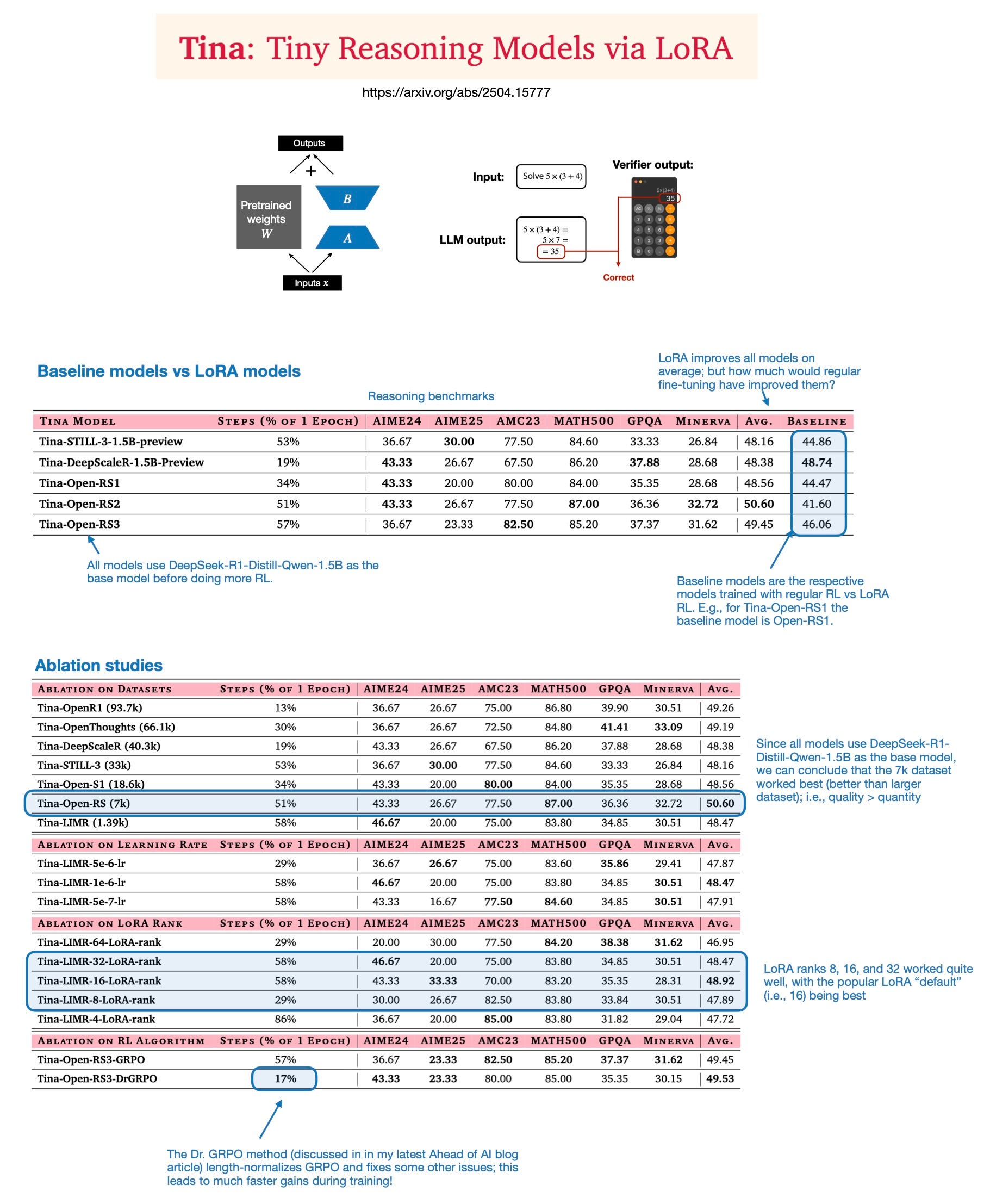
Is LoRA (Low Rank Adaptation) relevant in 2025 for reasoning models? I recently read "Tina: Tiny Reasoning Models via LoRA (https://arxiv.org/abs/2504.15777)", and it made me pause for a moment: when was the last time I heard someone excitedly talk/write about LoRA? LoRA was one of the most influential fine-tuning methods in the earlier LLM boom (as you may remember, I wrote about it a lot in recent years). The idea is simple but effective: avoid full model updates and instead inject a small number of trainable parameters for downstream tasks. This drastically reduces memory and compute costs. But in the age of ever-larger instruction-tuned models coupled with well-working distillation techniques (like popularized by DeepSeek-R1 etc), LoRA seemed to become more irrelevant recently. What about LoRA work for developing reasoning models? This paper tackles exactly that question. Instead of the usual supervised fine-tuning or instruction distillation pipeline, the authors use LoRA with reinforcement learning (RL) to improve reasoning capabilities. Specifically, they fine-tune a 1.5B base model using LoRA adapters while applying RL on reasoning benchmarks. Their baseline model is DeepSeek-R1-Distill-Qwen-1.5B, which is a model already fine-tuned for reasoning tasks. (I wish they started with the base Qwen-1.5B model; but this way, I guess they have more comparisons with other methods that further trained the DeepSeek-R1-Distill-Qwen-1.5B.) From there, the authors ran experiments across datasets, learning rates, LoRA ranks, and RL algorithms. Their best-performing model was trained on just 7k examples and cost just $9 to train. Even with hyperparameter sweeps and multiple ablations, the entire study cost just $526. So, how well does LoRA work? The top half of the results figure (highlighted in blue) compares models trained with LoRA-based RL versus standard RL (i.e., no LoRA). On every benchmark (AIME24, AIME25, AMC23, MATH500, GPAQ, Minerva), LoRA outperforms the regular RL baseline when applied to the same starting model. Insights from ablations 1) Surprisingly, the best-performing model came from the smallest dataset: just 7k examples from Open-RS. 2) The classic LoRA rank 16 emerged as the sweet spot, but ranks 8 and 32 also worked well. 3) It's nice that they included the recent Dr. GRPO (I recently discussed it in my latest Ahead of AI blog). It substantially reduces training time by length-normalizing rewards and addressing issues in GRPO Bottom line: Reasoning is certainly an interesting use case, and it's interesting (and a bit surprising) that LoRA does so well here. It might also be the first case where I've seen LoRA coupled with RL, which is another interesting aspect. LoRA certainly peaked in popularity 1-2 years ago, and more people now consider (more expensive) full-parameter updates (based on anecdotal perception); there's still a place for LoRA and LoRA-like methods. Let's not forget that one of the key advantages of LoRA is that it doesn't modify the underlying base model. This is key in applications where you either have lots of specialized use cases or lots of customers. For example, instead of storing 100 1B full-parameter tuned models, it would be much cheaper to store a 32B model with 100 sets of LoRA weights.
The distillation panic
‘Distillation attacks’ is a horrible term for what is happening right now.