

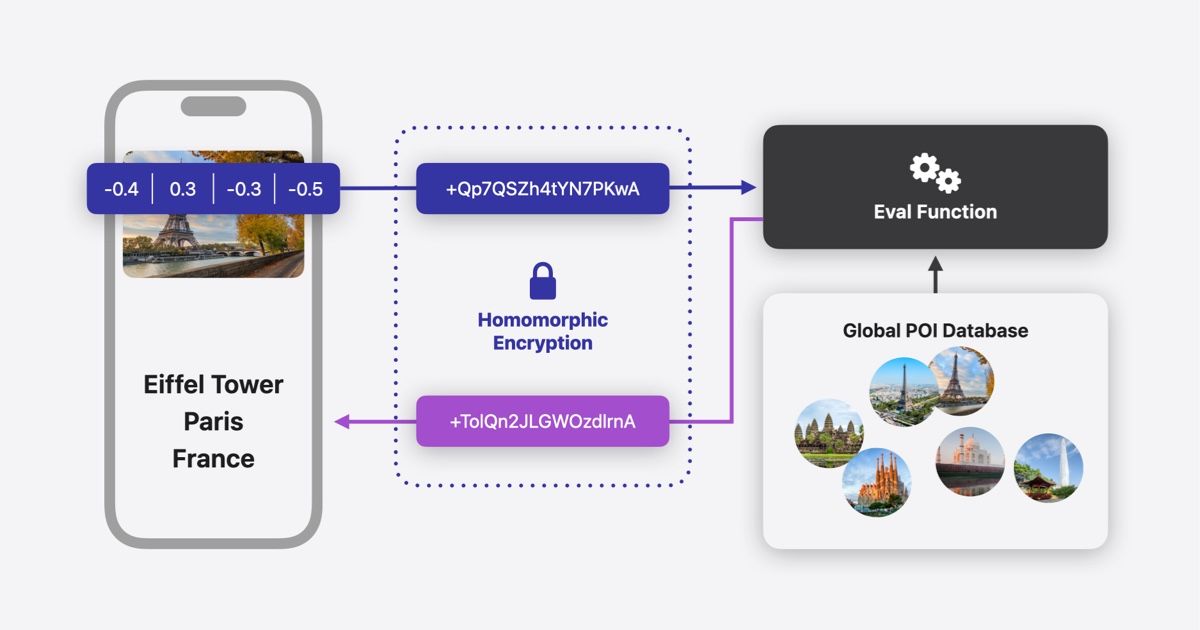
At Apple, we believe privacy is a fundamental human right. Our work to protect user privacy is informed by a set of privacy principles, and…
Private Cloud Compute: A new frontier for AI privacy in the cloud - Apple Security Research
Secure and private AI processing in the cloud poses a formidable new challenge. To support advanced features of Apple Intelligence with larger foundation models, we created Private Cloud Compute (PCC), a groundbreaking cloud intelligence system designed specifically for private AI processing. Built with custom Apple silicon and a hardened operating system, Private Cloud Compute extends the industry-leading security and privacy of Apple devices into the cloud, making sure that personal user data sent to PCC isn’t accessible to anyone other than the user — not even to Apple. We believe Private Cloud Compute is the most advanced security architecture ever deployed for cloud AI compute at scale.

Darkbloom — Cost-Efficient Private AI Inference on Verified Macs
Encrypted inference on hardware-verified Apple Silicon. Comparable model performance, operator-blind privacy, and about 50% lower cost.
Darkbloom — Cost-Efficient Private AI Inference on Verified Macs
Encrypted inference on hardware-verified Apple Silicon. Comparable model performance, operator-blind privacy, and about 50% lower cost.
Darkbloom — Cost-Efficient Private AI Inference on Verified Macs
Encrypted inference on hardware-verified Apple Silicon. Comparable model performance, operator-blind privacy, and about 50% lower cost.
Apple Intelligence Promises Better AI Privacy. Here’s How It Actually Works
Private Cloud Compute is an entirely new kind of infrastructure that, Apple’s Craig Federighi tells WIRED, allows your personal data to be “hermetically sealed inside of a privacy bubble.”

Security research on Private Cloud Compute - Apple Security Research
Private Cloud Compute (PCC) fulfills computationally intensive requests for Apple Intelligence while providing groundbreaking privacy and security protections — by bringing our industry-leading device security model into the cloud. To build public trust in our system, we’re making it possible for researchers to inspect and verify PCC’s security and privacy guarantees by releasing tools and resources including a comprehensive PCC Security Guide, the software binaries and source code of key PCC components, and — in a first for any Apple platform — a Virtual Research Environment, which allows anyone to install and test the PCC software on a Mac with Apple silicon.
zama-ai/concrete-ml
Concrete ML: Privacy Preserving ML framework using Fully Homomorphic Encryption (FHE), built on top of Concrete, with bindings to traditional ML frameworks.
Machine Learning
Learn how Ente uses on-device machine learning to power private, end-to-end encrypted features like face recognition and semantic search—without a cloud.

How Google is Making Private AI Practical with Homomorphic Encryption
Today we're excited to showcase HEIR, the latest powerful tool added to our Private Computing Toolkit. HEIR is an open source compiler that unlocks cryptographically-sec…

Introducing the Third Generation of Apple’s Foundation Models
Our next generation of Apple Intelligence is centered around our users, integrated deeply into our operating systems, and powered by a bold…
Apple Private Cloud Compute
Announced at [[Private Cloud Compute New Frontier]] blog post.[[Matthew Green]] initial reaction thread [[Matthew Green Apple PCC Thread]]

Thread by @matthew_d_green on Thread Reader App
@matthew_d_green: So Apple has introduced a new system called “Private Cloud Compute” that allows your phone to offload complex (typically AI) tasks to specialized secure devices in the cloud. I’m still trying to wo...…

Protected by its moat, Apple has time to get AI right
Best of all, the hardware it sells today will run whatever Apple comes up with.

Vertical Federated Learning: Concepts, Advances, and Challenges
Vertical Federated Learning (VFL) is a federated learning setting where multiple parties with different features about the same set of users jointly train machine learning models without exposing their raw data or model parameters. Motivated by the rapid growth in VFL research and real-world applications, we provide a comprehensive review of the concept and algorithms of VFL, as well as current advances and challenges in various aspects, including effectiveness, efficiency, and privacy. We provide an exhaustive categorization for VFL settings and privacy-preserving protocols and comprehensively analyze the privacy attacks and defense strategies for each protocol. In the end, we propose a unified framework, termed VFLow, which considers the VFL problem under communication, computation, privacy, as well as effectiveness and fairness constraints. Finally, we review the most recent advances in industrial applications, highlighting open challenges and future directions for VFL.
Why I hope Apple keeps investing in on-device AI
Edge intelligence is safer, more private, and less resource-intensive than cloud-based AI services.

Is Apple Security a MYTH?