

This paper was accepted at the Workshop on Large Language Model Memorization (L2M2) 2025. Large Language Models (LLMs) have quickly become…
On the Way to LLM Personalization: Learning to Remember User Conversations
Large Language Models (LLMs) have quickly become an invaluable assistant for a variety of tasks. However, their effectiveness is constrained by their ability to tailor responses to human preferences and behaviors via personalization. Prior work in LLM personalization has largely focused on style transfer or incorporating small factoids about the user, as knowledge injection remains an open challenge. In this paper, we explore injecting knowledge of prior conversations into LLMs to enable future work on less redundant, personalized conversations. We identify two real-world constraints: (1) conversations are sequential in time and must be treated as such during training, and (2) per-user personalization is only viable in parameter-efficient settings. To this aim, we propose PLUM, a pipeline performing data augmentation for up-sampling conversations as question-answer pairs, that are then used to finetune a low-rank adaptation adapter with a weighted cross entropy loss. Even in this first exploration of the problem, we perform competitively with baselines such as RAG, attaining an accuracy of 81.5% across 100 conversations.

Do language models accommodate their users? A study of linguistic convergence
While large language models (LLMs) are generally considered proficient in generating language, how similar their language usage is to that of humans remains understudied. In this paper, we test whether models exhibit linguistic convergence, a core pragmatic element of human language communication: do models adapt, or converge, to the linguistic patterns of their user? To answer this, we systematically compare model completions of existing dialogues to original human responses across sixteen language models, three dialogue corpora, and various stylometric features. We find that models strongly converge to the conversation's style, often significantly overfitting relative to the human baseline. While convergence patterns are often feature-specific, we observe consistent shifts in convergence across modeling settings, with instruction-tuned and larger models converging less than their pretrained and smaller counterparts. Given the differences in human and model convergence patterns, we hypothesize that the underlying mechanisms driving these behaviors are very different.
Do language models accommodate their users? A study of linguistic convergence
While large language models (LLMs) are generally considered proficient in generating language, how similar their language usage is to that of humans remains understudied. In this paper, we test whether models exhibit linguistic convergence, a core pragmatic element of human language communication: do models adapt, or converge, to the linguistic patterns of their user? To answer this, we systematically compare model completions of existing dialogues to original human responses across sixteen language models, three dialogue corpora, and various stylometric features. We find that models strongly converge to the conversation's style, often significantly overfitting relative to the human baseline. While convergence patterns are often feature-specific, we observe consistent shifts in convergence across modeling settings, with instruction-tuned and larger models converging less than their pretrained and smaller counterparts. Given the differences in human and model convergence patterns, we hypothesize that the underlying mechanisms driving these behaviors are very different.
LLM in a Flash: Efficient Large Language Model Inference with Limited Memory
Large language models (LLMs) are central to modern natural language processing, delivering exceptional performance in various tasks…
Large language model
A large language model (LLM) is a neural network trained on a vast amount of text for natural language processing tasks, especially language generation. LLMs can typically generate, summarize, translate, and analyze text in many contexts, and are a foundational technology behind modern chatbots.[1] Biased or inaccurate training data can make an LLM's output less reliable.[2]
Simulating Human Memory with Language Models
Language models are increasingly being deployed as user simulators, but their memory is far more reliable than that of real users. To measure this gap, we run a series of classic memory...
Improving Cross-Lingual Factual Recall via Consistency-Driven Reinforcement Learning
Large language models (LLMs) trained predominantly on English data encode substantial world knowledge, yet often fail to express it reliably in other languages, a phenomenon known as cross-lingual...
Mem0: Building Production-Ready AI Agents with Scalable Long-Term Memory
Large Language Models (LLMs) have demonstrated remarkable prowess in generating contextually coherent responses, yet their fixed context windows pose fundamental challenges for maintaining consistency over prolonged multi-session dialogues. We introduce Mem0, a scalable memory-centric architecture that addresses this issue by dynamically extracting, consolidating, and retrieving salient information from ongoing conversations. Building on this foundation, we further propose an enhanced variant that leverages graph-based memory representations to capture complex relational structures among conversational elements. Through comprehensive evaluations on LOCOMO benchmark, we systematically compare our approaches against six baseline categories: (i) established memory-augmented systems, (ii) retrieval-augmented generation (RAG) with varying chunk sizes and k-values, (iii) a full-context approach that processes the entire conversation history, (iv) an open-source memory solution, (v) a proprietary model system, and (vi) a dedicated memory management platform. Empirical results show that our methods consistently outperform all existing memory systems across four question categories: single-hop, temporal, multi-hop, and open-domain. Notably, Mem0 achieves 26% relative improvements in the LLM-as-a-Judge metric over OpenAI, while Mem0 with graph memory achieves around 2% higher overall score than the base configuration. Beyond accuracy gains, we also markedly reduce computational overhead compared to full-context method. In particular, Mem0 attains a 91% lower p95 latency and saves more than 90% token cost, offering a compelling balance between advanced reasoning capabilities and practical deployment constraints. Our findings highlight critical role of structured, persistent memory mechanisms for long-term conversational coherence, paving the way for more reliable and efficient LLM-driven AI agents.
OpenAI on Twitter / X
We’re starting to roll out a lightweight version of memory improvements to Free users. In addition to existing saved memories, ChatGPT now references your recent conversations to provide more personalized responses. https://t.co/RZFYUC9JAT https://t.co/O8lubCBNZO— OpenAI (@OpenAI) June 3, 2025
Build A Large Language Model (From Scratch), Published by Manning, ISBN 978-1633437166
Implement a ChatGPT-like LLM in PyTorch from scratch, step by step
Learning User Simulators with Turing Rewards
Learning to simulate human users in interactive settings could advance the training of agent assistants, evaluation of personalization systems, research in the social sciences, and more. Existing approaches generally do so by training a large language model (LLM) to match a single ground truth response, either by maximizing the log probability or by using a similarity reward. We instead propose Turing-RL: a Turing-Test-based reinforcement learning approach for training user simulator models. Turing-RL uses a discriminative Turing reward with an LLM judge to score how indistinguishable a generated response is from the real user's given the user's history, and the user simulator LLM learns to produce responses indistinguishable from what the user could have said with such rewards. Across two different domains--conversational chat and Reddit forum discussion--we find that Turing-RL consistently outperforms baseline methods on both LLM and human evaluation metrics. Our study suggests that optimizing for indistinguishability, rather than response matching, is effective for learning user simulators.
Beyond Model Collapse: Scaling Up with Synthesized Data Requires...
Large Language Models (LLM) are increasingly trained on data generated by other LLM, either because generated text and images become part of the pre-training corpus, or because synthetized data is...
Awni Hannun on Twitter / X
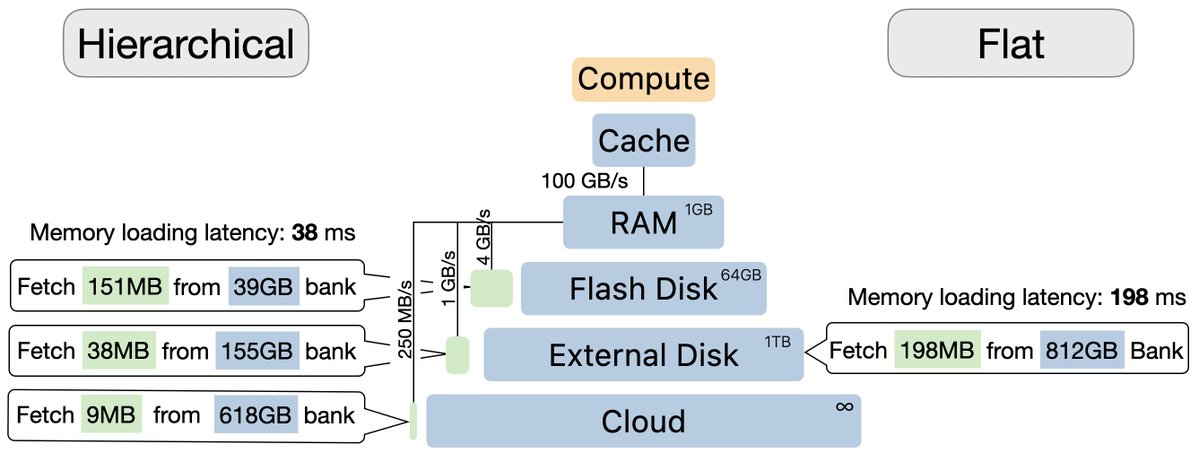
I love this line of research from my colleagues at Apple:Augmenting a language model with a hierarchical memory makes perfect sense for several reasons:- Intuitively the memory parameters should be accessed much less frequently than the weights responsible for reasoning. You… https://t.co/q7HQnYmdR4 pic.twitter.com/38b9q7YKCe— Awni Hannun (@awnihannun) October 6, 2025
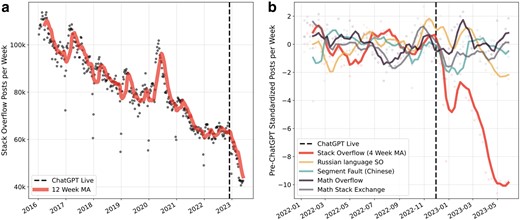
Large language models reduce public knowledge sharing on online Q&A platforms
Abstract. Large language models (LLMs) are a potential substitute for human-generated data and knowledge resources. This substitution, however, can present
MemOS: An Operating System for Memory-Augmented Generation (MAG) in Large Language Models
Large Language Models (LLMs) have emerged as foundational infrastructure in the pursuit of Artificial General Intelligence (AGI). Despite their remarkable capabilities in language perception and generation, current LLMs fundamentally lack a unified and structured architecture for handling memory. They primarily rely on parametric memory (knowledge encoded in model weights) and ephemeral activation memory (context-limited runtime states). While emerging methods like Retrieval-Augmented Generation (RAG) incorporate plaintext memory, they lack lifecycle management and multi-modal integration, limiting their capacity for long-term knowledge evolution. To address this, we introduce MemOS, a memory operating system designed for LLMs that, for the first time, elevates memory to a first-class operational resource. It builds unified mechanisms for representation, organization, and governance across three core memory types: parametric, activation, and plaintext. At its core is the MemCube, a standardized memory abstraction that enables tracking, fusion, and migration of heterogeneous memory, while offering structured, traceable access across tasks and contexts. MemOS establishes a memory-centric execution framework with strong controllability, adaptability, and evolvability. It fills a critical gap in current LLM infrastructure and lays the groundwork for continual adaptation, personalized intelligence, and cross-platform coordination in next-generation intelligent systems.
Intent Mismatch Causes LLMs to Get Lost in Multi-Turn Conversation
Multi-turn conversation has emerged as a predominant interaction paradigm for Large Language Models (LLMs). Users often employ follow-up questions to refine their intent, expecting LLMs to adapt dynamically. However, recent research reveals that LLMs suffer a substantial performance drop in multi-turn settings compared to single-turn interactions with fully specified instructions, a phenomenon termed ``Lost in Conversation'' (LiC). While this prior work attributes LiC to model unreliability, we argue that the root cause lies in an intent alignment gap rather than intrinsic capability deficits. In this paper, we first demonstrate that LiC is not a failure of model capability but rather a breakdown in interaction between users and LLMs. We theoretically show that scaling model size or improving training alone cannot resolve this gap, as it arises from structural ambiguity in conversational context rather than representational limitations. To address this, we propose to decouple intent understanding from task execution through a Mediator-Assistant architecture. By utilizing an experience-driven Mediator to explicate user inputs into explicit, well-structured instructions based on historical interaction patterns, our approach effectively bridges the gap between vague user intent and model interpretation. Experimental results demonstrate that this method significantly mitigates performance degradation in multi-turn conversations across diverse LLMs.