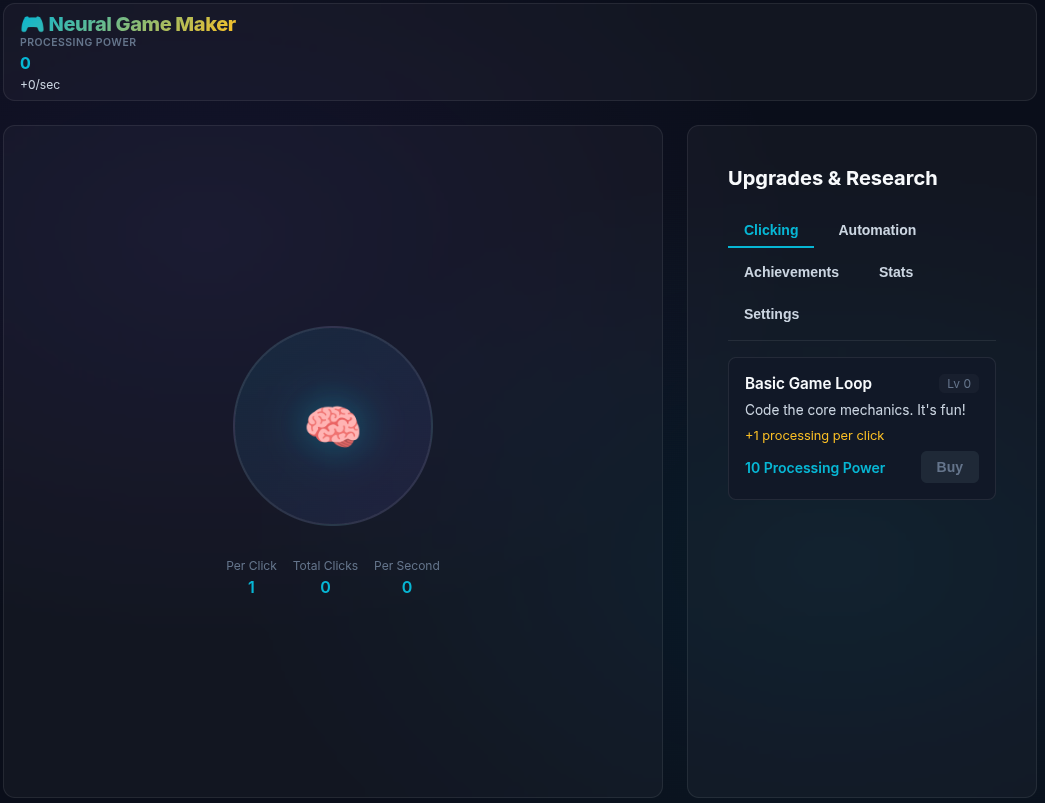
I turned a forest trail near my apartment into a playable neural world. You can explore that world in your web browser by clicking right here:

How AIs See Our World
AIs are increasingly perceiving our world, but in order to comprehend it, our user interfaces must operate in reverse.

WorldClaw: Agentic 3D Open-World Generation at Scale
From one open-ended prompt to an explicit, explorable, and editable 3D world.

freestylefly/wesight
Open-source desktop AI agent workspace with one-click Claude Code, Codex, OpenClaw, Hermes Agent setup and custom LLM model routing.
The Welch Labs Illustrated Guide to AI [Digital Download] — Welch Labs
The Welch Labs Illustrated Guide to AI offers unique perspectives on artificial intelligence through hands-on exploration and richly detailed graphics that give readers a visceral understanding of how AI actually works. From the fundamental perceptron to cutting-edge AI video generation, each chapte

The Dark Forest and Generative AI
Proving you're a human on a web flooded with generative AI content
Environments Hub: A Community Hub To Scale RL To Open AGI
RL environments are the playgrounds where agents learn. Until now, they’ve been fragmented, closed, and hard to share. We are launching the Environments Hub to change that: an open, community-powered platform that gives environments a true home.Environments define the world, rules and feedback loop of state, action and reward. From games to coding tasks to dialogue, they’re the contexts where AI learns, without them, RL is just an algorithm with nothing to act on.

Unsloth AI on Twitter / X
Introducing Unsloth Desktop 🦥The first desktop app to run and train models locally.• Open-source. Runs on Mac, Windows and Linux• Supports MLX, diffusion image/video, audio, GGUF• Connect Claude Code and Codex to local LLMs• 50% more accurate, self-healing tool calls +… pic.twitter.com/vjTFB1e5IQ— Unsloth AI (@UnslothAI) August 11, 2026
ml5 - A friendly machine learning library for the web.
ml5.js aims to make machine learning approachable for a broad audience of artists, creative coders, and students. The library provides access to machine learning algorithms and models in the browser, building on top of TensorFlow.js with no other external dependencies.
Grounded world models in biological organisms and future embodied AI
Recent advances in generative and embodied AI have been driven by large-scale predictive learning over multimodal data. However, the resulting systems remain largely based on passive training regimes where linguistic regularities create the scaffold onto which information from other modalities is attached. Conversely, neuroscience and cognitive science suggest that biological intelligence is organized in the opposite way, where grounded world models acquired through interaction with the environment provide the semantic scaffold to which language is attached. Here, we illustrate five examples of neural circuits supporting grounded world modelling, which underlie navigation in physical and conceptual spaces, affordance-based perception and interaction with objects, active perception and exploratory learning, allostatic control and emotion, and the distinction between self- and world-generated outcomes. These examples highlight several features largely missing from current embodied AI, including the role of intrinsic dynamics as a foundation for learning, the centrality of action in aligning these dynamics with the external world, the prominence of autonomous experience and open-ended learning over passive assimilation of externally provided data, and the fact that early predictive and control mechanisms scaffold higher cognitive abilities such as reasoning, conceptual navigation, planning, imagination, understanding others' minds, and communication. Finally, we discuss whether and how principles derived from biological systems may inform future embodied AI, including training regimes based on social interaction to construct world models that are not only grounded but also socially shared and aligned with human norms and values.

François Chollet on Twitter / X
Eventually, much of AI will converge towards intuition-guided symbolic world modeling, i.e. deep learning-guided program synthesis. It is inevitable. Symbolic modeling lets a system construct a compact, reusable, highly generalizable mental model of a problem space using minimal…— François Chollet (@fchollet) July 2, 2026
Letta
Making machines that learn. Create stateful agents that remember everything, learn continuously, and improve themselves over time.

Locally AI - Run AI models locally on your iPhone, iPad, and Mac.
Run Llama, Gemma, Qwen, DeepSeek, and more on your iPhone, iPad, and Mac. Optimized for Apple Silicon. Offline. Private.