Over 11 hours of coding videos on evaluation, inference-time scaling, reinforcement learning, and distillation, with Python and PyTorch.
Crafting a good (reasoning) model
A recent talk I gave on model training, reasoning, and the next frontier.

Build a Reasoning Model (From Scratch)
"An exceptional deep dive into the next frontier of AI.” —Aman Chadha, Google Build a Reasoning Model (From Scratch) is a practical guide to understanding how modern reasoning-oriented LLMs work by building their core methods step by step. The book tells a clear engineering story: start with a conventional pre-trained LLM, learn how text generation works, build reliable evaluation tools, improve reasoning through inference-time methods, then move into training-based approaches such as reinforcement learning and distillation. The progression is deliberate. Early chapters establish the baseline model and explain text generation, KV caching, and evaluation with math verifiers. The middle chapters show how reasoning can be improved without changing model weights, using chain-of-thought prompting, sampling, self-consistency, response scoring, and self-refinement. Later chapters move to changing the model itself through reinforcement learning with verifiable rewards, GRPO improvements, format rewards, and finally distillation from stronger reasoning models into smaller ones. The book is especially useful because it implements the core methods from scratch rather than treating them as black-box library calls. Readers see how self-consistency, self-refinement, Best-of-N, and training-based methods actually work, including their cost and latency trade-offs. It also discusses common failure modes, including cases where refinement can make answers worse. Difficult concepts such as softmax, temperature, and top-p sampling are clarified with code-linked explanations and diagrams, and visual workflows make pipelines and scoring methods easier to follow. Reading the book feels like following a guided technical build rather than a loose survey of AI topics. Each concept is introduced because the project now needs it. Diagrams, roadmaps, code listings, exercises, and repeated workflow summaries help readers stay oriented through advanced material. This structure reflects Sebastian Raschka’s professional strength: explaining complex machine learning topics by making every detail concrete and showing exactly where each section fits in the larger story. He does not treat mechanisms like evaluation, log-probabilities, KL regularization, or distillation as isolated abstractions; he connects them to the goal of making reasoning models understandable and implementable. Physically and organizationally, the book has eight chapters and seven substantial appendixes. That design keeps the main narrative focused while moving supporting material like references, exercise solutions, model source code, larger models, batching, evaluation alternatives, and chat interfaces into ordered appendixes. The result is a logically flowing book that remains hands-on, navigable, and technically deep without constantly interrupting the central build.
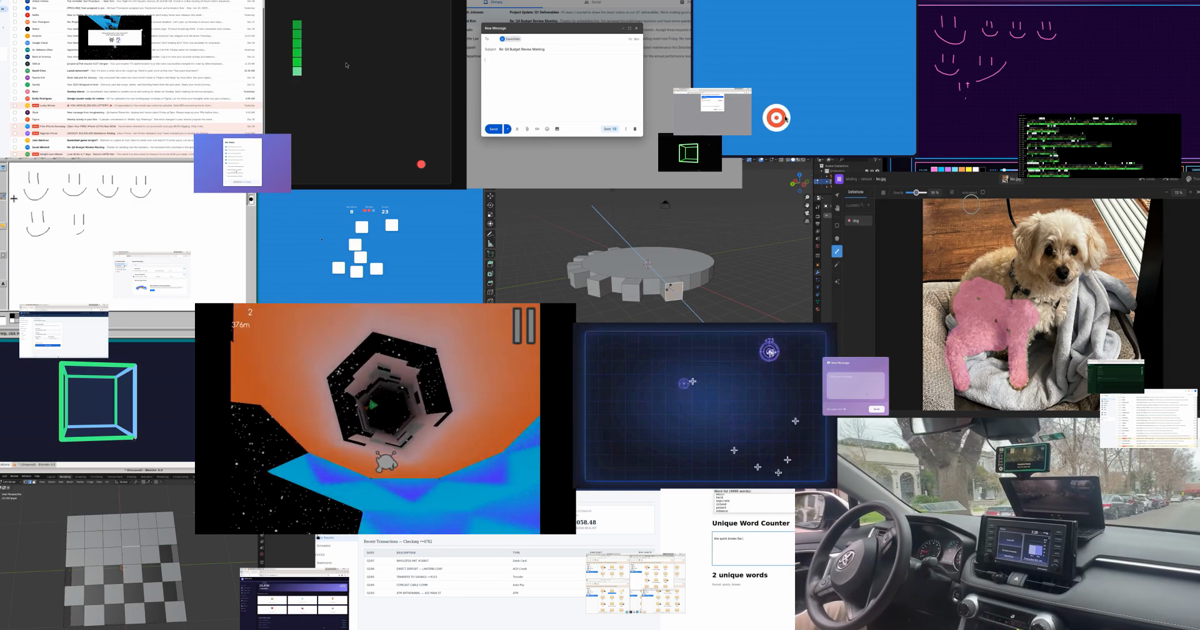
The First Fully General Computer Action Model
We trained a model on our 11-million-hour video dataset. Our model can explore complex websites, complete multi-action CAD modeling sequences, and drive a car in the real world, all at 30 FPS.
Brilliant | Your Personal Tutor for Math and Coding
Visual, interactive tutoring in math and coding, from 5th grade through college. Master concepts in algebra, calculus, Python, computer science, and more.
Towards Principled Representation Learning from Videos for Reinforcement Learning
We study pre-training representations for decision-making using video data, which is abundantly available for tasks such as game agents and software testing. Even though significant empirical advances have been made on this problem, a theoretical understanding remains absent. We initiate the theoretical investigation into principled approaches for representation learning and focus on learning the latent state representations of the underlying MDP using video data. We study two types of settings: one where there is iid noise in the observation, and a more challenging setting where there is also the presence of exogenous noise, which is non-iid noise that is temporally correlated, such as the motion of people or cars in the background. We study three commonly used approaches: autoencoding, temporal contrastive learning, and forward modeling. We prove upper bounds for temporal contrastive learning and forward modeling in the presence of only iid noise. We show that these approaches can learn the latent state and use it to do efficient downstream RL with polynomial sample complexity. When exogenous noise is also present, we establish a lower bound result showing that the sample complexity of learning from video data can be exponentially worse than learning from action-labeled trajectory data. This partially explains why reinforcement learning with video pre-training is hard. We evaluate these representational learning methods in two visual domains, yielding results that are consistent with our theoretical findings.

Mindful Design
A high quality, expansive video course that will elevate your design skills to a level you never thought was achievable.

Training Agentic Reasoners — Will Brown, Prime Intellect
AI is Proving Things No One Understands*
The spelled-out intro to neural networks and backpropagation: building micrograd
A taxonomy for next-generation reasoning models
Where we've been and where we're going with RLVR.

The Welch Labs Illustrated Guide to AI [Digital Download] — Welch Labs
The Welch Labs Illustrated Guide to AI offers unique perspectives on artificial intelligence through hands-on exploration and richly detailed graphics that give readers a visceral understanding of how AI actually works. From the fundamental perceptron to cutting-edge AI video generation, each chapte

Look-ahead Reasoning with a Learned Model in Imperfect Information Games
Test-time reasoning significantly enhances pre-trained AI agents' performance. However, it requires an explicit environment model, often unavailable or overly complex in real-world scenarios....
OpenThoughts: Data Recipes for Reasoning Models — Ryan Marten, Bespoke Labs
How I Built a SECOND Brain 🧠 in Obsidian MD (Tiago Forte BASB / PARA Method)
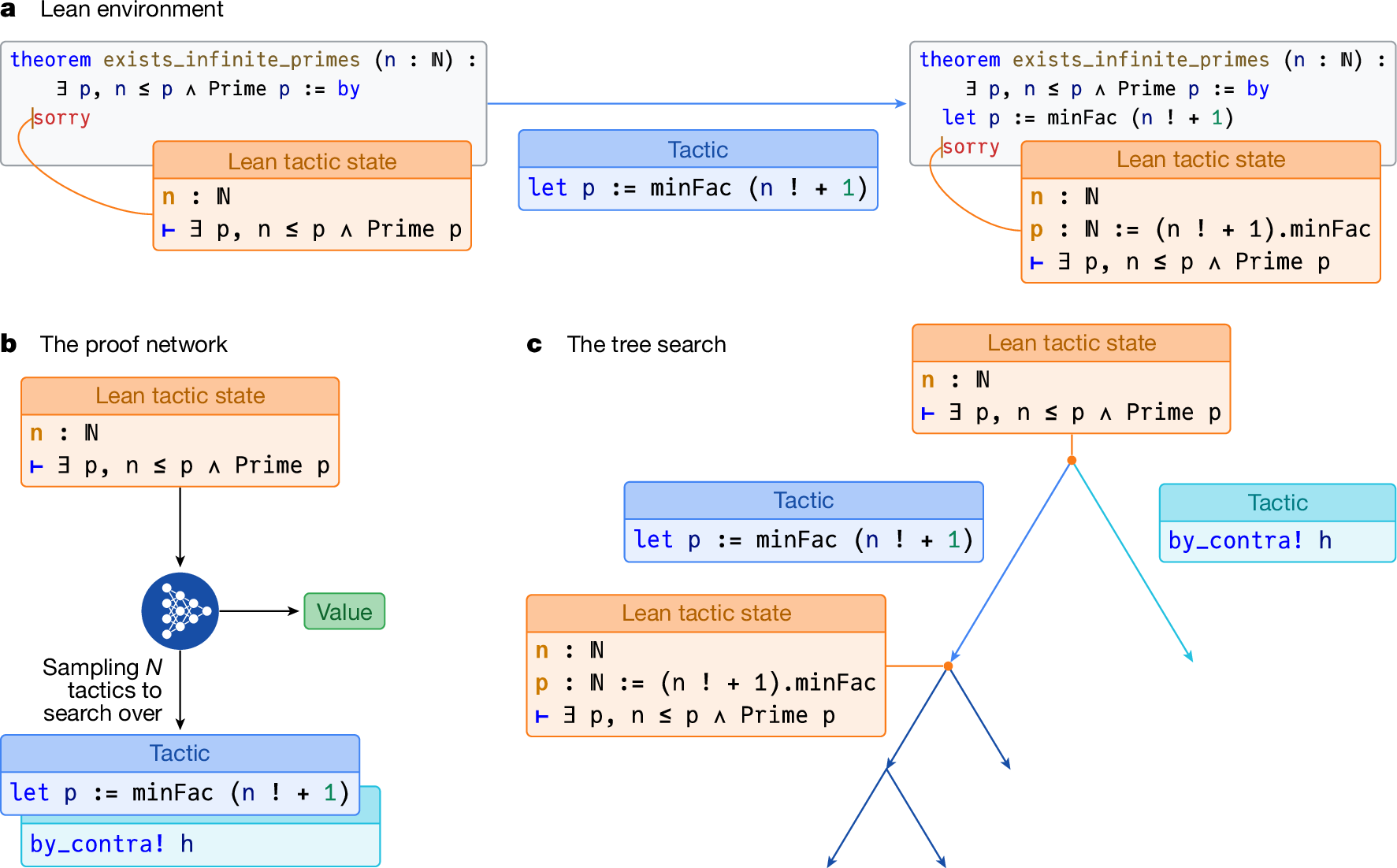
Olympiad-level formal mathematical reasoning with reinforcement learning
A long-standing goal of artificial intelligence (AI) is to build systems capable of complex reasoning in vast domains, a task epitomized by mathematics with its boundless concepts and demand for rigorous proof. Recent AI systems, often reliant on human data, typically lack the formal verification necessary to guarantee correctness. By contrast, formal languages such as Lean1 offer an interactive environment that grounds reasoning, and reinforcement learning (RL) provides a mechanism for learning in such environments. Here we present AlphaProof, an AlphaZero-inspired2 agent that learns to find formal proofs through RL by training on millions of auto-formalized problems. For the most difficult problems, it uses test-time RL, a method of generating and learning from millions of related problem variants at inference time to enable deep, problem-specific adaptation. AlphaProof substantially improves state-of-the-art results on historical mathematics competition problems. At the 2024 International Mathematical Olympiad competition, our AI system, with AlphaProof as its core reasoning engine, solved three out of the five non-geometry problems, including the competition’s most difficult problem. Combined with AlphaGeometry 23, this performance, achieved with multi-day computation, resulted in reaching a score equivalent to that of a silver medallist, marking the first time an AI system achieved any medal-level performance, to our knowledge. Our work demonstrates that learning at scale from grounded experience produces agents with complex mathematical reasoning strategies, paving the way for a reliable AI tool in complex mathematical problem solving.