

Creating a subtle, peripheral, and synchronous sense of shared space and context on the web
Ambient Co-presence
Creating a subtle, peripheral, and synchronous sense of shared space and context on the web
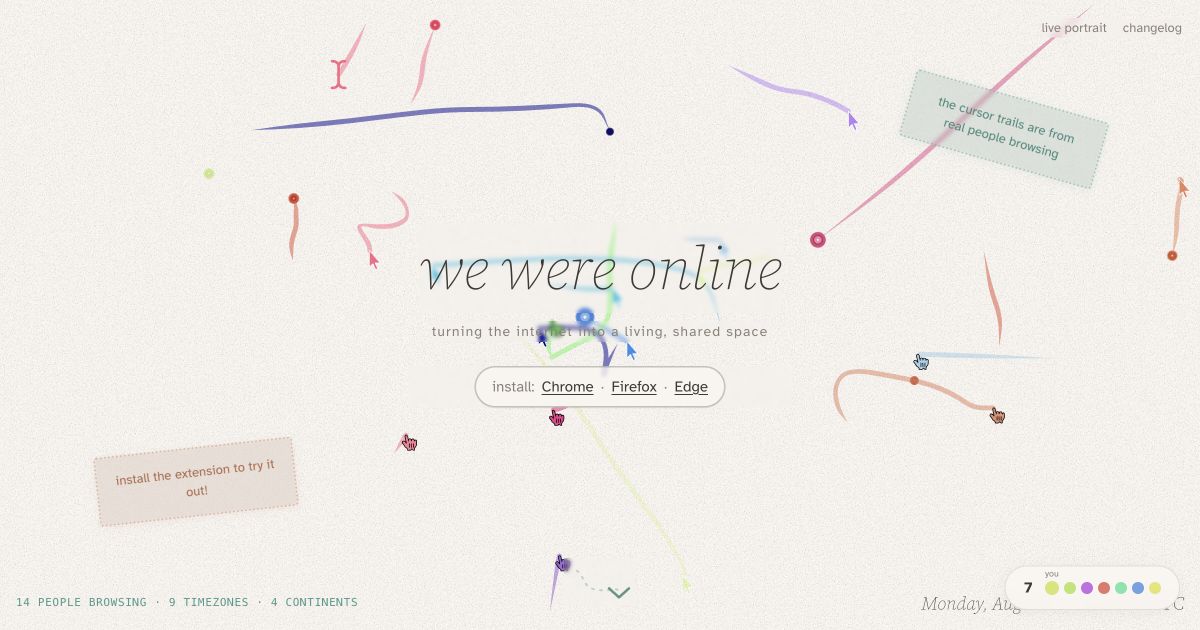
we were online
Turn the internet into a living, shared space with real-time traces of people browsing.
The Atmosphere . Building the open social web

Federating friendly spaces - Roomy
hearkening back to the cozy vibes of old-web neighborhoods
The Web Needs a Context Layer Built on a Shared Protocol
Making context a shared protocol, rather than a platform feature, would let readers see competing perspectives anywhere on the web, argue Mallory Knodel, Evan Friedman, and Brad Friedman.

ambientROOM
Introducing Ringspace: A Proposal for the Human Web
For months, I've been working on a project to demonstrate how we can preserve humanity on the web. It's finally ready for testing.

Home is where the bits flow
We aren’t purely physical beings. Most of our day exists outside our body. Our minds slip out through our eyes, out into our screens. We become a different kind of organism, living in a weird symbiosis with reddit and whatsapp and gmail. When was the last time you noticed
No Sense of Place: The Impact of Electronic Media on Social Behavior
Electronic media present us with a collage of experiences from everyplace. We eat dinner at home while watching starving children thousands of miles away reach out to us for food. From our easy chairs, we stare at blindfolded hostages, and coolly

Spatial Web Browsing
Adding spatial affordances to the experience of browsing the web
A space to converse and connect.
An X/Twitter Spaces alternative for Bluesky and the open web. Creating good vibes in the friendly skies.

Rethink: Web - Open Space
When we struggle to explain the inherent qualities of a medium, we tend to defer to analogies and metaphors. This is especially true of the internet. Clouds, highways, streams, and real estate are just a few examples of the concepts employed to represent this intangible invention. Staring into a screen, it’s easy to imagine an […]

FWIW the most cohesive big picture atmosphere experience I've gotten so far is getting a push notification from stream.place, logging in to the stream, and chatting with oomfs. it's perfect
Guys... GUYS, listen. I am begging you all to think bigger! The Atmosphere may be a fun space to explore how familiar services and apps interact—but it's still just social media. The protocol enables us to change behaviors and solve *systemic* problems It's the thing that gets us TO the thing.

zeu
this is why i love ya'll
The Atmosphere is a rethinking of the Internet, with social connections that you control, built in. It allows you to do more with others, while maintaining more control over your own data and experiences.

daniel holmgren 🫠
& you lose if you say the word "protocol", "decentralized", "repo", or "pds" to illustrate: the cloud is "the thing where i keep my photos when i drop my phone in a lake". if you even mention a "server" while explaining the cloud then you lost the thread


