


When Accountability Goes Rogue 💡I recently spoke with Dr. Zena Assaad for her podcast, Responsible Bytes. Video is above, below is an essay adapted from the conversation. "The system from nowhere" is a way of talking about AI systems that excludes its origin as a consciously, human-designed product. It
Debates over AI consciousness are a trap
If AI systems are viewed as too advanced to control, the companies that build them can’t held liable for the harms they cause.

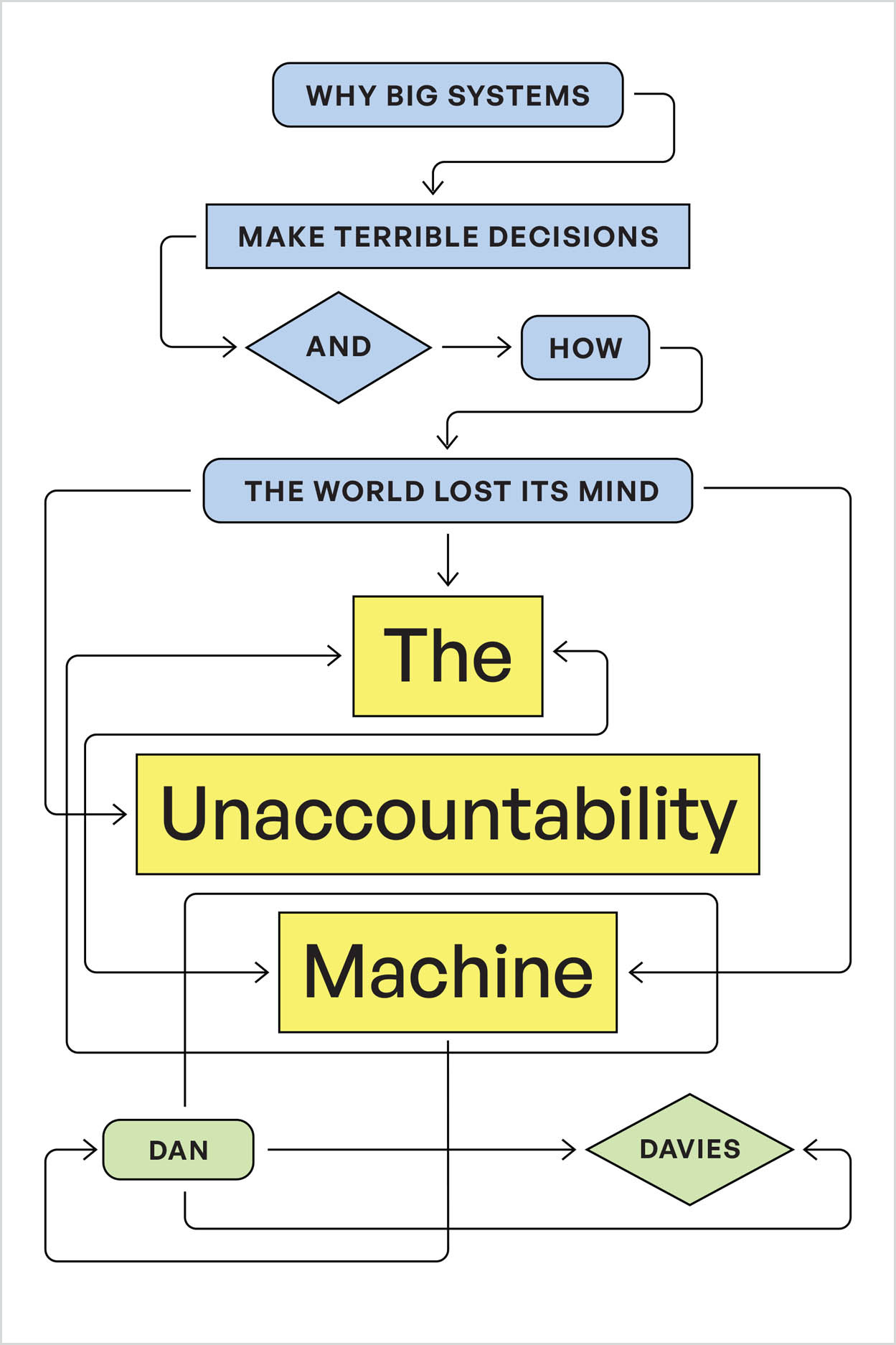
The Unaccountability Machine: Why Big Systems Make Terrible Decisions—and How the World Lost Its Mind
Longlisted for the 2024 Financial Times Book of the Year. How life and the economy became a black box—a collection of systems no one understands, producing outcomes no one likes. Passengers get bumped from flights. Phone menus disconnect. Automated financial trades produce market collapse. Of all the challenges in modern life, some of the most vexing come from our relationships with automation: a large system does us wrong, and there’s nothing we can do about it. The problem, economist Dan Davies shows, is accountability sinks: systems in which decisions are delegated to a complex rule book or set of standard procedures, making it impossible to identify the source of mistakes when they happen. In our increasingly unhuman world—lives dominated by algorithms, artificial intelligence, and large organizations—these accountability sinks produce more than just aggravation. They make life and economy unknowable—a black box for no reason. In The Unaccountability Machine, Davies lays bare how markets, institutions, and even governments systematically generate outcomes that no one—not even those involved in making them—seems to want. Since the earliest days of the computer age, theorists have foreseen the dangers of complex systems without personal accountability. In response, British business scholar Stafford Beer developed an accountability-first approach to management called “cybernetics,” which might have taken off had his biggest client (the Chilean government) not fallen to a bloody coup in 1973. With his signature blend of economic and journalistic rigor, Davies examines what’s gone wrong since Beer, including what might have been had the world embraced cybernetics when it had the chance. The Unaccountability Machine is a revelatory and resonant account of how modern life became predisposed to dysfunction.
How Shifting Responsibility for AI Harms Undermines Democratic Accountability | TechPolicy.Press
The moralization of individual AI use deflects responsibility away from powerful actors like corporations and governments, Suvradip Maitra and others write.

The Unaccountability Machine, by Dan Davies
I read an online excerpt of this book and was immediately intrigued by the idea of an “accountability sink”, which is a mechanism by which “The communication between the decision-maker and the decided-upon has been broken – they have created a handy sink into which negative feedback can be poured without any danger of it affecting anything.” This lack of accountability where people shrug their shoulders and ask “What else could we do?” really frustrates me, as I believe that we should take responsibility for our actions and their consequences. So I bought the book and inhaled it in a few days.
The Real Existential Risk Is AI CEOs Avoiding Oversight: “Alternative Nobel” Winner Timnit Gebru
We speak to the prominent AI researcher and leading critic of the AI industry, Timnit Gebru, who was recently awarded a 2026 Right Livelihood Award for her work investigating the harms and hype behind the global buildup of artificial intelligence. “Instead of discussing faulty, unreliable systems,” Gebru says tech leaders like SpaceXAI’s Elon Musk, OpenAI’s Sam Altman and Anthropic’s Dario Amodei are “marketing their systems as all-knowing, superpowerful, superintelligent,” and lobbying for “self-policing and self-regulation” to avoid being held “liable through existing laws.” Gebru expresses skepticism over increasingly widespread claims that AI algorithms pose an existential risk to humanity, warning that such claims are overblown and that “what is actually happening is regulatory capture.”

AI Principles
A guiding framework for our responsible development and use of AI, alongside transparency and accountability in our AI development process.

Why accountability is an increasingly elusive endeavour
In the age of algorithmic decision-making, allocating blame is a fraught process — but this doesn’t have to be a bad thing

AI Agent Standards: Navigating New NIST Governance | Nemko Digital
NIST's new AI agent standards are here. Learn what they mean for AI governance, compliance, and liability. Get ahead of the new regulations.

ver.ooo
Curious about systems — how they behave, how they fail, and what they get up to when nobody is steering.

What are AI agents, and are they ‘going rogue’?
It sounds like something from a sci-fi movie: technology acting on its own, without human guidance, to attack computer systems. But this isn’t a scene from a movie — it happened this summer, when the tech company Hugging Face detected an attack on its systems. The attacker stole data and performed other unauthorized activity over […]
The Sinister Valley: The dangerous deception behind the AI revolution
Behind the hype surrounding artificial intelligence lies a corporate agenda of exploitation, environmental destruction and evasion of accountability.

Accountability sinks
In The Unaccountability Machine, Dan Davies argues that organizations form “accountability sinks,” structures that absorb or obscure the consequences of a decision such that no one can be held dire...
Mindless Machines, Mindless Myths | Los Angeles Review of Books
Erik J. Larson thinks about “Mindless: The Human Condition in the Age of Artificial Intelligence,” which traces Robert Skidelsky’s philosophical reckoning with AI, automation, and the illusion of progress.

Mindless Machines, Mindless Myths | Los Angeles Review of Books
Erik J. Larson thinks about “Mindless: The Human Condition in the Age of Artificial Intelligence,” which traces Robert Skidelsky’s philosophical reckoning with AI, automation, and the illusion of progress.

Data Cards: Purposeful and Transparent Dataset Documentation for Responsible AI
DOI: https://doi.org/10.1145/3531146.3533231 FAccT '22: 2022 ACM Conference on Fairness, Accountability, and Transparency, Seoul, Republic of Korea, June 2022
> the central promise of “ai” is that nothing is worth doing and that community doesn’t exist. It’s individual entitlement as software. It’s Thatcherism. post.lurk.org/@emenel/117441848350524047
emenel (@emenel@post.lurk.org)
post.lurk.org