Create interactive, explorable decks that truly deliver



Designing Imaginative Environments by Nathan Fowkes
Join industry veteran Nathan Fowkes on a deep dive into the hows and whys of designing environments for entertainment. From creating mood with color and light, to exploring different biomes and weather, to crafting architecture and props, he will teach you how to design amazing environments that make your work stand out from the crowd.
Weaving Narratives into Procedural Worlds
Examining the value, characteristics, and methods of integrating static narratives into otherwise procedurally generated environments.
Generative Agents: Interactive Simulacra of Human Behavior
Believable proxies of human behavior can empower interactive applications ranging from immersive environments to rehearsal spaces for interpersonal communication to prototyping tools. In this paper, we introduce generative agents--computational software agents that simulate believable human behavior. Generative agents wake up, cook breakfast, and head to work; artists paint, while authors write; they form opinions, notice each other, and initiate conversations; they remember and reflect on days past as they plan the next day. To enable generative agents, we describe an architecture that extends a large language model to store a complete record of the agent's experiences using natural language, synthesize those memories over time into higher-level reflections, and retrieve them dynamically to plan behavior. We instantiate generative agents to populate an interactive sandbox environment inspired by The Sims, where end users can interact with a small town of twenty five agents using natural language. In an evaluation, these generative agents produce believable individual and emergent social behaviors: for example, starting with only a single user-specified notion that one agent wants to throw a Valentine's Day party, the agents autonomously spread invitations to the party over the next two days, make new acquaintances, ask each other out on dates to the party, and coordinate to show up for the party together at the right time. We demonstrate through ablation that the components of our agent architecture--observation, planning, and reflection--each contribute critically to the believability of agent behavior. By fusing large language models with computational, interactive agents, this work introduces architectural and interaction patterns for enabling believable simulations of human behavior.

mdx-deck: slide decks powered by markdown and react
Why it's awesome, what it is, how it works, and how to use mdx-deck.
Minimum Viable Demos
An evening showcase of ambitious projects exploring technology, art, and science.
Generative UI: A rich, custom, visual interactive user experience for any prompt
Yaniv Leviathan, Google Fellow, Dani Valevski, Senior Staff Software Engineer, Vishnu Natchu, Principal Engineer, and Yossi Matias, Vice President & Head of Google Research

Grant Barbee — Portfolio
Conquer the Citadel was created as the final project for my VR course. The game is a VR roguelike deckbuilder that takes inspiration from games like Slay the Spire and Gloomhaven. Going into it, my teammate and I knew the scope was ambitious, but we managed to implement almost all of the systems we designed for the game. Altogether we managed to implement combat, status effects, a procedural dungeon map, adding cards to your deck, treasures that grant useful passives, multiple-choice events, shops, and two different characters with their own card pools. One interesting design choice we made was to make the cards and enemy AI highly data-driven. This way, we could add new cards and enemies using existing actions without writing any new code.
Practical Examples and Analysis of TTRPG Layouts (Or, Steal From These Games) - Part 1
Once you have read this blog post you will be able to make your tabletop roleplaying game look very good, either: Without having any illustr...

contextual animation stuff in Sleight of Hand – joe wintergreen internet zone
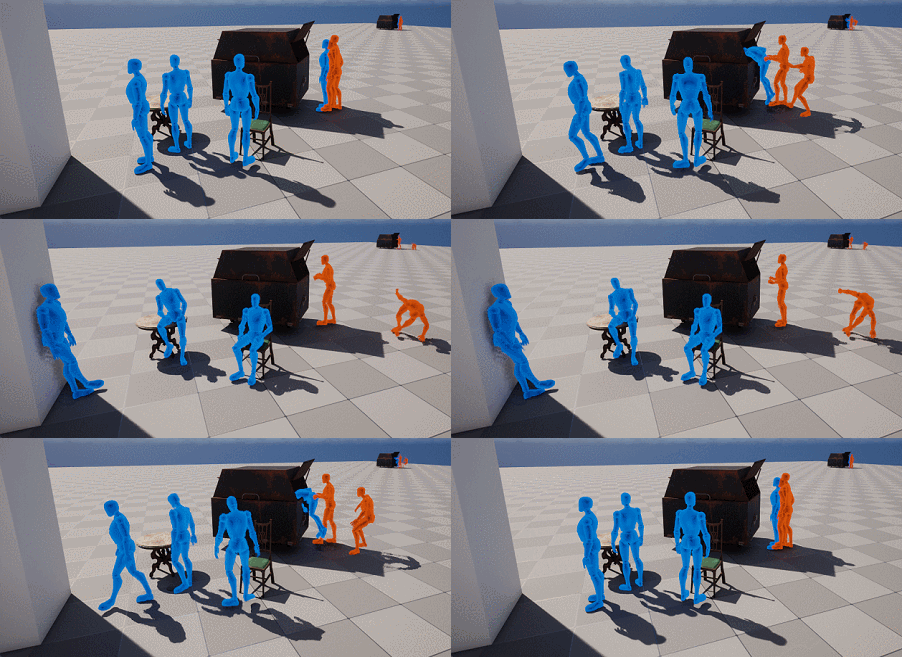
I’ve been working for the last week or two on a system to streamline contextual or scripted animation stuff in Sleight of Hand, a stealth game with a lot of systemic interaction aspirations. I built an interest source system a while back for coordinated investigations and dynamic behaviours, and while some of those interactions have been doing cool stuff on the animation side (a guy might rip open a wardrobe you’re hiding in, for example), it has tended to involve a lot of more-or-less-boilerplate Blueprint every time; it’s not been as easy as it should be to drop in what Half-Life called a “scripted sequence”. This fortnight’s work has improved this a great deal, and I’ll tell you for why, and perhaps you will benefit from doing something like this yourself.