

When I reverse-engineered ChatGPT’s memory system, I found it uses pre-computed summaries injected into every prompt. But Claude’s approach is different. Through extensive experimentation, I discovered Claude uses on-demand tools and selective retrieval, a fundamentally different architecture. But how does this actually work? And how does it compare to ChatGPT’s approach? This is the second post in a series where I reverse-engineer the memory systems of popular AI assistants. The first post focused on ChatGPT’s memory system. In this post, we’ll do the same exercise for Claude—and the differences are fascinating.
Comparing the memory implementations of Claude and ChatGPT
Shlok Khemani has been doing excellent work reverse-engineering LLM systems and documenting his discoveries. Last week he wrote about ChatGPT memory. This week it's Claude. Claude's memory system has two …
I Reverse Engineered ChatGPT's Memory System, and Here's What I Found!
When I asked ChatGPT what it remembered about me, it listed 33 facts from my name and career goals to my current fitness routine. But how does it actually store and retrieve this information? And why does it feel so seamless? After extensive experimentation, I discovered that ChatGPT’s memory system is far simpler than I expected. No vector databases. No RAG over conversation history. Instead, it uses four distinct layers: session metadata that adapts to your environment, explicit facts stored long-term, lightweight summaries of recent chats, and a sliding window of your current conversation.
Use Claude’s chat search and memory to build on previous context | Anthropic Help Center
You can prompt Claude to search through your previous conversations to find and reference relevant information in new chats. Claude can also remember context from your chats and carry it into new conversations and Cowork tasks. This article explains how chat search and memory work, what Claude does and doesn't remember, how to review and edit what's saved, and how to turn these features on or off.

ChatGPT Memory and the Bitter Lesson
I reverse-engineered ChatGPT's memory system to understand what it stores, how it works (spoiler: not RAG!), and why OpenAI built it this way. Complete with prompts you can try yourself to explore your own ChatGPT memory.
Claude Memory: A Different Philosophy
A breakdown of Claude's memory implementation, how it differs from ChatGPT, and what these opposite approaches reveal about each company's philosophy.
ellen livia ᯅ on Twitter / X
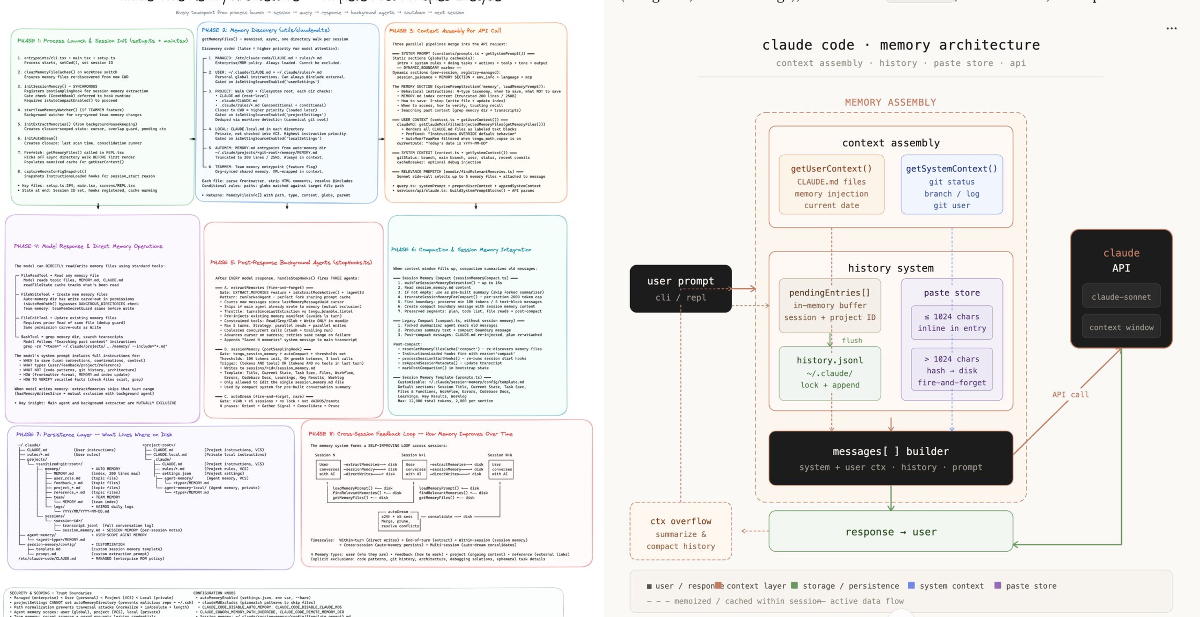
here's how Claude Code actually handles memory : all 8 phases 🧵Our team at @mem0ai use @claudeai a lot, we deeply care about memory. here is a summary of how it works 👇User Input -> Context Assembly -> History System -> API / Query -> Response -> SummaryPhase 1: session… pic.twitter.com/hcZbJzbUxB— ellen livia ᯅ (@ellen_in_sf) March 31, 2026
Basic Memory
AI conversations that actually remember. Never re-explain your project to your AI again. Join our Discord: https://discord.gg/tyvKNccgqN
ChatGPT will now use its 'memory' to personalize web searches | TechCrunch
ChatGPT will now use its 'memory' to personalize web searches, thanks to a new feature called Memory with Search.

Inside ChatGPT: How AI chatbots work
Large language models like ChatGPT use a complicated series of equations to understand and respond to your prompts. Here’s a look inside the system.

Mem0: Building Production-Ready AI Agents with Scalable Long-Term Memory
Large Language Models (LLMs) have demonstrated remarkable prowess in generating contextually coherent responses, yet their fixed context windows pose fundamental challenges for maintaining consistency over prolonged multi-session dialogues. We introduce Mem0, a scalable memory-centric architecture that addresses this issue by dynamically extracting, consolidating, and retrieving salient information from ongoing conversations. Building on this foundation, we further propose an enhanced variant that leverages graph-based memory representations to capture complex relational structures among conversational elements. Through comprehensive evaluations on LOCOMO benchmark, we systematically compare our approaches against six baseline categories: (i) established memory-augmented systems, (ii) retrieval-augmented generation (RAG) with varying chunk sizes and k-values, (iii) a full-context approach that processes the entire conversation history, (iv) an open-source memory solution, (v) a proprietary model system, and (vi) a dedicated memory management platform. Empirical results show that our methods consistently outperform all existing memory systems across four question categories: single-hop, temporal, multi-hop, and open-domain. Notably, Mem0 achieves 26% relative improvements in the LLM-as-a-Judge metric over OpenAI, while Mem0 with graph memory achieves around 2% higher overall score than the base configuration. Beyond accuracy gains, we also markedly reduce computational overhead compared to full-context method. In particular, Mem0 attains a 91% lower p95 latency and saves more than 90% token cost, offering a compelling balance between advanced reasoning capabilities and practical deployment constraints. Our findings highlight critical role of structured, persistent memory mechanisms for long-term conversational coherence, paving the way for more reliable and efficient LLM-driven AI agents.

Memora scales agent memory to boost long-horizon productivity
AI agents can't remember past conversations. They must constantly reload or retrieve context, which grows less efficient as tasks get longer and more complex. Memora solves this with a scalable memory system separating what’s stored from how it's retrieved.

ChatGPT acts as a "cognitive crutch" that weakens memory, new research suggests
A recent experiment provides evidence that relying on artificial intelligence to study tends to reduce how much information students remember weeks later.

Claude carries memory into work - Sensemaker
Chat and cloud Cowork now share remembered topics; continuity improves, but so can the reach of a mistake.
ChatGPT is smarter now that it's learned to forget - a huge memory upgrade is coming
The AI chatbot will remember what matters most and quietly let the rest fade
Anthropic's Opinionated Memory Bet
A deep dive into Claude's new memory tool—how it works, the architectural bets they're making, and whether it's the right fit for your application.