


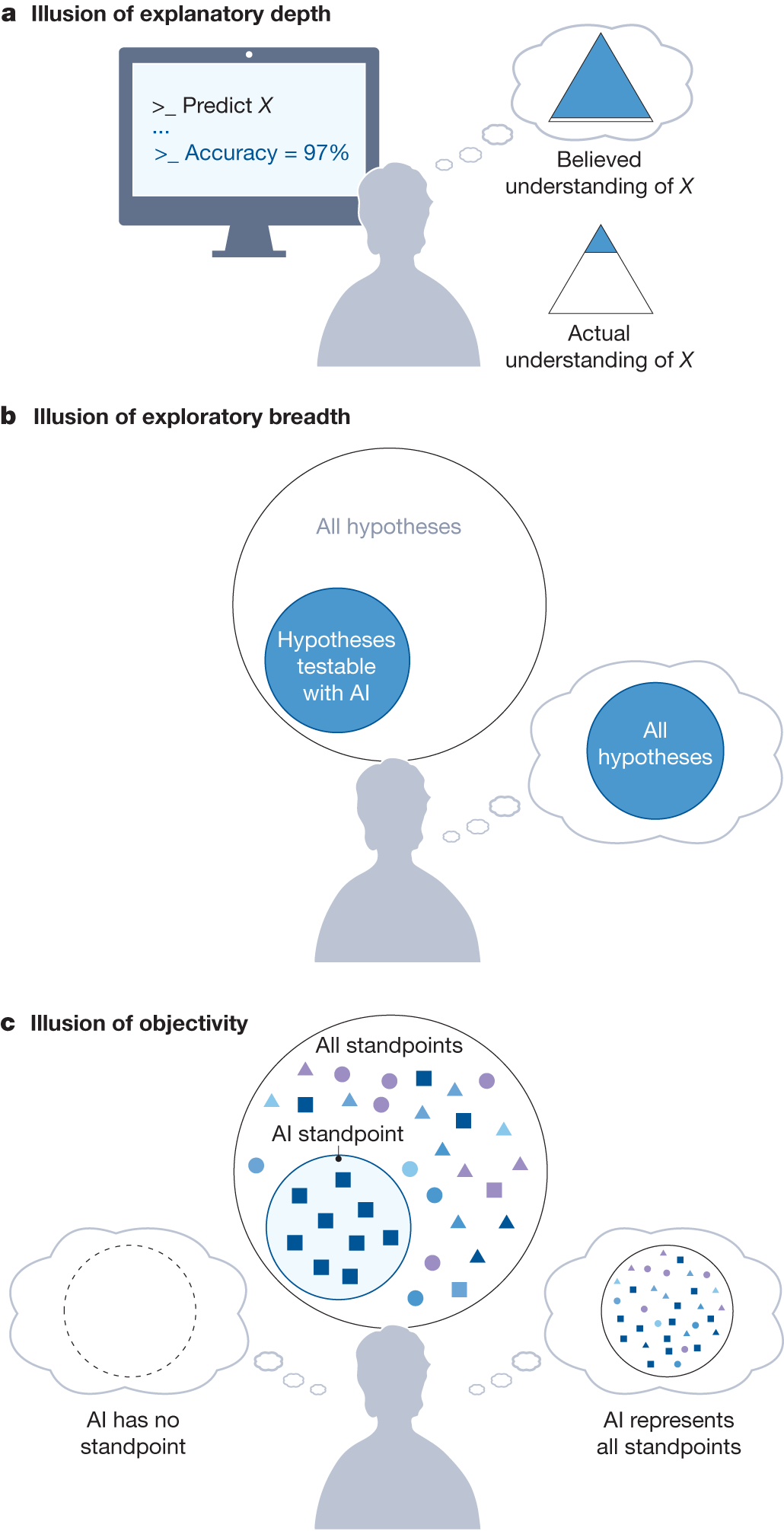
AI will fundamentally transform science. It will supercharge the research process, making it faster and more efficient and broader in scope. It will make scientists themselves vastly more productive, more objective, maybe more creative. It will make many human participants—and probably some human scientists—obsolete… Or at least these are some of the claims we are hearing these days. There is no question that various AI tools could radically reshape how science is done, and how much science is done. What we stand to gain in all this is pretty clear. What we stand to lose is less obvious, but no less important. My guest today is . Molly is a Professor in the Department of Psychology and the University Center for Human Values at Princeton University. In a recent , Molly and the anthropologist presented a framework for thinking about the different roles that are being imagined for AI in science. And they argue that, when we adopt AI in these ways, we become vulnerable to certain illusions. Here, Molly and I talk about four visions of AI in science that are currently circulating: AI as an Oracle, as a Surrogate, as a Quant, and as an Arbiter. We talk about the very real problems in the scientific process that AI promises to help us solve. We consider the ethics and challenges of using Large Language Models as experimental subjects. We talk about three illusions of understanding the crop up when we uncritically adopt AI into the research pipeline—an illusion that we understand more than we actually do; an illusion that we're covering a larger swath of a research space than we actually are; and the illusion that AI makes our work more objective. We also talk about how ideas from Science and Technology Studies (or STS) can help us make sense of this AI-driven transformation that, like it or not, is already upon us. Along the way Molly and I touch on: AI therapists and AI tutors, anthropomorphism, the culture and ideology of Silicon Valley, Amazon's Mechanical Turk, fMRI, objectivity, quantification, Molly's mid-career crisis, monocultures, and the squishy parts of human experience. Without further ado, on to my conversation with Dr. Molly Crockett. Enjoy! A transcript of this episode is available . Notes and links 5:00 – For more on LLMs—and the question of whether we understand how they work—see our with Murray Shanahan. 9:00 – For the paper by Dr. Crockett and colleagues about the social/behavioral sciences and the COVID-19 pandemic, see . 11:30 – For Dr. Crockett and colleagues’ work on outrage on social media, see this . 18:00 – For a recent exchange on the prospects of using LLMs in scientific peer review, see . 20:30 – Donna Haraway’s essay, 'Situated Knowledges: The Science Question in Feminism and the Privilege of Partial Perspective’, is . See also Dr. Haraway's book, . 22:00 – For the recent essay by Henry Farrell and others on AI as a cultural technology, see . 23:00 – For a recent report on chatbots driving people to mental health crises, see . 25:30 – For the already-classic “stochastic parrots” article, see . 33:00 – For the study by Ryan Carlson and Dr. Crockett on using crowd-workers to study altruism, see . 34:00 – For more on the “illusion of explanatory depth,” see with Tania Lombrozo. 53:00 – For more about Ohio State’s plans to incorporate AI in the classroom, see . For a recent essay by Dr. Crockett on the idea of “techno-optimism,” see . Recommendations , by Adam Becker , by L. A. Paul , by Miranda Fricker Many Minds is a project of the , which is made possible by a generous grant from the John Templeton Foundation to Indiana University. The show is hosted and produced by , with help from Assistant Producer and with creative support from DISI Directors Erica Cartmill and Jacob Foster. Our artwork is by . Our transcripts are created by . Subscribe to Many Minds on Apple, Stitcher, Spotify, Pocket Casts, Google Play, or wherever you listen to podcasts. You can also now subscribe to the Many Minds newsletter ! We welcome your comments, questions, and suggestions. Feel free to email us at: manymindspodcast@gmail.com. For updates about the show, visit or follow us on Twitter () or Bluesky ().
Artificial intelligence and illusions of understanding in scientific research
Scientists are enthusiastically imagining ways in which artificial intelligence (AI) tools might improve research. Why are AI tools so attractive and what are the risks of implementing them across the research pipeline? Here we develop a taxonomy of scientists’ visions for AI, observing that their appeal comes from promises to improve productivity and objectivity by overcoming human shortcomings. But proposed AI solutions can also exploit our cognitive limitations, making us vulnerable to illusions of understanding in which we believe we understand more about the world than we actually do. Such illusions obscure the scientific community’s ability to see the formation of scientific monocultures, in which some types of methods, questions and viewpoints come to dominate alternative approaches, making science less innovative and more vulnerable to errors. The proliferation of AI tools in science risks introducing a phase of scientific enquiry in which we produce more but understand less. By analysing the appeal of these tools, we provide a framework for advancing discussions of responsible knowledge production in the age of AI.
Deep Research, information vs. insight, and the nature of science
What AI will accelerate in the scientific process, what it cannot do, and how we can prepare for new manners of scientific investigation.
AI has supercharged scientists—but may have shrunk science
Analysis of 41 million papers finds that although AI expands individual impact, it narrows collective scientific exploration
AI Science Fiction Versus Reality
Will AI ruin the social sciences — or revolutionize them?
The technology can whip up spurious findings and pollute survey responses, but it could also make research more rigorous.
Artificial intelligence tools expand scientists’ impact but contract science’s focus
Developments in artificial intelligence (AI) have accelerated scientific discovery1. Alongside recent AI-oriented Nobel prizes2–9, these trends establish the role of AI tools in science10. This advancement raises questions about the influence of AI tools on scientists and science as a whole, and highlights a potential conflict between individual and collective benefits11. To evaluate these questions, we used a pretrained language model to identify AI-augmented research, with an F1-score of 0.875 in validation against expert-labelled data. Using a dataset of 41.3 million research papers across the natural sciences and covering distinct eras of AI, here we show an accelerated adoption of AI tools among scientists and consistent professional advantages associated with AI usage, but a collective narrowing of scientific focus. Scientists who engage in AI-augmented research publish 3.02 times more papers, receive 4.84 times more citations and become research project leaders 1.37 years earlier than those who do not. By contrast, AI adoption shrinks the collective volume of scientific topics studied by 4.63% and decreases scientists’ engagement with one another by 22%. By consequence, adoption of AI in science presents what seems to be a paradox: an expansion of individual scientists’ impact but a contraction in collective science’s reach, as AI-augmented work moves collectively towards areas richest in data. With reduced follow-on engagement, AI tools seem to automate established fields rather than explore new ones, highlighting a tension between personal advancement and collective scientific progress.

The AI Question that No AI Person Asks
The AI Question that No AI Person Asks
The Age of Wonders and Terrors
Twenty years ago, when the idea of AI taking over the world in our lifetimes still struck most of us as the unconstrained fantasy of those who knew too much science fiction and too little science, …

AI as the Catalyst of the New Paradigm of Science? | Cadmus Journal
The rapid advancement of Artificial Intelligence (AI) is reshaping the landscape of scientific inquiry. This article examines the challenges confronting modern science, including knowledge fragmentation, diminishing returns of current paradigms, and the disconnect between science and society. It explores how AI offers solutions enhancing collaboration and integrating knowledge—as well as considers the possible “darker side” of using AI in research. However, the advent of AI in science not only enhances scientific research but also redefines the role of human researchers and fosters a new paradigm of human understanding. By embracing these transformations, a more cohesive and responsive scientific enterprise can emerge.
What we can’t measure about AI – yet | Aeon Essays
The costs of transformative innovations are immediately clear: it’s the longterm gains that are hardest to understand

The AI We Deserve
Critiques of artificial intelligence abound. Where’s the utopian vision for what it could be?
What Does 'Human-Centred AI' Mean?
While it seems sensible that human-centred artificial intelligence (AI) means centring "human behaviour and experience," it cannot be any other way. AI, I argue, is usefully seen as a relationship between technology and humans where it appears that artifacts can perform, to a greater or lesser extent, human cognitive labour. This is evinced using examples that juxtapose technology with cognition, inter alia: abacus versus mental arithmetic; alarm clock versus knocker-upper; camera versus vision; and sweatshop versus tailor. Using novel definitions and analyses, sociotechnical relationships can be analysed into varying types of: displacement (harmful), enhancement (beneficial), and/or replacement (neutral) of human cognitive labour. Ultimately, all AI implicates human cognition; no matter what. Obfuscation of cognition in the AI context -- from clocks to artificial neural networks -- results in distortion, in slowing critical engagement, perverting cognitive science, and indeed in limiting our ability to truly centre humans and humanity in the engineering of AI systems. To even begin to de-fetishise AI, we must look the human-in-the-loop in the eyes.

What Does 'Human-Centred AI' Mean?
While it seems sensible that human-centred artificial intelligence (AI) means centring "human behaviour and experience," it cannot be any other way. AI, I argue, is usefully seen as a relationship between technology and humans where it appears that artifacts can perform, to a greater or lesser extent, human cognitive labour. This is evinced using examples that juxtapose technology with cognition, inter alia: abacus versus mental arithmetic; alarm clock versus knocker-upper; camera versus vision; and sweatshop versus tailor. Using novel definitions and analyses, sociotechnical relationships can be analysed into varying types of: displacement (harmful), enhancement (beneficial), and/or replacement (neutral) of human cognitive labour. Ultimately, all AI implicates human cognition; no matter what. Obfuscation of cognition in the AI context -- from clocks to artificial neural networks -- results in distortion, in slowing critical engagement, perverting cognitive science, and indeed in limiting our ability to truly centre humans and humanity in the engineering of AI systems. To even begin to de-fetishise AI, we must look the human-in-the-loop in the eyes.
The Impact of Artificial Intelligence on Human Thought
This research paper examines, from a multidimensional perspective (cognitive, social, ethical, and philosophical), how AI is transforming human thought. It highlights a cognitive offloading effect: the externalization of mental functions to AI can reduce intellectual engagement and weaken critical thinking. On the social level, algorithmic personalization creates filter bubbles that limit the diversity of opinions and can lead to the homogenization of thought and polarization. This research also describes the mechanisms of algorithmic manipulation (exploitation of cognitive biases, automated disinformation, etc.) that amplify AI's power of influence. Finally, the question of potential artificial consciousness is discussed, along with its ethical implications. The report as a whole underscores the risks that AI poses to human intellectual autonomy and creativity, while proposing avenues (education, transparency, governance) to align AI development with the interests of humanity.
Saw this metaphor by Terence Tao floating around about one of the drawbacks of using AI to solve hard math problems, and kind of have the same feeling for “vibe science” or “fully automated science” line of research in #AI4Science. theatlantic.com/technology/2026/02/ai-math-te… #ScAISci
