maraoz's website.
Composing Music With Recurrent Neural Networks
Writeup for my first major machine learning project.
Deep learning for assisting the process of music composition (part 1)
This is part 1 of my explorations of using deep learning for assisting the process of music composition. In this part, I look at some almost-winning output of a model trained by deep learning metho…

Machines learn to play Tabla — Gaurav Trivedi
Using Karpathy's char-RNN to train a recurrent neural network on tabla compositions, generating new rhythmic sequences and exploring whether deep learning can capture the grammar of Indian classical percussion.
Making a Neural Synthesizer Instrument
In a previous post, we described the details of NSynth (Neural Audio Synthesis), a new approach to audio synthesis using neural networks. We hinted at furthe...

Neural Translation of Musical Style
Can we teach a neural network to perform like a human?
Recurrent neural network
In artificial neural networks, recurrent neural networks (RNNs) are designed for processing sequential data, such as text, speech, and time series,[1] where the order of elements is important. Unlike feedforward neural networks, which process inputs independently, RNNs utilize recurrent connections, where the output of a neuron at one time step is fed back as input to the network at the next time step. This enables RNNs to capture temporal dependencies and patterns within sequences.
EuterPen: Unleashing Creative Expression in Music Score Writing
The Millions of Songs Mashed Into AI-Generated Music
Explore the astonishing amount of music available to AI developers.

Why We’re Taking a Human‑First Stand on AI‑Generated Music — Qobuz Community
Artificial intelligence is transforming the music industry at an unprecedented pace. Faced with the explosion of AI-generated content and the legitimate questions it raises, Qobuz has chosen transparency. This charter establishes our framework: how we use AI, where we draw our lines, and what commi

From Prompting to Describing: A Cross-Cultural Study of Language for AI-Generated Music
Recent text-to-music (TTM) systems such as Suno [22], Udio [23], and Google’s MusicFX [7] allow users to generate music from a natural language prompt, lowering the barrier to music creation for users without specialized musical knowledge [27]. Understanding how users write these prompts is therefore a fundamental question for music information retrieval and human-AI interaction research. Yet, prompting a generative system is not the same cognitive or linguistic act as describing music one has heard [12]. When a user writes a prompt, they encode anticipatory intent to steer the system toward a desired or imagined output, whereas when a listener describes a piece of music, their language is grounded in a perceptual experience. We argue that these two acts produce systematically different language—a distinction that, despite being intuitive, has not been quantitatively examined. This gap has practical consequences: recent TTM models are trained predominantly on metadata-centric corpora (genre labels, BPM, descriptive tags) [6] rather than on the kind of language users naturally produce when listening, leaving the prompt-description gap unexamined. Moreover, this gap limits our ability to evaluate and improve human–AI interaction in music generation, as current systems are optimized for prompt input but commonly assessed through human perception.
Introduction to Moss
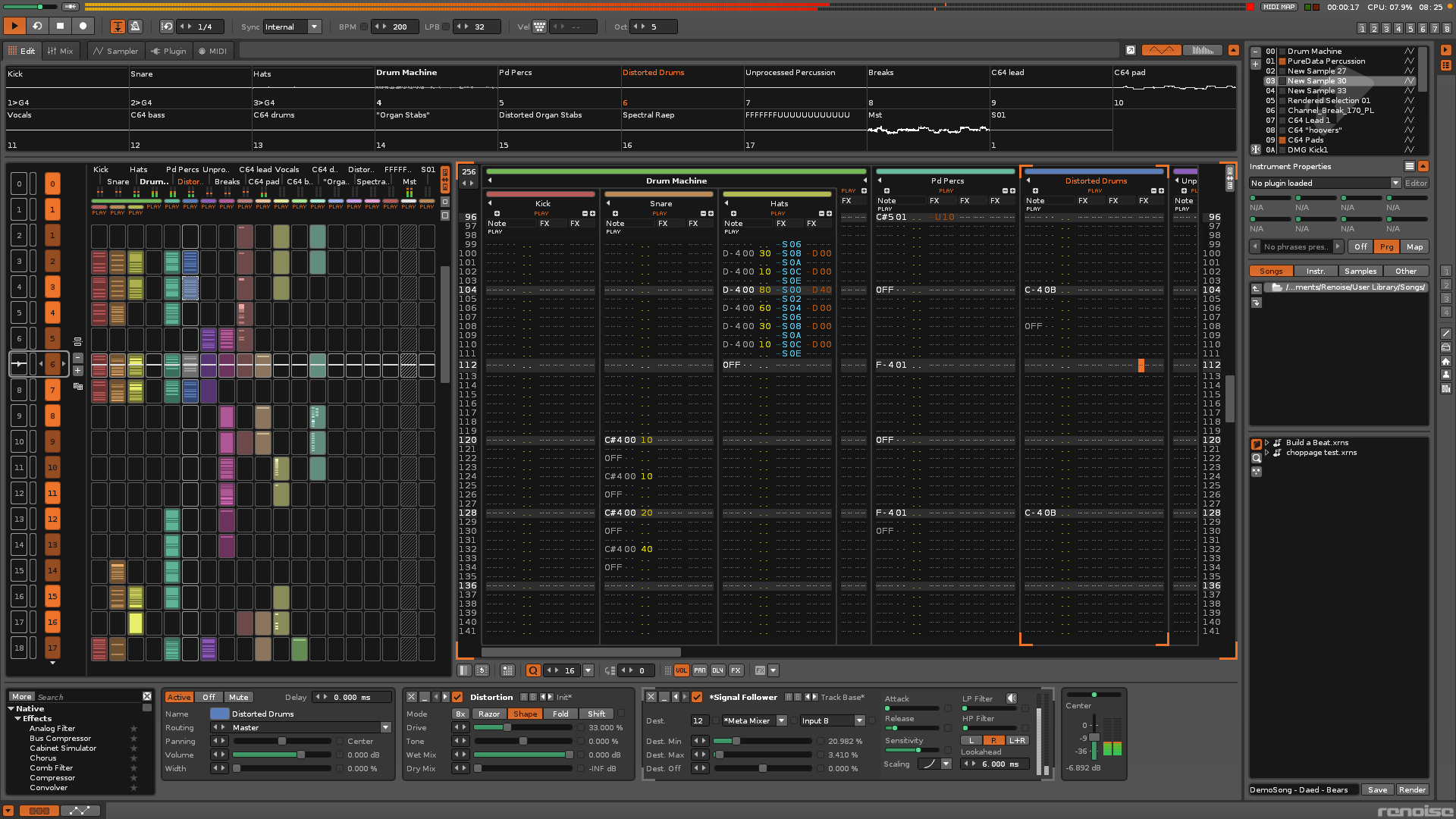
“It’s unfamiliar, intimidating, and seemingly impenetrable for producers raised on DAWs like Ableton Live - but it can unlock a whole new world of creativity”: I tried a music tracker and it rewired my brain (in a good way)
Beloved by artists from Aphex Twin to Deadmau5, trackers swap the trusty piano roll for a text-based, vertically-scrolling interface that looks like something out of The Matrix. Let's find out how deep the tracker rabbit hole goes