

This FAQ addresses questions for developers & companies interested in working on Business Source License (BSL) software or adopting BSL for their own business.
MariaDB Business Source License (BSL) | MariaDB
This FAQ addresses questions for MariaDB customers and users interested in why MariaDB is employing the Business Source License (BSL).
MariaDB Business Source License (BSL) | MariaDB
This FAQ addresses questions for MariaDB customers and users interested in why MariaDB is employing the Business Source License (BSL).
Business Source License 1.1 | MariaDB
Details of MariaDB’s Business Source License (BSL) 1.1.
Business Source License 1.1 | MariaDB
Details of MariaDB’s Business Source License (BSL) 1.1.
MariaDB Fixes it's Business Source License With My Help, Releases MaxScale 2.1 Database Routing Proxy
MariaDB asked me to look over their "Business Source License". The BSL is a non-Open-Source license which transitions into an Open Source license after a delay. It's designed to help companies to get paid for developing Open Source by allowing them to make it commercial-license-only for a limited time in which they collect revenue for its licensing, and then the work goes Open.
MySQL founder tries a new software licensing model | TechCrunch
When it comes to open-source licenses, developers have their fair share of choices (GPL, BSD, MIT, Apache, etc.), all of them with their own pros and

Introducing the Functional Source License: Freedom without Free-riding
Sentry started life in 2008 as an unlicensed, 71-line Django plugin. The next year we began publishing it under BSD-3, and ten years later we switched to the Business Source License (BSL or BUSL). Last year we purchased Codecov, and a few months ago we published it under BSL/BUSL as well. That led to some vigorous debate because of our use of the term “Open Source” to describe Codecov, from which emerged this helpful suggestion from Adam Jacob, co-founder of Chef:
The Great Open Source Shake-up
The past year and a half has seen a number of open source and open source-ish companies like Elastic, Confluent, and MongoDB change licenses on certain products, moving away from traditional open s…

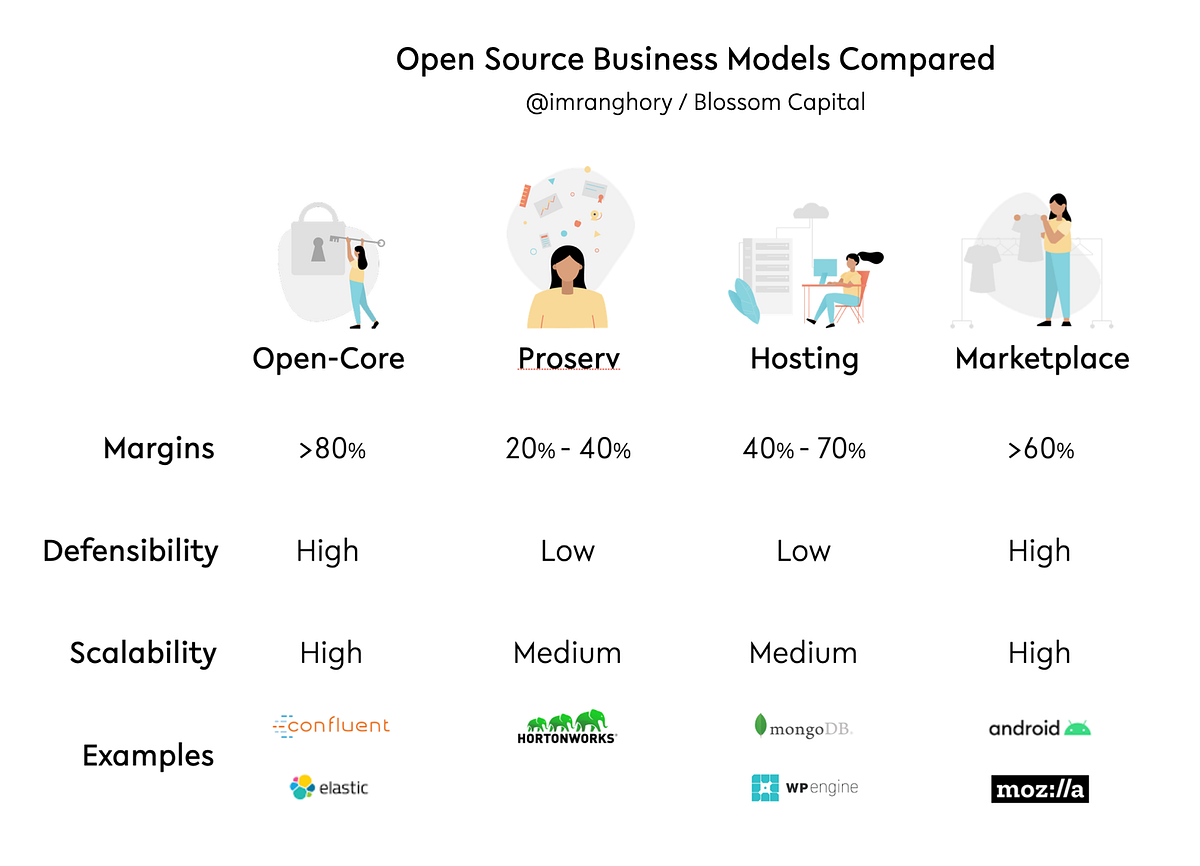
The Single-Vendor Commercial Open Source Business Model
Dirk Riehle Research, SAP Labs LLC Updated 2010-11-09: Renamed “commercial open source” to “single-vendor (commercial) open source” to be clear about the difference to distr…

Everything an open source maintainer might need to know about open source licensing | Ben Balter
There's lots of internet lore around open source licensing. An attorney and open source developer answers the most common questions.
Revisiting the Open Source Business Model
In the past few years, many companies have come to me asking for help drafting a “new open source license.” As a rule, drafting a new open source software license is not a good idea, s…

Making money from Open Source Software: How we do it?
How we make money from open source software with RavenDB: dual licensing, AGPL, support reduction, and treating OSS like a commercial product.

The Open Source Distributor Business Model
Dirk Riehle, dirk@riehle.org, Published in Computer vol. 54, no. 12 (December 2021), pp. 99-103. Abstract This article defines and discusses one particular commercial open source business model, ca…

How to build a successful business model around open source software
The right approach to open source can be a great revenue model for the software provider — my company did it and we've been profitable since day one.

The Secrets of Successful Open Source Business Models
Finding the right model for your open-source startup
What is RSL? | RSL: Really Simple Licensing
The open content licensing standard for the AI-first Internet