


I see a continued fragmentation of social media as people leave X(Twitter).
Shifts in U.S. Social Media Use, 2020–2024: Decline, Fragmentation, and Enduring Polarization
The social media ecosystem appears to be in flux. Twitter’s rebranding to X has come to symbolize a broader reorganization of online publics – political reshuffling, user attrition, and uncertainty over the role of legacy platforms. Simultaneously, the shift from text-based, networked feeds toward algorithmically curated, short-form video has accelerated, with TikTok setting the pace for the wider ecosystem [18, 14, 16]. At the same time, everyday communication increasingly migrates from large, open networks to semi-private spaces such as group chats and messaging apps. Commentators describe a digital public sphere in transition: smaller, more fragmented, less dominated by traditional social networking sites, and rise of more broadcast-oriented forms of media – with some even suggesting that we are seeing the beginning of the end of the social media era.
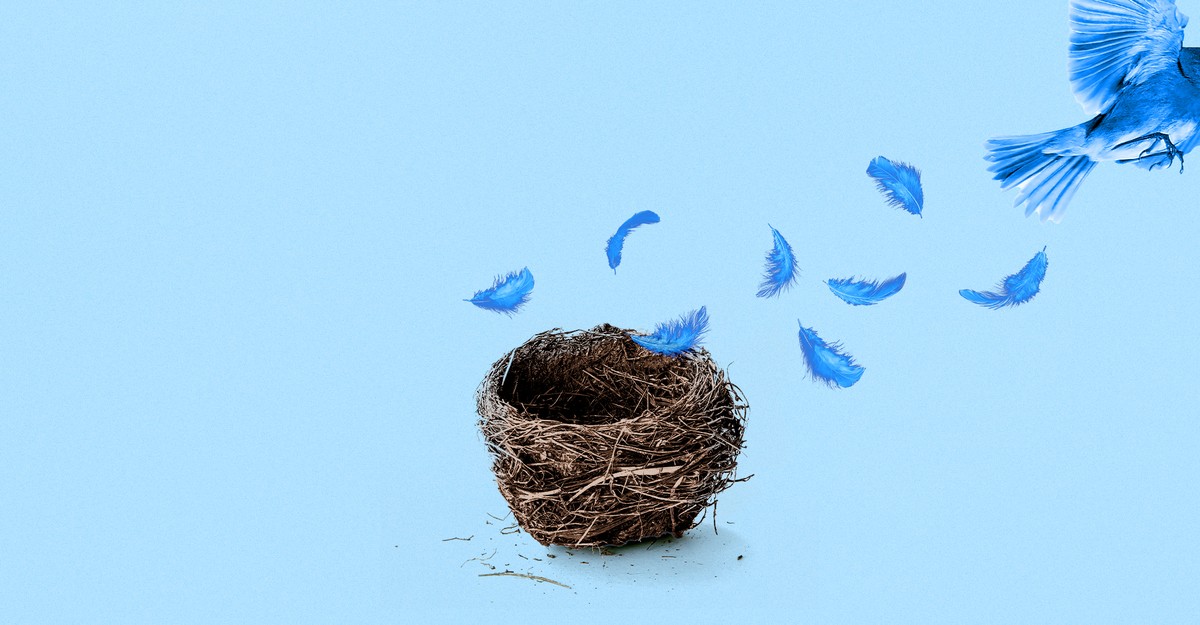
The Weird, Fragmented World of Social Media After Twitter
The common forum that Elon Musk destroyed will never be replaced—and that’s okay.
Shifts in U.S. Social Media Use, 2020-2024: Decline,...
Using nationally representative data from the 2020 and 2024 American National Election Studies (ANES), this paper traces how the U.S. social media landscape has shifted across platforms,...

The Weird, Fragmented World of Social Media After Twitter - The Atlan…
archived 7 Aug 2023 02:41:57 UTC

My top Bluesky feature requests for 2024
In 2023 my social media consumption changed dramatically after I DM'd a random mufo on what-was-then-called Twitter for a Bluesky invite. At the time, I was floating between Twitter itself and Mastodon for my primary daily social media experience. On one hand, I loathed Twitter (and
Twitter Thoughts For You
I previously have written back in March 2022 about how I use Twitter, and back in April 2023 about Twitter and its then-new algorithms, which have changed again.
RIP social media. What comes next is messy.
As social media splinters, how can we keep the new online spaces from devolving into toxic pits of despair?

Social media is a gnarly coordination problem we need to decompose - a warm space
A few weeks of X’s algorithm can make you more right-wing – and it doesn’t wear off quickly
Elon Musk’s social media platform is boosting conservative content – and it’s having long-lasting effects on how users see the world.

A few weeks of X’s algorithm can make you more right-wing – and it doesn’t wear off quickly
Elon Musk’s social media platform is boosting conservative content – and it’s having long-lasting effects on how users see the world.
Shifts in U.S. Social Media Use, 2020–2024: Decline, Fragmentation, and Enduring Polarization
Using nationally representative data from the 2020 and 2024 American National Election Studies (ANES), this paper describes how U.S. social media use has shifted across platforms, demographics, and politics. Overall platform reach declined, driven by growth in the share of Americans — especially the youngest and oldest cohorts — who report using no social media. Visiting and posting activity on Twitter/X and Facebook have fallen by nearly 50% since 2020, with the decline on Twitter/X driven primarily by reduced participation among Democratic users. While Facebook, YouTube, and Twitter/X lost ground, TikTok and Reddit grew modestly, consistent with a more fragmented digital public sphere. Platform audiences aged and became slightly more educated and racially diverse. Politically, most platforms shifted toward Republican users while remaining, on balance, Democratic-leaning. Twitter/X experienced the largest change: among posters, the partisan balance swung over 70 percentage points from Democrats to Republicans. Across platforms, political posting remains closely tied to affective polarization, as the most partisan respondents are also the most active. As casual users disengage while polarized partisans remain vocal, online discourse becomes narrower and more ideologically extreme.
The Great Social Media Diaspora
What happens when sprawling online communities fracture into politically homogenous, self-governing communities?

How Bluesky, Alternative to X and Facebook, Is Handling Explosive Growth (Published 2024)
The fledgling social media site has been flooded with new users since the election. It hasn’t all been easy.

Social media is no longer social. Most of it is passive viewing of videos and pictures from people we've never met. But we're still studying social media like it's 2010. We've entered the post-social media era — and research needs to catch up. osf.io/preprints/socarxiv/6nue7_v1 preprint w/ Richard Rogers
Twitter died a long time ago and X isn't worth it. Before I made the jump, my ego was holding me back. I was too concerned with vanity metrics. I finally realized if you're posting stuff people want to follow, then they'll follow you, even when you leave. siliconrepublic.com/enterprise/kelsey-hightower-b…

Open-source champion Kelsey Hightower on the promise of Bluesky
www.siliconrepublic.com
