

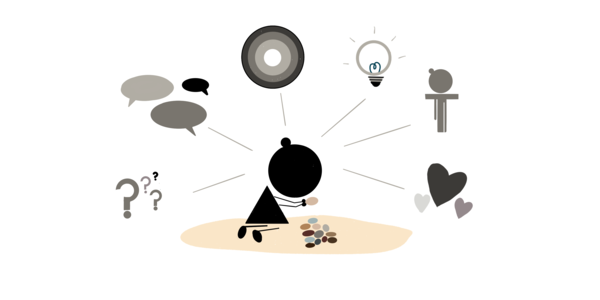
Being an Expert Generalist should be treated as a first-class skill, one that can be assessed and taught.
The Calculus of Grit
I find myself feeling strangely uncomfortable when people call me a generalist and imagine that to be a compliment. My standard response is that I am actually…

How Software Groups Rot: Legacy of the Expert Beginner - DaedTech
Expert Beginner Recap In my last post I introduced the term “Expert Beginner” to describe someone who has capped out in their learning at some sort of local maximum, convinced that the local is global. Expert Beginners are developers who do not understand enough of the big picture to understand that they aren’t actually experts....

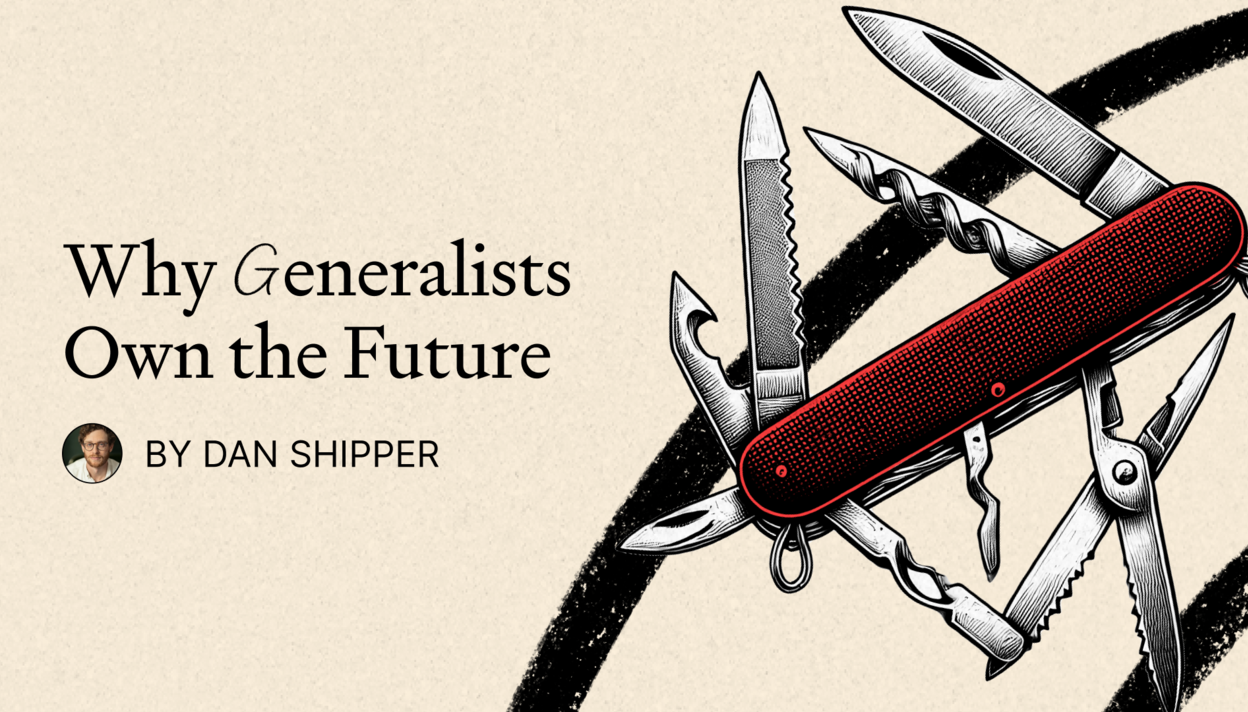
Why Generalists Own the Future
In the age of AI, it’s better to know a little about a lot than a lot about a little
How Developers Stop Learning: Rise of the Expert Beginner - DaedTech
In this post, I describe the phenomenon of the so-called expert beginner -- someone with mediocre skill who thinks he's an expert.

The language of generalization.
The Death Of Expertise
To reject the notion of expertise, and to replace it with a sanctimonious insistence that every person has a right to his or her own opinion, is silly.
Beware the Casual Polymath
We live in times of great disaggregation, and yet, seem to learn increasingly from generalists. In the past, an expert in one field of Psychology might have been forced to teach a broad survey class.
How to do hard things
A fully general system for learning to do things you currently find difficult, only somewhat tongue-in-cheek.
General 2 — Fairly Trained
These are the companies and models that we’ve certified so far. We encourage you to choose them when considering generative AI providers.

Introducing beginners to the mechanics of machine learning – Miriam Posner
Every year, I spend some time introducing students to the mechanics of machine learning with neural nets. I definitely don’t go into great depth; I usually only have one class for this. But I try to unpack at least some of the major concepts, so that ML isn’t quite such a black box.
Agent Skills Overview - Agent Skills
A standardized way to give AI agents new capabilities and expertise.
Agent Skills Overview - Agent Skills
A standardized way to give AI agents new capabilities and expertise.
Prompting Science Report 4: Playing Pretend: Expert Personas Don't Improve Factual Accuracy
<span> <p><span>This is the fourth in a series of short reports that help business, education, and policy leaders understand the technical details of working with AI through rigorous testing. Here, we ask whether assigning personas to models improves performance on difficult objective multiple-choice questions. We study both domain-specific expert personas and low-knowledge personas, evaluating six models on GPQA Diamond (Rein et al. 2024) and MMLU-Pro (Wang et al. 2024), graduate-level questions spanning science, engineering, and law. </span></p> <p><span>We tested three approaches:</span></p> <p><span>• In-Domain Experts: Assigning the model an expert persona (“you are a physics expert”) matched to the problem type (physics problems) had no significant impact on performance (with the exception of the Gemini 2.0 Flash model).</span></p> <p><span> • Off-Domain Experts (Domain-Mismatched): Assigning the model an expert persona (“you are a physics expert”) not matched to the problem type (law problems) resulted in marginal differences.</span></p> <p><span> • Low-Knowledge Personas: We assigned the model negative capability personas (layperson, young child, toddler), which were generally harmful to benchmark accuracy. </span></p> <p><span>Across both benchmarks, persona prompts generally did not improve accuracy relative to a no-persona baseline. Expert personas showed no consistent benefit across models, with few exceptions. Domain-mismatched expert personas sometimes degraded performance. Low-knowledge personas often reduced accuracy. These results are about the accuracy of answers only; personas may serve other purposes (such as altering the tone of outputs), beyond improving factual performance.</span></p></span>

The Tragedy of the Cognitive Commons: How AI Could Disrupt the Regeneration of Professional Expertise
Artificial intelligence is reshaping cognitive work, but Human Resource Development scholarship has treated this transformation as an organizational training challenge, leaving the collective regeneration of professional expertise unexamined. This conceptual paper introduces the Cognitive Commons framework, integrating commons theory, HRD scholarship, and distributed cognition to explain how rational AI adoption decisions can deplete the shared expertise pool professions require for renewal. The framework distinguishes Internalized Mastery (deep domain knowledge from sustained practice) from Distributed Mastery (orchestrating human-AI systems), and develops the Validation Tether: effective AI oversight depends on the expertise AI adoption may undermine. Early labor market and clinical evidence suggests possible disruption to expertise-regeneration pathways in highly AI-exposed sectors, though adoption is recent and the strongest signals come from leading sectors rather than all professions. Five factors determine occupational vulnerability, and governance arrangements may form across organizational, professional-association, and policy levels. The paper reframes expertise development as collective stewardship rather than organizational optimization, with implications for HRD theory and workforce policy.

"One of the important skills of the professional scientists... is to know what to read and what not to read. This is narrow community knowledge built up through extended face-to-face socialisation in expert groups."

Large language models eroding science understanding: an empirical study of ‘malignment’ - AI and Ethics
link.springer.com