

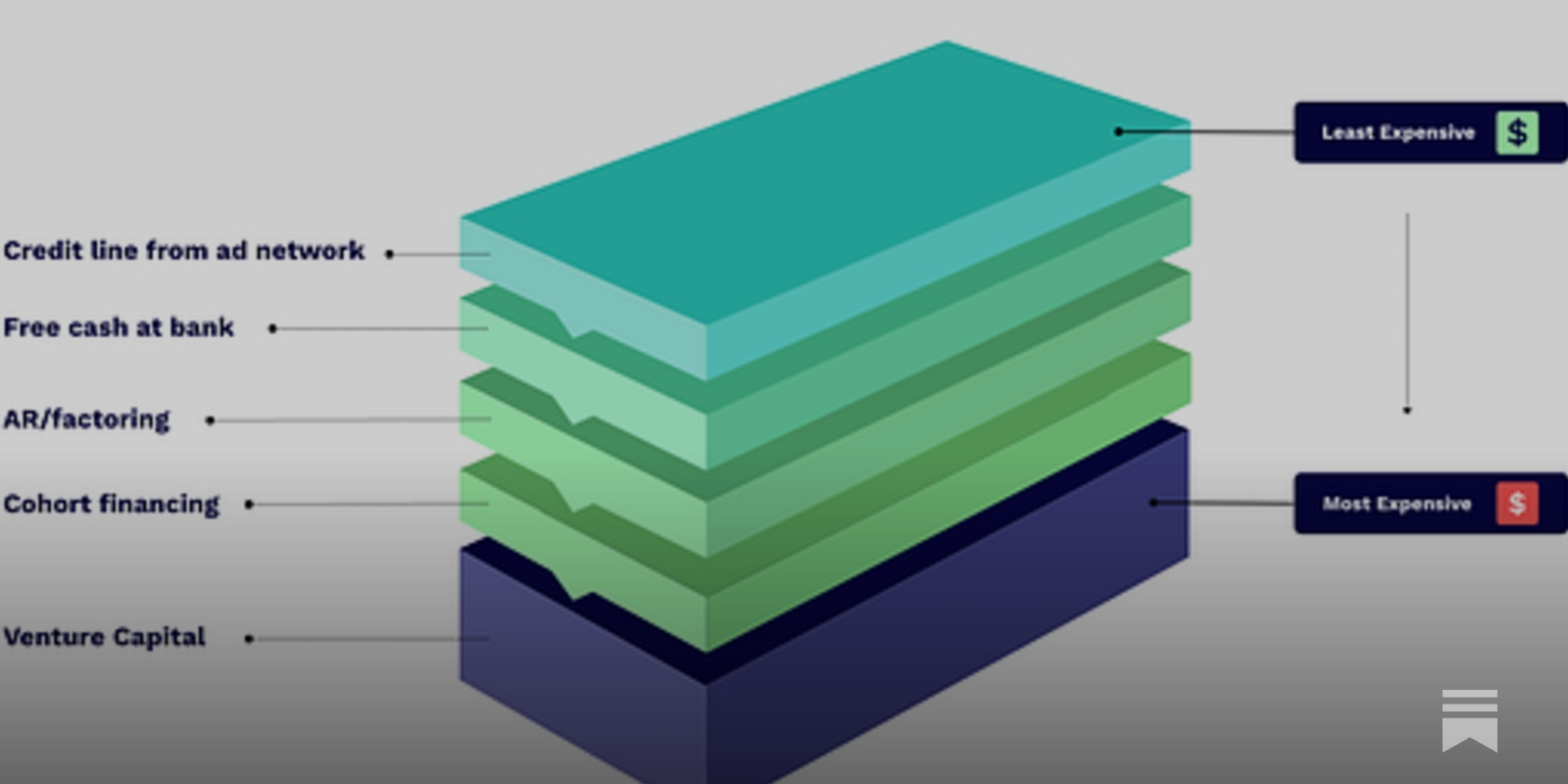
A framework for capital-efficient deployment of funds into mobile user acquisition
Capital Stack | Real Estate Investment Structure
Capital Stack is the structure of financing sources used to fund a real estate investment, such as a commercial property acquisition.

Brad Neuberg on Twitter / X
Y Combinator is predicated on startups that require low capitalization since most of the technology they depend on is already mostly developed. This was true pre-2015 where startups depended on commodity open source software, the smartphone capitalized by Apple and others, cloud…— Brad Neuberg (@bradneuberg) September 16, 2024
MetaMask: Where your money lives
Buy, trade, earn, and spend, all from one app you control.

Founders Hub | Transform Finance
The founder playbook for building a company that lasts and stays true to why you started it. Research, case studies, and practical tools for incorporation, fundraising terms, board structure, ownership, and culture.

We Spent $3.3M Buying Out Investors: Why and How We Did It
Last month, Buffer spent $3.3 million – about half of all the cash we had in the bank – to buy out our main venture capital (VC) investors. Here is the full journey of how we decided on this path for the company, including all the details and numbers involved in carrying out a stock buyback.

Capital and CHI: Technological Capture and How It Structures CHI Research
This paper advances a theoretical argument about the role capital plays in structuring CHI research. We introduce the concept of technological capture to theorize the mechanism by which this happens. Using this concept, we decompose the effect on CHI into four broad forms: technological capture creates market-creating, market-expanding, market-aligned, and externality-reducing CHI research. We place different CHI subcommunities into these forms -- arguing that many of their values are inherited from capital underlying the field. Rather than a disciplinary- or conference-oriented conceptualization of the field, this work theorizes CHI as tightly-coupled with capital via technological capture. The paper concludes by discussing some implications for CHI.

Sovereign Tech Fund | Sovereign Tech Agency
With the Sovereign Tech Fund, we invest globally in the open software components that underpin Germany's and Europe's competitiveness and ability to innovate. By targeting core digital infrastructure, our investments scale across many sectors and benefit a broad range of users. Improving the security, stability, and reusability of open software components directly enhances the productivity, competitive edge, and capacity for innovation of startups and small and medium-sized businesses.

Tagus Capital — DeepTech Venture Capital | Oxford
Tagus Capital is a DeepTech venture capital fund based in Oxford
Tailscale raises $160 Million (USD) Series C to build the New Internet
Tailscale has raised $160 million USD ($230 million CAD) in our Series C, led by Accel with participation from CRV, Insight Partners, Heavybit, Uncork Capital — and new investment from Anthony Casalena - CEO of Squarespace.

Amino Apps raises $19.2 million to create mobile apps for interest-based communities
Amino Apps believes that there's still a need for networks that are both community-centric and geared toward the mobile generation. Investors seem to agree, which is why they've invested $19.2 million into the company, which not only offers underserved communities a place to exist, but gives the most passionate ones a chance to grow through standalone mobile apps.

FinTech Adoption Across Generations: Financial Fitness in the Information Age
This paper analyzes how better access to financial information via new technology changes use of consumer credit and affects financial fitness. We exploit the introduction of a smartphone application for personal financial management as a source of exogenous variation. FinTech adoption reduces financial fee payments and penalties, but differs cross-sectionally in the population. After adopting the new technology, Millennials and members of Generation X incur fewer financial fees and penalties, whereas Baby Boomers do not benefit from the technological advance. Millennials and Gen Xers save fees by using their credit cards rather than overdrafts to manage short-term liabilities. Moreover, Millennials shift some of their spending to discretionary entertainment, whereas members of Generation X remain more austere. Finally, while men tend to adopt new technology and access information at a higher rate, the economic impact of access is larger for women.

Manifest Financial | Banking Solutions for Creators
Crafted specifically for creators, streamlining financial management with seamless payments and effortless expense tracking—all in one place.

Clerk for Startups
Your exclusive offer for authentication. Get 50,000 monthly retained users and 100 monthly retained organizations free.
YC Safe Financing Documents | Y Combinator
Information about startup documents, including the safe (simple agreement for future equity).

