

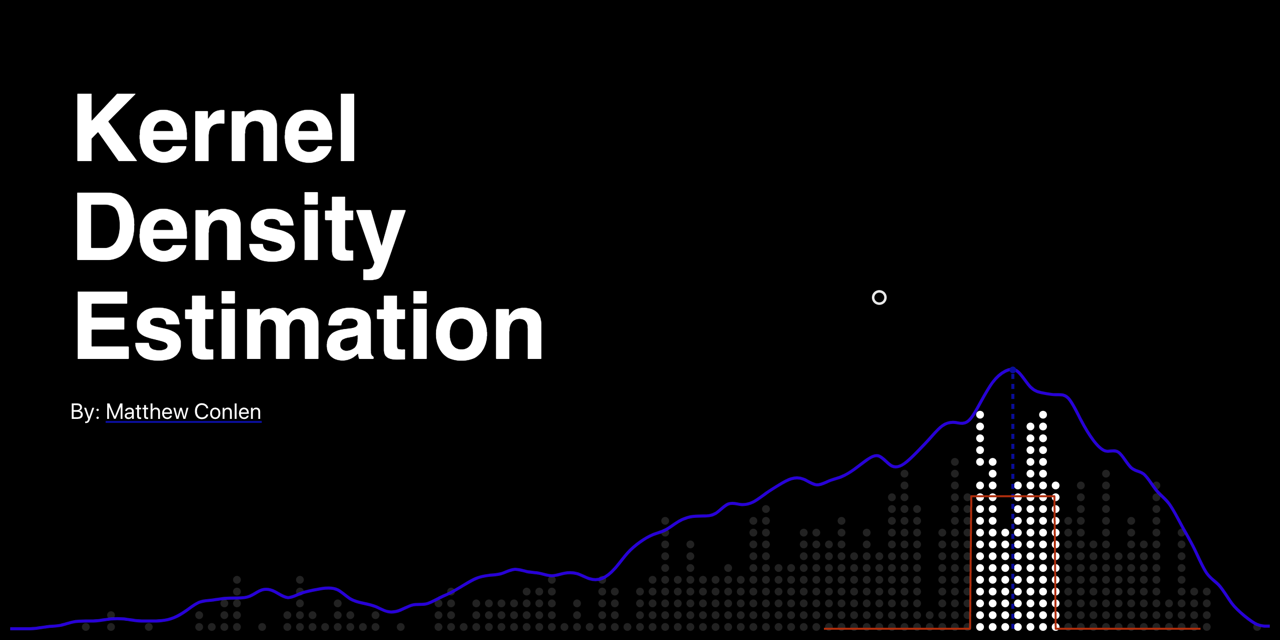
A useful statistical tool that sounds scarier than it is.
How to intuitively explain what a kernel is?
Many machine learning classifiers (e.g. support vector machines) allow one to specify a kernel. What would be an intuitive way of explaining what a kernel is? One aspect I have been thinking of is...

MLDemos - A visualization tool for machine learning
An Introduction to Statistical Learning
As the scale and scope of data collection continue to increase across virtually all fields, statistical learning has become a critical toolkit for anyone who wishes to understand data. An Introduction to Statistical Learning provides a broad and less technical treatment of key topics in statistical learning. This book is appropriate for anyone who wishes to use contemporary tools for data analysis.
Optimal and Diffusion Transports in Machine Learning
Slides for a general introduction to the use of Optimal Transport methods in learning, with an emphasis on diffusion models, flow matching, training 2 l…

Datasheets for Datasets
The machine learning community currently has no standardized process for documenting datasets, which can lead to severe consequences in high-stakes domains. To address this gap, we propose...

Kernel Probes (Kprobes) — The Linux Kernel documentation
Kprobes enables you to dynamically break into any kernel routine and collect debugging and performance information non-disruptively. You can trap at almost any kernel code address [1], specifying a handler routine to be invoked when the breakpoint is hit.
Introducing @huggingface/kernels: 200+ WebGPU Kernels for Local AI
We’re on a journey to advance and democratize artificial intelligence through open source and open science.

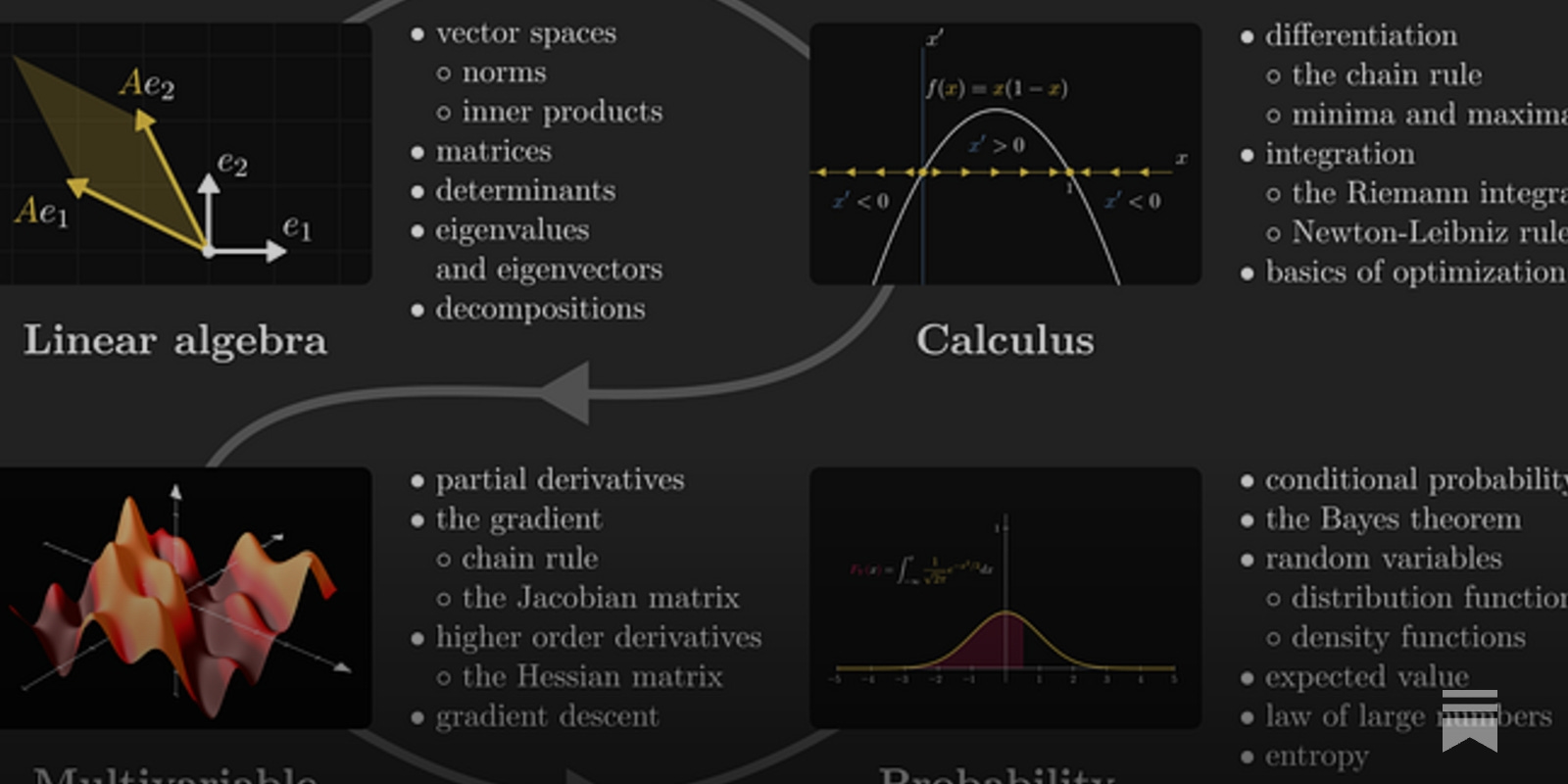
The Roadmap of Mathematics for Machine Learning
A complete guide to linear algebra, calculus, and probability theory
DiffusionGemma as Jev: Open-Source vLLM Patch (2026) | explainx.ai Blog
A vLLM contributor built an open-source Jev clone using DiffusionGemma — roughly matching TypeSafe's proprietary model on accuracy.
Squiggle
A simple programming language for intuitive probabilistic estimation
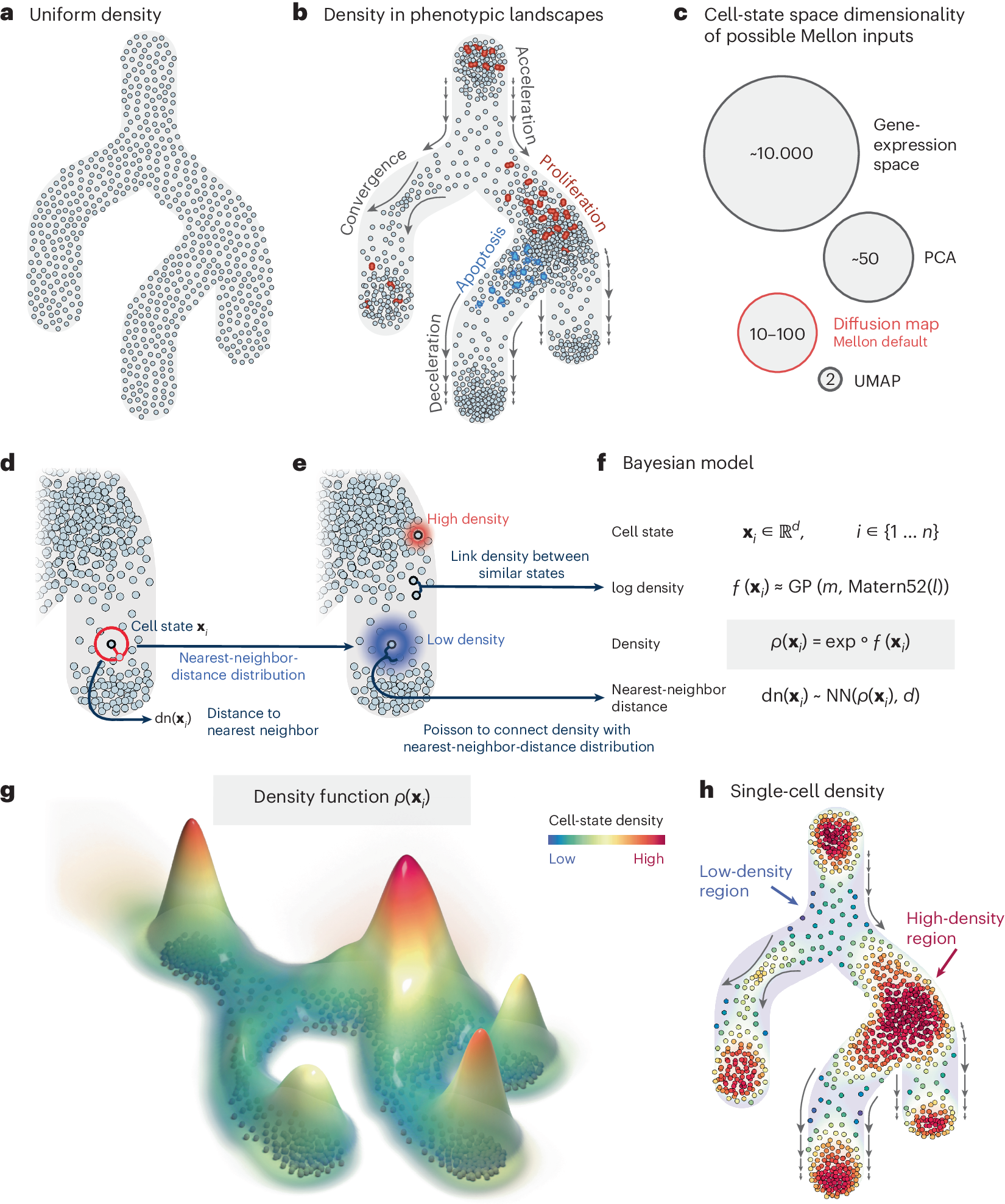
Quantifying cell-state densities in single-cell phenotypic landscapes using Mellon
Cell-state density characterizes the distribution of cells along phenotypic landscapes and is crucial for unraveling the mechanisms that drive diverse biological processes. Here, we present Mellon, an algorithm for estimation of cell-state densities from high-dimensional representations of single-cell data. We demonstrate Mellon’s efficacy by dissecting the density landscape of differentiating systems, revealing a consistent pattern of high-density regions corresponding to major cell types intertwined with low-density, rare transitory states. We present evidence implicating enhancer priming and the activation of master regulators in emergence of these transitory states. Mellon offers the flexibility to perform temporal interpolation of time-series data, providing a detailed view of cell-state dynamics during developmental processes. Mellon facilitates density estimation across various single-cell data modalities, scaling linearly with the number of cells. Our work underscores the importance of cell-state density in understanding the differentiation processes, and the potential of Mellon to provide insights into mechanisms guiding biological trajectories.
DaisyDisk, the most popular disk space analyzer
Get a visual breakdown of your disk space in form of an interactive map, reveal the biggest space wasters, and remove them with a simple drag and drop.

DR Group
For high-dimensional data, dimensionality reduction (DR) methods have been invaluable tools for human understanding, as they can map datasets into two or three dimensions for visualization, providing an intuitive way to understand the data. In recent years, tons of DR methods for data visualization have been proposed, and some are much better than others. In this blog post, we explore several DR methods, discuss how to determine which methods are effective, and explain why some are better than others.
Poisoning Attacks against Support Vector Machines
We investigate a family of poisoning attacks against Support Vector Machines (SVM). Such attacks inject specially crafted training data that increases the SVM's test error. Central to the motivation for these attacks is the fact that most learning algorithms assume that their training data comes from a natural or well-behaved distribution. However, this assumption does not generally hold in security-sensitive settings. As we demonstrate, an intelligent adversary can, to some extent, predict the change of the SVM's decision function due to malicious input and use this ability to construct malicious data. The proposed attack uses a gradient ascent strategy in which the gradient is computed based on properties of the SVM's optimal solution. This method can be kernelized and enables the attack to be constructed in the input space even for non-linear kernels. We experimentally demonstrate that our gradient ascent procedure reliably identifies good local maxima of the non-convex validation error surface, which significantly increases the classifier's test error.
Correcting the Measurement Errors of AI-Assisted Labeling in Image Analysis Using Design-Based Supervised Learning
Generative artificial intelligence (AI) has shown incredible leaps in performance across data of a variety of modalities including texts, images, audio, and videos. This affords social scientists the ability to annotate variables of interest from unstructured media. While rapidly improving, these methods are far from perfect and, as we show, even ignoring the small amounts of error in high accuracy systems can lead to substantial bias and invalid confidence intervals in downstream analysis. We review how using design-based supervised learning (DSL) guarantees asymptotic unbiasedness and proper confidence interval coverage by making use of a small number of expert annotations. While originally developed for use with large language models in text, we present a series of applications in the context of image analysis, including an investigation of visual predictors of the perceived level of violence in protest images, an analysis of the images shared in the Black Lives Matter movement on Twitter, and a study of U.S. outlets reporting of immigrant caravans. These applications are representative of the type of analysis performed in the visual social science landscape today, and our analyses will exemplify how DSL helps us attain statistical guarantees while using automated methods to reduce human labor.
