An elaboration of the previous post mentioning the bounded gaps between primes problem as an illustration of the opportunity cost of converting a fruitful problem such as this solely into a competitive benchmark. [Indeed, as I point out below, this already came close to happening back in 2013.] As with most other problems worth studying in pure mathematics, the particular bound one gets on these gaps is not of much intrinsic importance. Improving Zhang's bound of 70 million, to 246, 188, or 6 would not, in itself, have significant impact on any other mathematical problem, let alone any real-world application, except for a small number of other analytic number theory problems in which a related numerical bound would also similarly improve. Even the twin prime conjecture, which asserts that the bound can be chosen to be 2, would only unlock a small number of immediate applications if the result is taken as a "black box", although the significantly more general and quantitative prime tuples conjecture of Hardy and Littlewood would be more useful in this regard. But again: the value of this problem lies not in the numerical bound _per se_, but rather in what the quest to study this problem and improve the bound reveals. Let me first quickly review some key moments in the timeline on this problem. The Quanta articles https://www.quantamagazine.org/mathematicians-team-up-on-twin-primes-conjecture-20131119/ and https://www.quantamagazine.org/a-new-generation-of-mathematicians-pushes-prime-number-barriers-20231026/ in 2013 and 2023 respectively also do a good job of covering these events. (1/8)
98 out of 100. That's how many advanced maths problems current AI models managed to solve in an international benchmark in Leipzig. One of the two remaining problems? A simplified version of a… | Czech Technical University in Prague | 11 comments
98 out of 100. That's how many advanced maths problems current AI models managed to solve in an international benchmark in Leipzig. One of the two remaining problems? A simplified version of a combinatorics problem solved by researchers from the Faculty of Information Technology CTU in Prague. Alexander Clifton, Daniela Černá and Jan Volec, together with Bartołomiej Kielak from Universität Leipzig , found the solution to a simplified version of the long-standing open problem of breaking triples with permutations. The problem was later included among the 100 tasks used to test how today's AI models perform in advanced mathematics. While AI came remarkably close, this was one of the problems it couldn't solve on its own. A nice reminder that mathematical creativity and abstract reasoning still leave some room for humans. 🧠 🔗 Read the full story in the comments. | 11 comments on LinkedIn

Claude has improved on a longstanding lower bound for the fraction of zeros of the Riemann zeta function that satisfy the Riemann hypothesis
An unreleased Claude model improved the lower bound for the fraction of zeroes of the Riemann zeta function that satisfy the hypothesis, raising it from 41.6% to 67.2%.
Terence Tao (@tao@mathstodon.xyz)
I wrote recently about how the collection of good, fruitful open problems is now being mined in a non-renewable fashion, leading to the potential scenario of these problems becoming scarce. This may seem unintuitive at first, since the set of possible problems one could ask is infinite. Perhaps the following analogy can help: a country or region can suffer a critical shortage of drinking water while simultaneously being surrounded by a massive ocean. One can easily generate any number of open problems in mathematics at will, such as working out the 10^10^10th digit of pi. But the vast majority of such problems are not worth focusing attention on: they show no particular propensity to reveal any further insights or connections to other questions, or may either be too easy or too impossible relative to known techniques to learn anything from the exercise. (1/4)
Noam Brown on Twitter / X
And yes we did try other major problems without success. Sadly no Millennium Prize problems (yet).But also, we didn’t spend a lot on each problem. It’s possible to push test-time compute much further.— Noam Brown (@polynoamial) August 1, 2026
Przemek Chojecki | PC on Twitter / X
The Growing Map of Open Mathematical Problems.We mapped 15,000+ conjectures from UnsolvedMath to show potential links between concepts.It also shows how under formalized the frontier is (less than 10%). pic.twitter.com/nm0PCpXVPf— Przemek Chojecki | PC (@prz_chojecki) August 28, 2026

The sum-product conjecture is false for real numbers
We disprove the sum-product conjecture for real numbers by constructing arbitrarily large $A\subset \mathbb{R}$ (whose elements are algebraic integers in a number field of degree $\asymp \log\lvert A\rvert$) such that \[\max(\lvert A+A\rvert ,\lvert AA\rvert)\leq \lvert A\rvert^{2-c}\] where $c>0$ is an absolute constant. We also disprove the many sums and products conjecture by constructing, for any $k\geq 3$, arbitrarily large $A\subset \mathbb{R}$ such that \[\max(\lvert kA\rvert,\lvert A^{(k)}\rvert)\leq \lvert A\rvert^{C\frac{\log k}{\log\log k}}\] for some constant $C>0$. We obtain similar constructions for $p$-adics, finite fields, and function fields in positive characteristic, and also obtain new lower bounds for the number of solutions to linear equations in a multiplicative group and the number of solutions to the unit equation in sufficiently many variables.

Ten advances in mathematics and theoretical computer science
OpenAI shares new results on long-standing open problems in mathematics and theoretical computer science, including advances in geometry, cryptography, and complexity.
Terence Tao (@tao@mathstodon.xyz)
In traditional mathematics (or "Math 1.0"), a breakthrough proof of a long-standing open conjecture generates a large amount of subsequent activity and excitement in the field. The authors of the proof are invited to give many talks, and meet with other experts in the area. Workshops are set up to discuss the proof, as well as other recent developments. As a result, new connections and collaborations are formed, followup problems are shared, and other mathematicians (both junior and senior) are attracted to the field (including in some cases the authors themselves, if they initially came from a different subject). As a result of all this activity, the proofs naturally become digested, streamlined, placed in context with other results in the field, and ultimately become part of the textbooks and lecture notes for the next generation of mathematicians in the field. (1/4)
Can AI replace mathematicians? Vienna researchers weigh in
In September, OpenAI announced that some 10,000 AI agents partially 'solved' the Navier–Stokes problem, one of the most prestigious open challenges in mathematics. University of Vienna mathematicians Nathanaël Berestycki and Vera Fischer agree that the field will never be the same, but argue that maths is far more than producing proofs at speed.

OpenAI's Unreleased Model Astra Solves Ten Major Open Mathematics Problems
Math is hard.


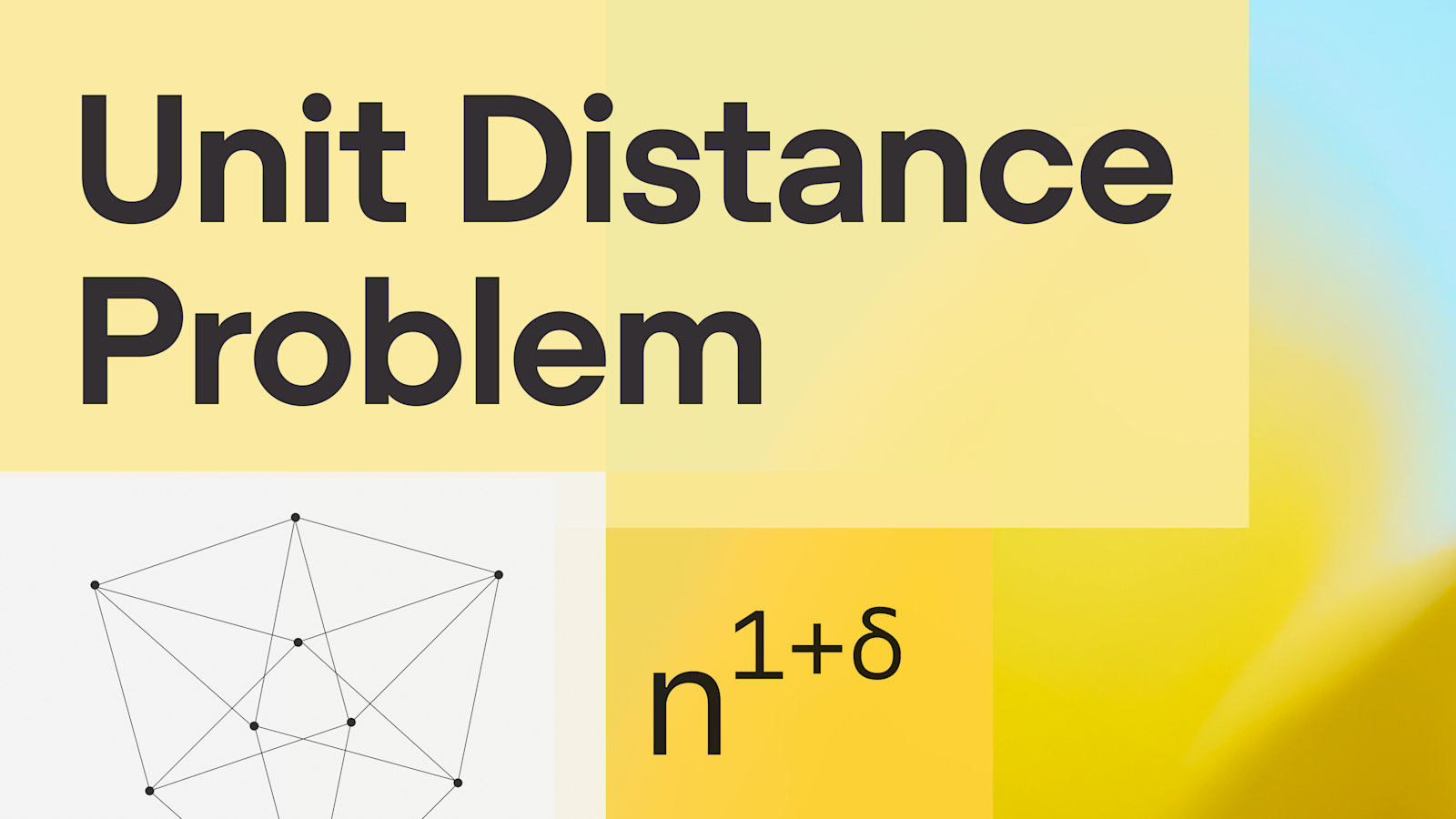
An OpenAI model has disproved a central conjecture in discrete geometry
An OpenAI model solved the 80-year-old unit distance problem, disproving a major conjecture in discrete geometry and marking a milestone in AI-driven mathematics.
Mathematics in the age of AI
An essay, based on a public lecture delivered at the 2026 International Congress of Mathematicians, on how the mathematical community might respond to the arrival of artificial intelligence tools that are capable of performing research-level mathematical tasks. Rather than debating the capabilities of such tools, we condition on the hypothesis that these capabilities will arrive, and examine instead a question that is orthogonal to it: what the goals and values of mathematical research actually are. The problem-solving component of mathematics is used as a case study.
Deedy on Twitter / X
The International Math Olympiad (IMO) 2026, the hardest math contest for high schoolers, just ended.I ran Fable (high), Sol (xhigh), K3 (max) and Axiom against it and all got a perfect score of 42/42 (repo below if you want to check their solutions):— Claude Fable 5 was the… pic.twitter.com/6oH7FiAjEP— Deedy (@deedydas) July 21, 2026

A big lesson of my China visit: compute shortages are holding back Chinese AI
One estimate suggests that OpenAI has about as much compute as the entire Chinese AI industry.
OpenAI unleashes hundreds more math results upon a field already in shock
A month after resolving one of the six biggest open problems in mathematics, the company says its new internal model has toppled heaps more—this time without the multimillion-dollar price tag