

Which is better for code reviews, a unified diff or a split diff?
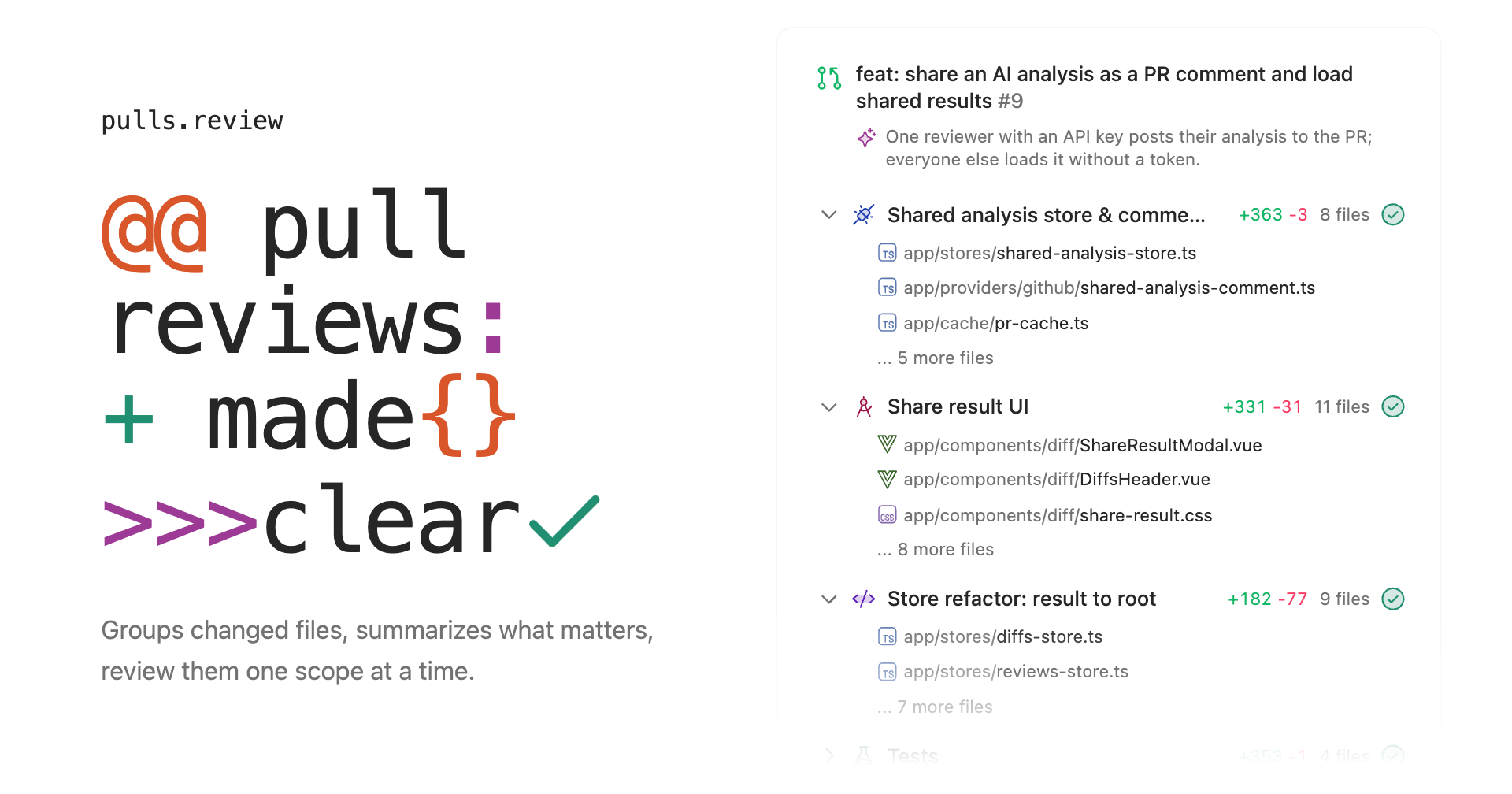
pulls.review
A better way to review a GitHub pull request’s diff: grouped, summarized, and fast.
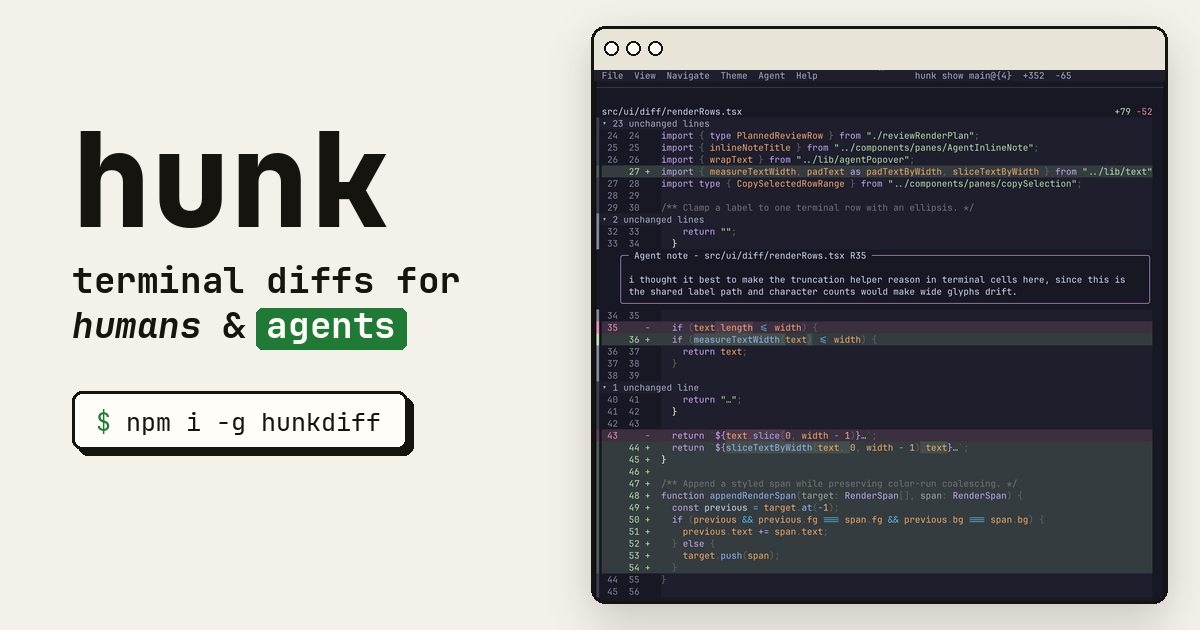
hunk — review-first terminal diff viewer
Hunk is a review-first terminal diff viewer for agent-authored changesets. Multi-file review stream, inline AI annotations, watch mode, and Git/Jujutsu integration.
On Rendering Diffs
A technical deep dive into how we built the @pierre/diffs package and CodeView component for zero-blanking diff rendering at any scale.
Better tools made Copilot code review worse. Here's how we actually improved it.
How migrating Copilot code review to shared Unix-style code exploration tools reduced review cost by reshaping agent workflows around pull request evidence.

Speeding up code review with `small-change`
Imprint’s average engineer is merging 4x more PRs than 2 years ago. Yay. Aggregated behind the average is something even more interesting: we have two teams that are merging 10x their PRs over that period. One engineer is merging 25x the PRs per week of our average engineer two years ago, and a number of others are closing in on that number. That’s pretty neat, and the slope of the line suggests our average in a year is going to look much closer to today’s p90 than today’s p50. Even more importantly, we aren’t just shipping more, our quality has improved: incidents are down 42% half-over-half, and critical incidents are down 78% half-over-half. I think we’ve always known the quality/velocity tradeoff wasn’t a particularly useful construct, but that’s undeniable today.


DiffsHub, from Pierre
View code changes from any public GitHub diff or patch URL with a super-freaking-fast, beautiful, and virtualized interface.
Humans approve intent, machines prove conformance
The pull request assumes a human wrote the diff. gittifacts is my attempt at a git platform for when agents write most of it.

Gerrit Code Review | Gerrit Code Review
The open source, patchset based, code review platform for Git-based development

AI Code Review | Greptile | Merge 4X Faster, Catch 3X More Bugs
AI Code Reviews that understand your entire codebase. Automate PR reviews, catch bugs faster, improve code quality with AI-driven analysis. Try Greptile free!
Meld
Meld helps you compare files, directories, and version controlled projects. It provides two- and three-way comparison of both files and directories, and has support for many popular version control systems.
