


There’s a blurry line between pattern matching and reasoning.
How do we bridge two worlds of math?
Performative Thinking? The Brittle Correlation Between CoT Length and Problem Complexity
Intermediate token generation (ITG), where a model produces output before the solution, has been proposed as a method to improve the performance of language models on reasoning tasks. While these reasoning traces or Chain of Thoughts (CoTs) are correlated with performance gains, the mechanisms underlying them remain unclear. A prevailing assumption in the community has been to anthropomorphize these tokens as "thinking", treating longer traces as evidence of higher problem-adaptive computation. In this work, we critically examine whether intermediate token sequence length reflects or correlates with problem difficulty. To do so, we train transformer models from scratch on derivational traces of the A* search algorithm, where the number of operations required to solve a maze problem provides a precise and verifiable measure of problem complexity. We first evaluate the models on trivial free-space problems, finding that even for the simplest tasks, they often produce excessively long reasoning traces and sometimes fail to generate a solution. We then systematically evaluate the model on out-of-distribution problems and find that the intermediate token length and ground truth A* trace length only loosely correlate. We notice that the few cases where correlation appears are those where the problems are closer to the training distribution, suggesting that the effect arises from approximate recall rather than genuine problem-adaptive computation. This suggests that the inherent computational complexity of the problem instance is not a significant factor, but rather its distributional distance from the training data. These results challenge the assumption that intermediate trace generation is adaptive to problem difficulty and caution against interpreting longer sequences in systems like R1 as automatically indicative of "thinking effort".
Operators
When building a Bonsai program, you chain together reactive operators to create new observable sequences. There are many different operators, which can create all kinds of observable sequences. These operators can be roughly grouped into different categories, depending on their shared characteristics.
Warnings for pattern matching
We examine the ML pattern-matching anomalies of useless clauses and non-exhaustive matches. We state the definition of these anomalies, building upon pattern matching semantics, and propose a simple algorithm to detect them. We have integrated the algorithm in the Objective Caml compiler, but we show that the same algorithm is also usable in a non-strict language such as Haskell. Or-patterns are considered for both strict and non-strict languages.

Compiling Higher-Order Specifications to SMT Solvers: How to Deal with Rejection Constructively | Proceedings of the 12th ACM SIGPLAN International Conference on Certified Programs and Proofs
We present a decision procedure that combines reasoning about datatypes and codatatypes. The dual of the acyclicity rule for datatypes is a uniqueness rule that identifies observationally equal codatatype values, including cyclic values. The procedure ...

VibeMathed - Math Problems Solved by AI
A community-curated record of math problems no human had solved before, proved or disproved with AI in the loop - with checkable sources and verification labels.
(PDF) Why is dialogical solving of a logical problem more effective than individual solving?: A formal and experimental study of an abstract version of Wason’s task
PDF | We study the accomplishment of the abstract version of Wason’s selection task in a cooperative dialogue context that has been neglected in the... | Find, read and cite all the research you need on ResearchGate

Functional Decision Theory — LessWrong
Functional Decision Theory is a decision theory described by Eliezer Yudkowsky and Nate Soares, an attempt at a logical decision theory, which says that agents should treat one’s decision as the output of a fixed mathematical function that answers the question, “Which output of this very function would yield the best outcome?”. It is a replacement of Timeless Decision Theory, and it outperforms other decision theories such as Causal Decision Theory (CDT) and Evidential Decision Theory (EDT). For example, it ends with better outcomes than CDT on Newcomb's Problem, ends better than EDT on the smoking lesion problem, and ends better than both in Parfit’s hitchhiker problem. In Newcomb's Problem, an FDT agent reasons that Omega must have used some kind of model of her decision procedure in order to make an accurate prediction of her behavior. Omega's model and the agent are therefore both calculating the same function (the agent's decision procedure): they are subjunctively dependent on that function. Given perfect prediction by Omega, there are therefore only two outcomes in Newcomb's Problem: either the agent one-boxes and Omega predicted it (because its model also one-boxed), or the agent two-boxes and Omega predicted that. Because one-boxing then results in a million and two-boxing only in a thousand dollars, the FDT agent one-boxes. External links: * Functional decision theory: A new theory of instrumental rationality * Cheating Death in Damascus * Decisions are for making bad outcomes inconsistent * On Functional Decision Theory by Wolfgang Schwarz See Also: * Timeless Decision Theory * Updateless Decision Theory * Superrationality * Introduction to Logical Decision Theory for Computer Scientists * Introduction to Logical Decision Theory for Economists * Introduction to Logical Decision Theory for Analytic Philosophers * An Introduction to Logical Decision Theory for Everyone Else

The last IMO problem AI could not solve
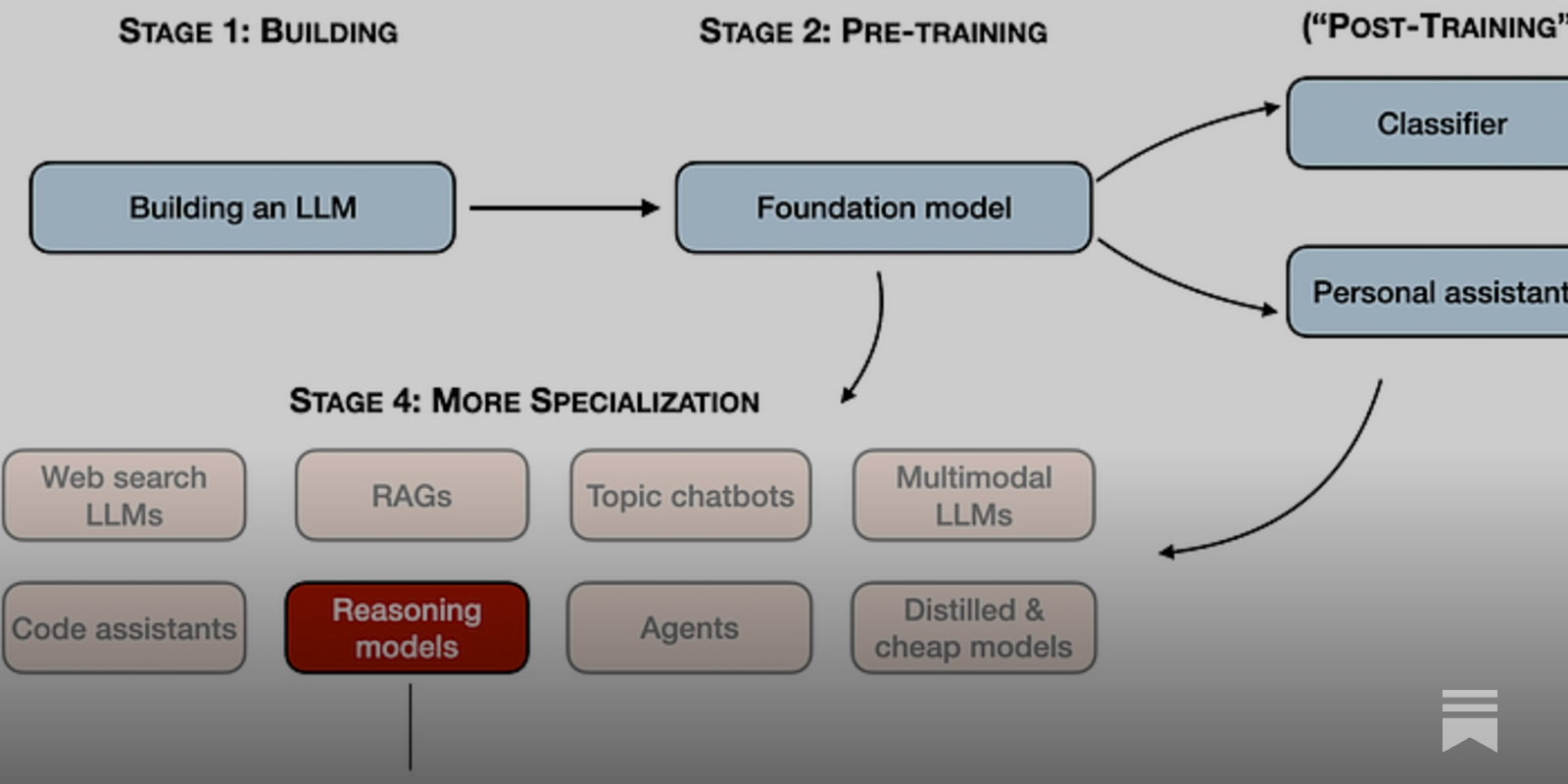
Understanding Reasoning LLMs
Methods and Strategies for Building and Refining Reasoning Models
Structured CoT: Shorter Reasoning with a Grammar File
Constrain only the think block with a tiny grammar. On Qwen3.6 coding evals, explicit reasoning gets 22x-43x shorter without losing pass@1 in these runs.
Advancing Mathematics Research with AI-Driven Formal Proof Search
Large language models (LLMs) increasingly excel at mathematical reasoning, but their unreliability limits their utility in mathematics research. A mitigation is using LLMs to generate formal proofs in languages like Lean. We perform the first large-scale evaluation of this method's ability to solve open problems. Our most capable agent autonomously resolved 9 of 353 open Erdős problems at the per-problem cost of a few hundred dollars, proved 44/492 OEIS conjectures, and is being deployed in combinatorics, optimization, graph theory, algebraic geometry, and quantum optics research. A basic agent alternating LLM-based generation with Lean-based verification replicated the Erdős successes but proved costlier on the hardest problems. These findings demonstrate the power of AI-aided formal proof search and shed light on the agent designs that enable it.
Mathematics with large language models as provers and verifiers
During 2024 and 2025 the discussion about the theorem-proving capabilities of large language models started reporting interesting success stories, mostly to do with difficult exercises (such as problems from the International Mathematical Olympiad), but also with conjectures [Feldman & Karbasi, arXiv:2509.18383v1] formulated for the purpose of verifying whether the artificial intelligence could prove it. In this paper we report a theorem proving feat achieved by ChatGPT by using a protocol involving different prover and verifier instances of the gpt-5 model working collaboratively. To make sure that the produced proofs do not suffer from hallucinations, the final proof is formally verified by the lean proof assistant, and the conformance of premises and conclusion of the lean code is verified by a human. Our methodology is by no means complete or exact. It was nonetheless able to solve five out of six 2025 IMO problems, and close about a third of the sixty-six number theory conjectures in [Cohen, Journal of Integer Sequences, 2025].
Nothing to see, just very powerful pattern matching. www-cs-faculty.stanford.edu/~knuth/papers/claude-cycles.p…
