


What is the deal with Rationalism and cults?
The Zizians and the Rationalist death cults
What is the deal with Rationalism and cults?
The Zizians and the Rationalist death cults
What is the deal with Rationalism and cults?
Who are the Zizians?
A cult-like group referred to as the Zizians is linked to a string of violent deaths across the U.S. It has its roots in Silicon Valley – and a movement called Rationalism. Who are these groups and what do they believe?

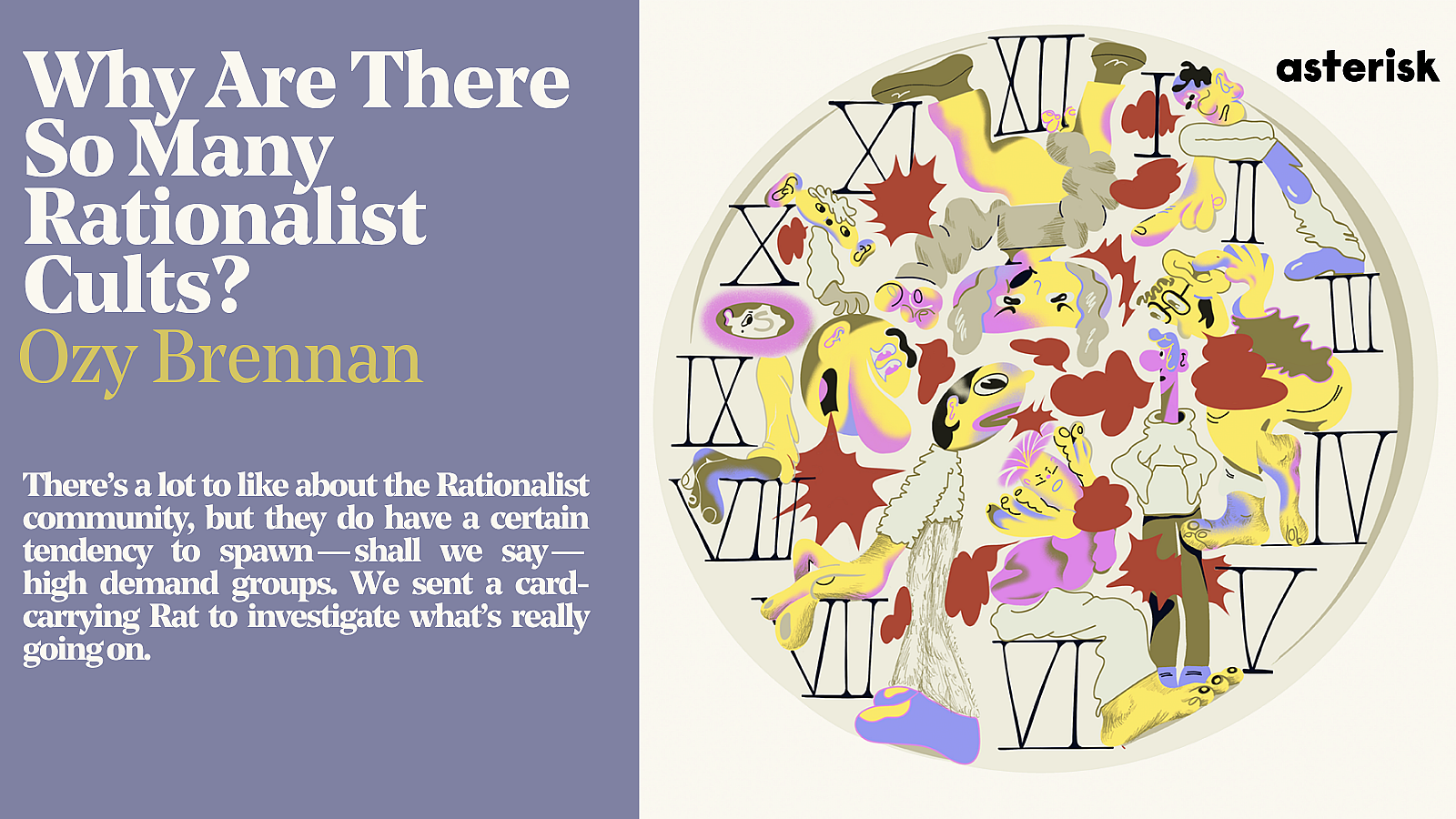
Why Are There So Many Rationalist Cults?
There’s a lot to like about the Rationalist community, but they do have a certain tendency to spawn — shall we say — high demand groups. We sent a card-carrying Rat to investigate what’s really going on.
Why it’s as hard to escape an echo chamber as it is to flee a cult | Aeon Essays
First you don’t hear other views. Then you can’t trust them. Your personal information network entraps you just like a cult

Methodology in Research on the Rainbow Body: Anthropological and Psychological Reflections on Death and Dying
The rainbow body research project, engaging claims of spiritual attainment and personal transformation, enables us to examine key features of anthropological research. Engagement with communities of discourse exposed aspects of the artificial emic–etic divide, allowing the anthropological study of religion to advance methods in religious studies. The study of paranormal phenomena cannot be isolated from societal contextualization. In this instance, a study of death and dying, contextualized in a traditional community, required unique features of engagement for the researcher who would be present to the social dynamics surrounding the death of a person of high repute.

The rationalists are not ok
Who, or what, are the rationalists? They are an internet-spawned sub-culture who ‘practice the art of rationality’. This means they spend lots of time thinking about topics like cognitive biases, Bayesian reasoning, probability and statistics, computer science, AI, decision theory, game theory, transhumanism, etc. Demographically they skew heavily toward STEM students from elite universities and tech guys in the bay area.

Effective Altruism Is a Dangerous Cult — Here's Why
Understanding the "Scientology of Silicon Valley." (7,700 words)

The sad decline of effective altruism
A once wholesome and inspiring movement has become entangled with cults and has lost years chasing dead-end ideas

The Ascendancy of the Scientific Dictatorship: An Examination of Epistemic Autocracy, from the 19th to the 21st Century
A. In the past, the elite manipulated the population through a more mystical belief system. In particular, there was the institution of Sun worship (typified by deities such as Osiris and Set). However, as antiquity gave way to modern history, this system of control began to lose its effectiveness. During the sixteenth century, the ruling class managed to co-opt a relatively new methodology of truth discernment...science. Over the years, they would contaminate this institution with their own virulent strains of thought...metaphysical naturalism, radical empiricism, Malthusianism, Darwinism, behaviorism, radical environmentalism, etc. Many of these paradigms were derivative of their own occult doctrines, thinly veiled to appear as objective science. All of these concepts correlate in some way and, at some point, coalesce. Together, they are gradually paving the way for the re-introduction of the hidden god of the Ancient Mysteries.
What Policymakers and the Public Need to Know About the Cult of AI
Nathalie Maréchal asks, why are we betting the economy and the future of democracy on cult-like beliefs?

npj on Twitter / X
Schumpeter in a nut shell:— Capitalism forces “rationalization” and the rationalist worldview, which just ends in an almost nihilistic skepticism that corrodes everything traditional that it touches: in particular “family life” and the aristocracy.— The traditional… pic.twitter.com/hThnUJ6jNE— npj (@TiltingatM3) May 28, 2026

Fascists Really Believe It
Millions could die because of ideas intellectually and morally equivalent to the ‘lizard people’ conspiracy theory.

Epstein and the Capitalist Conspiracy
Naomi Klein discusses what to do with a narrative that mirrors the worst anti-Jewish theories and the importance of holding our depraved elites…

Excuse me but this is cult behavior. And as a scientist, I have no business joining a cult. These personalized insults and intolerance for criticism are not scholarly virtues however you cut it. I do not understand or relate to it. What is my worth as a scholar if I do not value evidence over faith?
Rationalist Cults

Articles on rationalist-adjacent cults: the Zizians, Leverage Research, and the darker outgrowths of the rationalist / LessWrong-derived / Aella polycule scene that is behind "AI Safety" in Silicon Valley. Working thesis: MIRI and CFAR read as high-control groups (cults) who believe in P(DOOM) and use sex (and power) maliciously — yet they are unfortunately the ones who have captured the framing of "AI Safety," which has little to do with actual safety.

The Effective Altruism Kids Aren’t Alright

My Experience with Leverage Research
What Policymakers and the Public Need to Know About the Cult of AI
banteg (@banteg)

The Techno-Religion at the Center of the A.I. Debate

SE Gyges (@segyges.bsky.social)
