

Considerations for distributed and decentralized technologies from the perspective of a product that many would like to see decentralize....
Decentralization: Worth The Wait — Open Tech Strategies | Blog
Ethan Zuckerman has a piece in Wired that says building decentralization tools is a sucker's bet. He and his coauthors, Chelsea Barabas and Neha Narula, mention the FreedomBox, which I helped lead, as an example of how difficult this stuff is. They point to a list of things that make decentralized efforts prone to failure and conclude:
Ecosystem Mapping — Open Tech Strategies | Blog
All the power of open source comes from throwing in with your neighbors, even the neighbors you don't like very much. For most projects, the main reason to get involved in open source is to create productive relations with as many participants as possible, including rivals. Doing this well requires understanding who is in your ecosystem and how they relate to each other.
Ecosystem Review
A review of decentralized social media ecosystems published by Twitter's "bluesky" team on the 21st January 2021

Minimum viable decentralization – John Backus – Medium
If you want people to use your product, decentralize the bare minimum. Lessons from Freenet, I2P, Darknet markets, and Reddit.

Defining “Participatory Ecosystem” — Grow the Pie, N...
A blog on social software, collaboration, trust, security, privacy, and internet tools by Christopher Allen. Defining “Participatory Ecosystem” — Grow t...
Decentralisation: the next big step for the world wide web
The decentralised web, or DWeb, could be a chance to take control of our data back from the big tech firms. So how does it work and when will it be here?

Paradigm shifts for the decentralized Web
The answer to these questions varies with different degrees of decentralization:
Your platform is not an ecosystem
Another day, another exhortation to join an “ecosystem” that’s anything but. I could pick a hundred examples, but one that recently caught my eye was an ad placed in the Financial Times by the Singapore stock exchange, SGX Group, promising “multiple growth avenues, one trusted ecosystem”. SGX wants companies to list on its exchange rather than, say, the Hong Kong one which has more or less the same exclusive offer. SGX promises “access (to) Asia through our trusted ecosystem anchored in Singapore.” Ecosystems can be a lot of things. ‘Trusted’, by which they mean centrally policed to achieve defined, lower-risk outcomes, is not one of them. Calling built environments ‘ecosystems’ is common everywhere from financial services to supply chains to – quite a stretch, here – a retirement living complex. But it’s most often used in the tech world to describe the relations between software, services and hardware typically owned by a single company. For example, it’s how Google describes everything that hangs off the Android operating system. These kinds of proprietary and deterministic architectures are called ecosystems so often that we’ve stopped noticing. And that’s kind of the point. We need to start seeing this metaphor again, and what it’s hiding in plain sight. But first, a reminder of what an ecosystem actually is.
Centralization, Decentralization, and Internet Standards
Despite being designed and operated as a decentralized network-of- networks, the Internet is continuously subjected to forces that encourage centralization. This document offers a definition of centralization, explains why it is undesirable, identifies different types of it, catalogues limitations of common approaches to decentralization, and explores what Internet standards efforts can do to address it.
Protocol: How Control Exists after Decentralization
How Control Exists after DecentralizationIs the Internet a vast arena of unrestricted communication and freely exchanged information or a regulated, highly
Practical Decentralization
The point of decentralization is to guarantee the rights of individuals and communities on the Internet. Pulling that off is a balancing act between practicality and ideology.
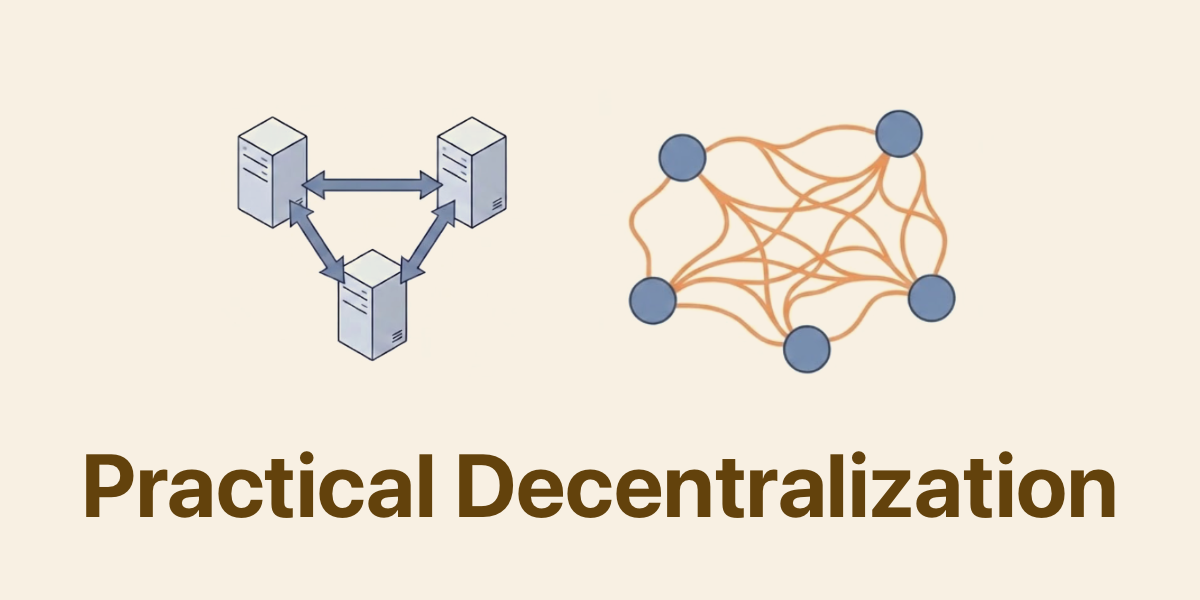
Practical Decentralization
The point of decentralization is to guarantee the rights of individuals and communities on the Internet. Pulling that off is a balancing act between practicality and ideology.
The Debate Over DWeb vs. Web3 & The Decentralized Elephant in the Room | FFDW
Comparing DWeb and Web3's approaches to decentralization, focusing on the key question: who designs, controls, and benefits from these technologies?

Networked Cooperative Ecosystems
Research TeamAndi Argast (Researcher), Nick Houde (Researcher), Dana Salama, (Researcher & Designer), Samuel Young (Network Mapping), Rithikha Rajamohan (Research Lead).
Decentralized Syndication — The Missing Internet Protocol
The Internet is decentralized by design. It came into being not at once, but in parts. New protocols were added on top of previous ones…
Actually I don't think #atproto is about decentralization. It's more about indexing over distributed data. @bsky.app and @tangled.org are actually a centralized service just like general web search engines are. But just like search engines, we don't own your content and this is the important part. 🧵

Theo
👀👀 To be clear I’m very into decentralized tech and atproto is very cool, I just don’t love shoving it into everything and don’t see it as valuable in a use case like GitHub I’m down to be convinced
