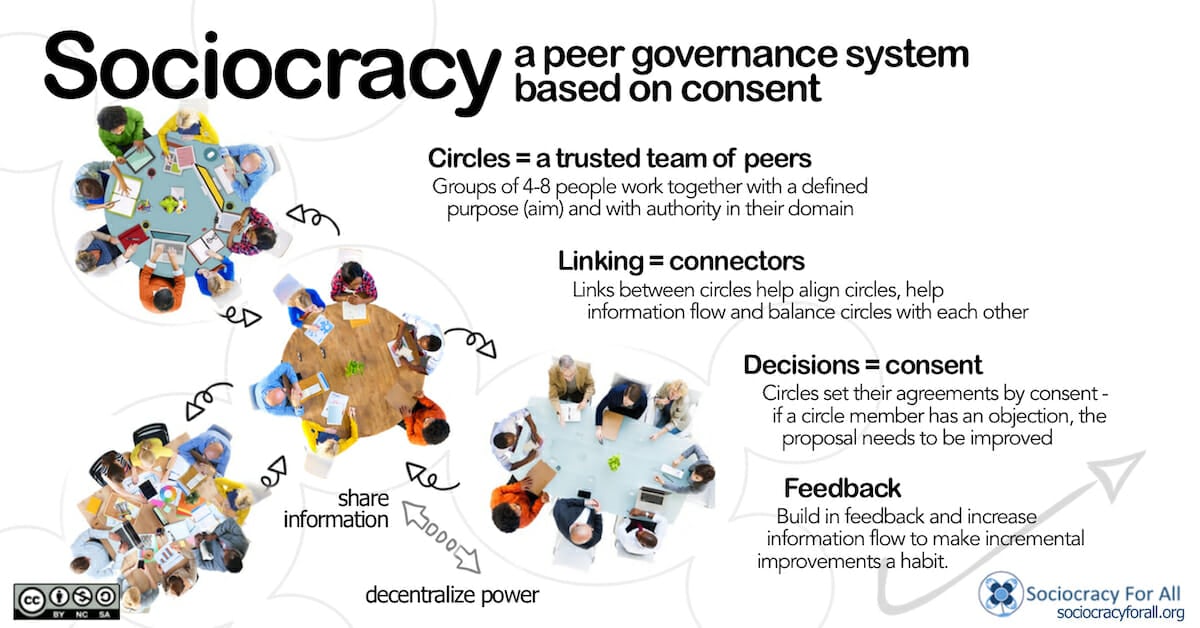
1. Introduction
Sociocracy - basic concepts and principles
Brief overview of sociocracy: basic concepts and principles, history, its use in organizations, its limits and differences to voting, consensus and hierarchical forms of organizing.
Comprehensive Sociocracy Books - Sociocracy For All
Sociocracy Books from Sociocracy For All: books to learn about circle structure, better meetings, consent decision making.

Who Decides Who Decides? - Sociocracy For All
Who Decides Who Decides is a book for starting groups with sociocracy - a guide for governance and decision-making that's clear and inclusive.

HoloChats: Matthew Schutte and Brian Robertson
"Collective Power: Patterns for a Self-Organized Future by Ted J. Rau" [english edition] (ebook) - Sociocracy For All
by Ted Rau Preorder Ebook
Sociocracy and Anarchism: Neither Gods nor Masters, but Systems and Structures - Sociocracy For All
Understand the similarities and the diferences between Sociocracy and Anarchism and how Systems and Structures can help.

Patterns for decentralized governance
Distilling the patterns of sociocracy as a governance protocol
Sociocracy and Nonviolent Communication (NVC)
What do Sociocracy and Nonviolent Communication (NVC) have in common? And how do they complement each other?

adhocracy+/adhocracy+ is launched
adhocracy+ is more than just a platform. With adhocracy+ digital democracy becomes easy: for everyone and everywhere. On 14 November, our guests were able to see for themselves how they can use adhocracy+ for their projects in NGOs, municipalities or politics.

Prism Political Quiz
Prism Political Quiz attempts to provide you with the breakdown of your ideology in 6 dimensions: Government, Economy, Society, Religion, Security, and Foreign Policy. Unlike many other quizzes, rather than giving you Agree/Disagree questions, it gives you a number of statements and asks you to pick the one that best represents your views. This ideally gives a better chance to show your reasoning for a particular view that allows differentiating someone who opposes democracy because they believe in monarchy from someone who disagrees with it because they believe in anarchy, for example. Additionally, each question has an option for apathy or disagreeing with everything, to allow it to even capture the beliefs of people who believe in very unique ideologies.
Conclave Democracy
What divine authority can teach us about democratic principles.

Time and the Neo-Monarchist Turn
One of the classical arguments against democracy concerns its supposed short-termism. Early-modern political thought contrasted the pitfalls of elected authority, whose timebound character was seen to invite inconstancy, instability and plunder, with the merits of indefinite rule on the model of kingship. Such reasoning has seen two revivals in recent years, first in a neo-liberal form as an argument for technocracy (see independent central banking), second in a neo-reactionary form as an argument for an all-powerful executive or ‘monarch’ (see the contemporary international far Right). This article looks at the structure of these political arguments and the work they do. Having reconstructed their historical background, it charts how the neo-monarchist turn marks a radicalisation in democracy-scepticism, guided by a patrimonial logic of authority as property ownership. The article goes on to examine the political-economic factors to which this responds, as well as the contradictions to which neo-monarchism is prone. As the article concludes, temporal arguments for authoritarian politics may be dubious in substance but merit careful observation in a context of widespread disaffection with existing institutions.


“Few societies can so conspicuously lack those judicial, administrative, and political procedures which lie at the heart of the western conception of government. The traditional northern Somali political system has no chiefs to run it and no formal judiciary to control it. Men are divided amongst political units without any administrative hierarchy of officials and with no instituted positions of leadership to direct their affairs.” (Lewis 1961 p. vii)
Whitepaper — The Collective Intelligence Project
I. Capitalist Acceleration: Sacrificing safety for progressII. Authoritarian Technocracy: Sacrificing participation for safetyIII. Shared Stagnation: Sacrificing progress for participation