


(And how to maximize your chances of being noticed)

Highlights From Matt Mullenweg’s Q&A Session on Product Hunt
On September 22nd, Matt Mullenweg participated in a question and answer session on Product Hunt. Product Hunt is a site that lets users share and discover new products. In the session, Mullenweg an…


Platform Information Provision and Consumer Search: A Field Experiment
Despite substantial efforts to help consumers search in more intuitive ways, text search remains the predominant tool for product discovery online. In this paper, we explore the effects of visual and textual cues for search refinement on consumer search and purchasing behavior. We collaborate with one of the largest e-commerce platforms in China and study its roll out of a new search tool. When a customer searches for a general term (e.g., “headphones”), the tool suggests refined queries (e.g., “bluetooth headphones” or “noise-canceling headphones”) with the help of images and texts. The search tool was rolled out with a long-run experiment, which allows us to measure its short-run and long-run effects. We find that, although there was no immediate effect on orders or total expenditures, the search tool changed customers’ search and purchasing behavior in the long-run. Customers with access to the new tool eventually increased orders and expenditures compared to those in the control group, especially for non top-selling products. The purchase increase comes from more effective searches, rather than an increase in activity on the platform. We also find that the effect is not only driven by the direct value of suggested searches, but also by customers indirectly learning to perform more effective searches on their own.

How Target Figured Out A Teen Girl Was Pregnant Before Her Father Did
Target has perfected the technique of analyzing consumers' shopping habits to figure out who's pregnant. How can they send customers congratulatory coupons without freaking them out?

How Targeting Affects Customer Search: A Field Experiment
It has become common practice for retailers to personalize direct marketing efforts based on customer transaction histories as a tactic to increase sales. Targeted email offers featuring products in the same category as a customer’s previous purchases generate higher purchase rates. However, a targeted offer emphasizing familiar products could result in curtailed search for unadvertised products, as a closely matched offer weakens a customer’s incentives to search beyond the targeted items. In a field experiment using email offers sent by an online wine retailer, targeted offers resulted in decreased search activity on the retailer’s website. This effect is driven by a lower rate of search by customers who visit the site, rather than a lower incidence of search. There are several ways this could potentially hurt retailers and consumers, such as reduced cross-selling and fewer opportunities for customers to explore new products. This paper was accepted by Pradeep Chintagunta, marketing.

How to Track the People Tracking YOU
Measuring the Privacy Experience
How do you know that a product respects your privacy – other than by wading through the fine print? We’ve created a framework to measure the way people actually experience privacy in tech products.

How to Build Product Features Customers Actually Use
Build features that drive adoption, not backlog. A process for turning customer feedback into product features that move retention and growth.

Advertising as a Reminder: Evidence from the Dutch State Lottery
We show that advertising can act as a reminder for consumers who intend to buy a product. , Consumers who intend to buy a product may forget to do so because they suffer from limited attention. Therefore, they may value being reminded by an advertisement. This reminder effect of advertising could be important in many markets but is usually difficult to document. We study it in the context of buying a product that has existed for almost 300 years: a ticket for the Dutch State Lottery. This context is particularly suitable for our analysis because the product is simple, it is very well known, and there are multiple fixed and known purchase cycles per year. Moreover, radio and TV advertisements are designed explicitly to remind consumers to buy a lottery ticket before the draw. This can conveniently be done online. We develop an approach to distinguish reminder effects of advertising from other effects, such as conveying information about the size of the jackpot. The key idea is that reminder effects are short lived. We use minute-level advertising and online sales data and find that the reminder effect of advertising is strong. Reaching 1% of the population by a radio advertisement leads to an increase in online sales of 1.55% in the four hours after the advertisement is aired. For TV advertisements, the increase is 0.78%. We show that the effects generally last longer for radio advertisements. We also provide direct evidence that reminding consumers not only affects the timing of purchases but also leads to market expansion. Finally, we estimate a model of consumer behavior under limited attention to quantify the effect on total sales. We find that total sales would be 16.7% lower without the reminder effect of advertising and that shifting advertising to the week of the draw would lead to a 9.2% increase in sales. History: Puneet Manchanda served as the senior editor and Günter Hitsch served as associate editor for this article. Supplemental Material: A replication package with code and log files and an Online Appendix are available at https://doi.org/10.1287/mksc.2022.1405 .

Variety Effects in Mobile Advertising
Mobile app users are often exposed to a sequence of short-lived marketing interventions (e.g., ads) within each usage session. This study examines how an increase in the variety of ads shown in a session affects a user's response to the next ad. The authors leverage the quasi-experimental variation in ad assignment in their data and propose an empirical framework that accounts for different types of confounding to isolate the effects of a unit increase in variety. Across a series of models, the authors consistently show that an increase in ad variety in a session results in a higher response rate to the next ad: holding all else fixed, a unit increase in variety of the prior sequence of ads can increase the click-through rate on the next ad by approximately 13%. The authors then explore the underlying mechanism and document empirical evidence for an attention-based account. The article offers important managerial implications by identifying a source of interdependence across ad exposures that is often ignored in the design of advertising auctions. Furthermore, the attention-based mechanism suggests that platforms can incorporate real-time attention measures to help advertisers with targeting dynamics.

Why You Should Ignore Customer Feedback Sometimes
We’ve heard time and time again that one of the best ways to make sure your customers are happy with your products is to listen to what they tell you.

Brands using AI-generated influencers to promote products on social media
Investigation finds AI content that purports to show genuine customers, prompting calls for greater transparency

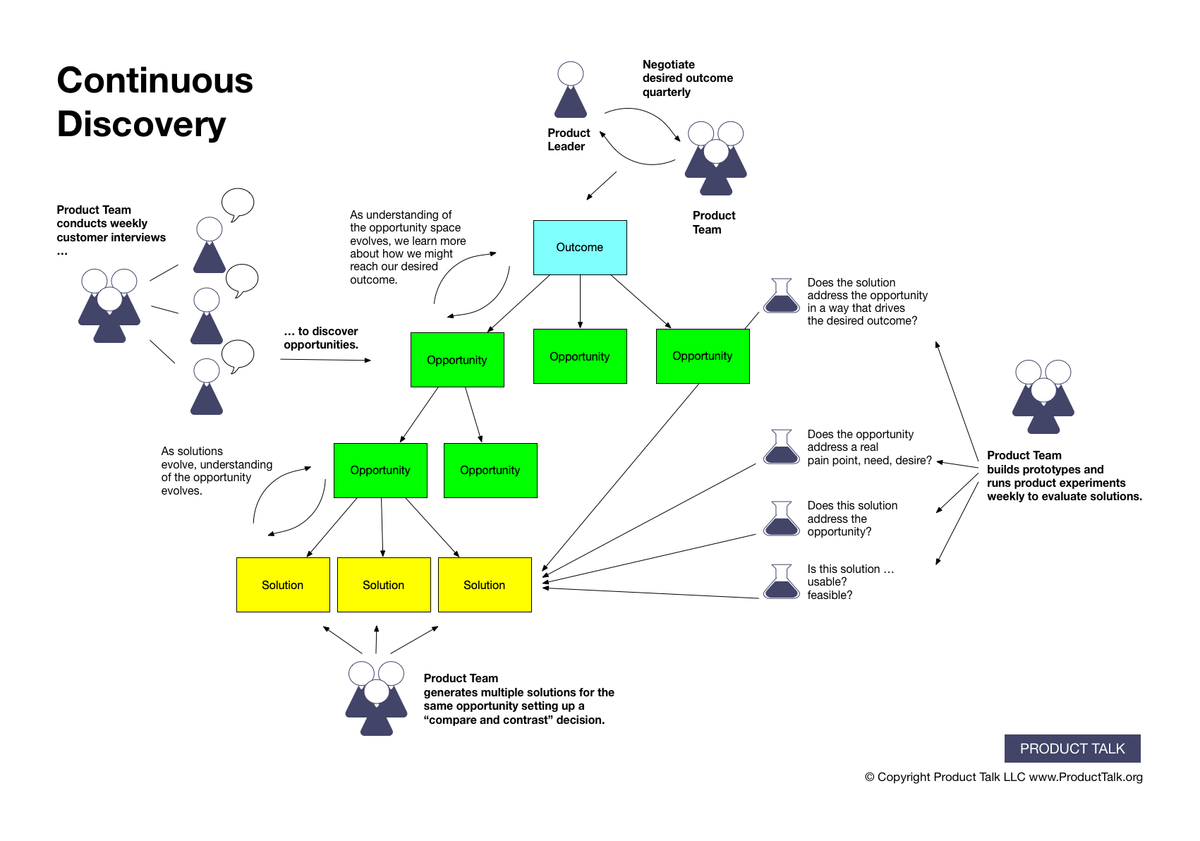
Continuous Discovery | Definition and Overview | Product Talk
Weekly touch points with customers by the team building the product, where they conduct small research activities in pursuit of a desired outcome.
blog 010: anne hero's online shopping guide
searching is: using a query to capture results. you can use boolean expressions to add constraints to your search. the problem is, sellers on secondhand e-commerce websites are not consistent in their listing title, descriptions, use of hard categories, and on e-commerce platforms ran by teenagers: knowledge. in order to see as much clothes as possible, you need to maximize how many listings you capture.
Bob Moesta - Jobs-to-be-Done Find Out the Why!