

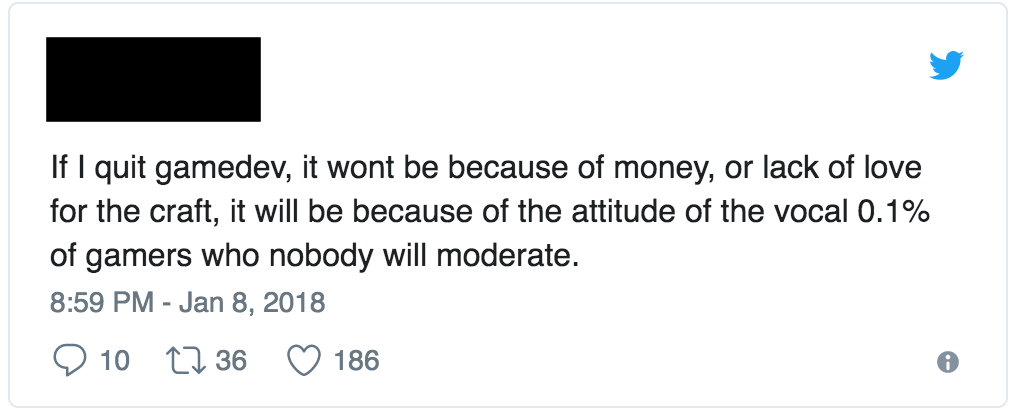
Content warning : I’ve embedded some tweets to various developers that show the sorts of comments that they receive every day. There’s some…
Building Games That Can Be Understood at a Glance

the Enshittification of Cozy Games
A speech about Free-to-Play game design
About a month ago, I gave a speech at Creative Mornings in Portland about the way the Free-to-Play business model affects game design. I compared games to television, looking at the way television business models have drastically affected the composition of those shows.
Blogs recent news | Game Developer
Explore the latest news and expert commentary on Blogs, brought to you by the editors of Game Developer
Opinion | Twitter Has an Old Media Problem. Here’s a Solution. (Published 2016)
The company has become an indispensable news source for millions but as a business, it needs a white knight to swoop in.

OpenAI connects the Dots
With safety questions still swirling, the company introduces a more business-focused take on agents
The Press Release Is Dead — Use This Instead – Mike Butcher
I’m QUITE TIRED of dealing with MILLIONS of tech entrepreneurs (these days there are a HELL of a lot of you) and (some) PR people who have ZERO clue how to pitch me/TechCrunch/the media. Their pitches are long-winded and rambling. They ask if they could ‘send some more information’. Listen, I have no idea if it’s interesting or not until you send it! Many just ask me out to lunch or coffee. (Thanks, but I prefer hanging out with my *actual friends*). Even worse, they haven’t read this post or seen my presentation on how to deal with tech media. [2021 update: This is a basic outline for super-early startups. If you want something for Post Series A / later stage startups go here].
Tren Griffin on Twitter / X
Software isn't Ending.Hoping the expense of creating software creates pricing power has always been a triumph of hope over experience.If a software business doesn't have attributes like network effects that create pricing power, its life can be nasty, brutish and short. pic.twitter.com/yzTVAdG2xb— Tren Griffin (@trengriffin) June 2, 2024

Anonymous EA comments
After seeing some of the debate last month about effective altruism's information-sharing / honesty / criticism norms (see Sarah Constantin's follow-…

Rational Silence and False Polarization: How Viewpoint Organizations and Recommender Systems Distort the Expression of Public Opinion
Social media platforms are one of the most important domains in which artificial intelligence (AI) has already transformed the nature of economic and social interaction. AI enables the massive scale and highly personalized nature of online information sharing that we now take for granted. Extensive attention has been devoted to the polarization that social media platforms appear to facilitate. However, a key implication of the transformation we are experiencing due to these AI-powered platforms has received much less attention: how platforms impact what observers of online discourse come to believe about community views. These observers include policymakers and legislators, who look to social media to gauge the prospects for policy and legislative change, as well as developers of AI models trained on large-scale internet data, whose outputs may similarly reflect a distorted view of public opinion. In this paper, we present a nested game-theoretic model to show how observed online opinion is produced by the interaction of the decisions made by users about whether and with what rhetorical intensity to share their opinions on a platform, the efforts of viewpoint organizations (such as traditional media and advocacy organizations) that seek to encourage or discourage opinion-sharing online, and the operation of AI-powered recommender systems controlled by social media platforms. We show that signals from ideological viewpoint organizations encourage an increase in rhetorical intensity, leading to the rational silence of moderate users. This, in turn, creates a polarized impression of where average opinions lie. We also show that this observed polarization can also be amplified by recommender systems that, pursuant to a platform’s incentive to maximize engagement, encourage the formation of viewpoint communities online that end up seeing a skewed sample of opinion. Unlike existing models, these well-known online phenomena are not here attributed to distortion in the formation of opinions nor to the seeking out of like-minded others, but rather to the interaction of the incentives of users, viewpoint organizations, and platforms implementing recommender systems. In addition to showing how these interactions can play out in simulations, we also identify practical strategies platforms can implement, such as reducing exposure to signals from ideological viewpoint organizations and a tailored approach to content moderation.
Just shut up and let your devs concentrate, advises Stack Overflow CEO Joel Spolsky
If you want to attract and keep developers, don't emphasize ping-pong tables, lounges, fire pits and chocolate fountains. Give them private offices or let

I understand perfectly well. My questions concern the people behind the flood of content about W since we launched our beta in June. Who are they? Who funds them? What other financial interests might they have? And why is the site anonymous? Those are reasonable questions about transparency.
I do wish it was better understood by now—especially by folks in the media—that these "warnings" from large AI corporations in fact function as "advertisements" axios.com/2025/04/22/ai-anthropic-virtu…

Exclusive: Anthropic warns fully AI employees are a year away
www.axios.comI do wish it was better understood by now—especially by folks in the media—that these "warnings" from large AI corporations in fact function as "advertisements" axios.com/2025/04/22/ai-anthropic-virtu…
Exclusive: Anthropic warns fully AI employees are a year away
www.axios.com
