

The more I learn, the more I realize how much I don’t know. — Albert Einstein
why do we assume progress should feel good?
I can count on one hand the number of times I’ve achieved something and genuinely felt lasting satisfaction.

The Friction I Don't Want to Lose
I love learning. And while the friction of solving new problems is increasingly traded for speed, the experience gained by overcoming that friction is as important as ever.
When AI builds itself
Our progress toward recursive self-improvement, and its implications.


‘AI gravity’ is pulling you toward dependency. Here’s how to push back | MIT Sloan
AI systems hold the promise of competitive advantage, but they can usher in cognitive decline among workers, says MIT Sloan School of Management’s Eric So. Learn how to protect cognitive capital.
‘AI gravity’ is pulling you toward dependency. Here’s how to push back | MIT Sloan
AI systems hold the promise of competitive advantage, but they can usher in cognitive decline among workers, says MIT Sloan School of Management’s Eric So. Learn how to protect cognitive capital.
Wisdom in a World in Crisis: The Counterintuitive Need to Slow Down and Find Spaciousness with Iain McGilchrist
Speed: How It Explains the World - Vaclav Smil
In a world that feels like it’s moving faster than ever, Smil examines how our relentless pursuit of speed – in areas such as production, travel and communication – shapes not only our technological landscape but also our social and environmental realities. And through engaging anecdotes and striking statistics, Smil challenges the assumption that faster is always better.

The Development Economist Who Wasn’t
Once dismissed from the field he helped found, Albert O. Hirschman feels newly relevant.

Up and Down the Ladder of Abstraction
"In science, if you know what you are doing, you should not be doing it. In engineering, if you do not know what you are doing, you should not be doing it. Of course, you seldom, if ever, see either pure state."
Brett Scott (@brettscott)
Despite all the rhetoric about automation supposedly making our lives easier, the true story being told by Big Tech is that our lives are better when speeded up You are supposed to be in an ever-accelerating race, packing more units of experience into the same unit of time, a phenomenon that requires a contraction of patience and a blurring of experience as everything quickens In the end, this is what ‘convenience’ actually is. It’s a state of being in which you become disassociated and disengaged from the texture of the world around you. You pass through it dreamlike, and suddenly wake up decades years later as an elderly person on your deathbed, thinking “WTF happened”, as then the memory slips away

Why do some people always get lost?
Research suggests that experience may matter more than innate ability when it comes to a sense of direction
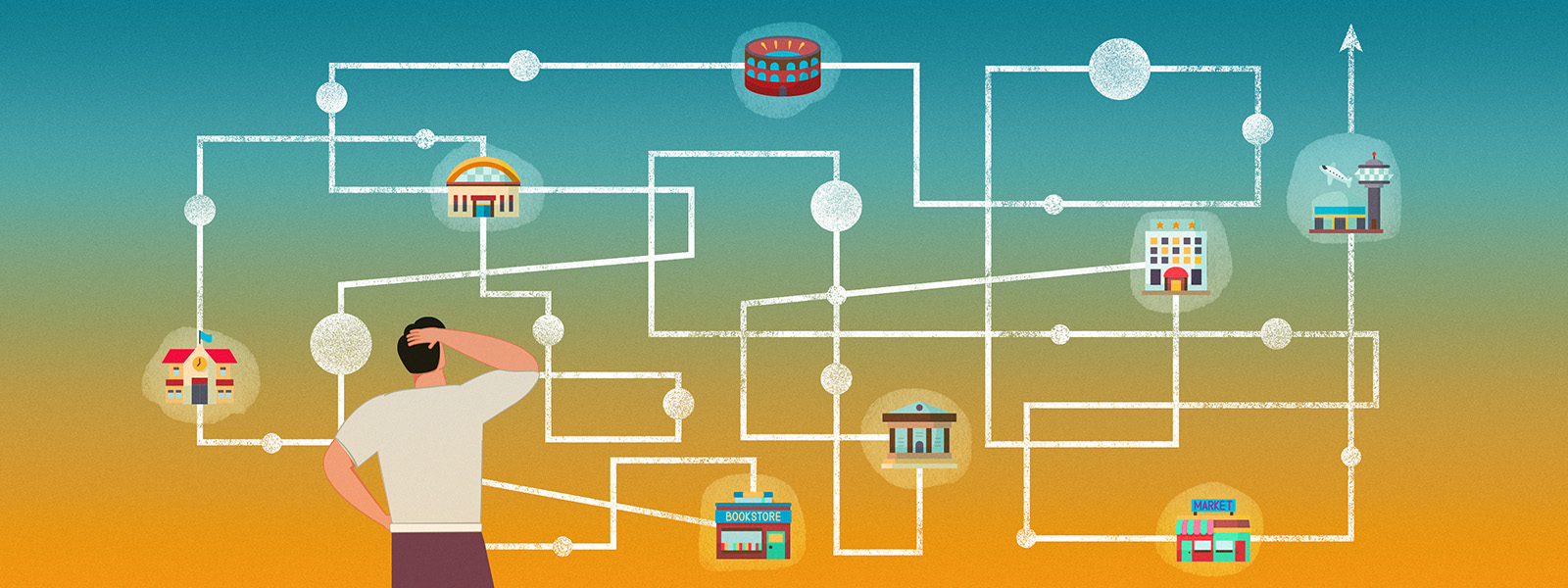
Ever thought we acquire generalizable knowledge by discarding details and compressing our experiences? In a new BBS paper, @sabinasloman.bsky.social and I argue otherwise, proposing a novel way of studying human learning inspired by double descent in ML. Disagree? Propose a commentary by May 15 :)
"There is a contrast between my biological development, confidently realizing its in-built norm, and my fumbling psychological development, realizing partially..one among many apparently possible orders .. Learning what to want is the most radical, the most painful and the most creative art of life"

