


Fixing the UX of hyperlinks User Interfaces should be predictable. Not like suspense thrillers where you don’t know what’s coming next. Users should be aware of the consequence of the actions …
The Subversive Hyperlink
Writing about the big beautiful mess that is making things for the world wide web.
What the ephemerality of the Web means for your hyperlinks
Hyperlinks are a powerful tool for journalists and their readers. Diving deep into the context of an article is just a click away. But hyperlinks are a double-edged sword; for all of the internet’s boundlessness, what’s found on the Web can also be modified, moved, or entirely vanished. The fragility of the Web poses an […]

No Longer No Sense of an Ending
This is my first feature piece on Contents Magazine, about harnessing the properties of hypertext and the Web for superior reader experiences and business results.
On Link Rot
The web suffers from link rot: hyperlinks that were valid upon creation will often point into nothingness after some time has passed. Within the framework of the web, the typical solution is to link to a snapshot of the original page, hosted on archive.org.
On Link Rot
The web suffers from link rot: hyperlinks that were valid upon creation will often point into nothingness after some time has passed. Within the framework of the web, the typical solution is to link to a snapshot of the original page, hosted on archive.org.
Disaster, doubt, and the origins of hypertext
Hypertext and the World Wide Web are built on a complex network of ideas that originate in the military and ecological disasters of the short 20 th Century, 1914--1989, and in a world-spanning intellectual effort to prevent their recurrence. Though that effort now appears to have failed, and though the tragic story of the 20 th Century has not, it seems, concluded, we may learn profit by examining the concepts and ideals on which hypertext was built.

Freeing the Web from the Browser | reinterpretcast.com
The Web is, without a doubt, the most powerful research tool currently available to man. No longer must researchers comb through endless indices and catalogues to find what they are looking for. Instead, hyperlinks allow users to associatively explore rich interconnected structures of information with ease. In just a few clicks, it is possible to navigate through a vast global space of information comprising documents on virtually any subject.
LN 040: The venerable hyperlink
Decades after hyperlinks transformed humanity's information and text into a densely-linked graph, mainstream OSs have yet to afford users their benefits in personal computing.
On folders, broken links, and Bill Gates' biggest mistake
Files and folders are holding us back. There has to be a better way.
Vision and Reality of Hypertext and GUIs: 2.1.13 Microcosm @mprove
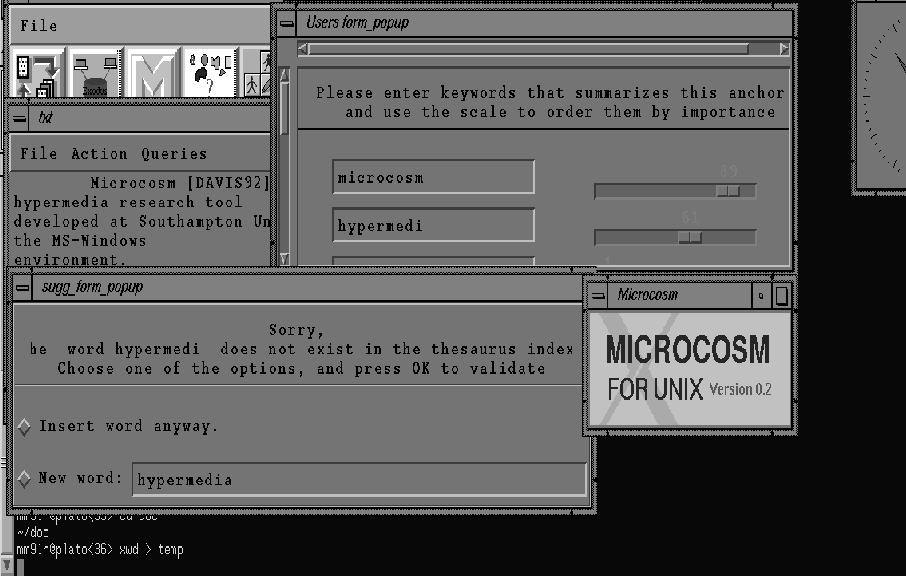
Microcosm (cf. 2.1.13) is a research project at the University of Southampton. Like Intermedia five years before, Microcosm is designed around the idea that material of diverse sources and formats should be tied together into one hypertext. To achieve this goal links have to be separated from the documents. They are stored and maintained in special link databases. In contrast to Intermedia, Microcosm plays the active role in gathering the necessary data out of the documents. For each topic it stores data on which documents contain information about it and also where inside the documents the information is located. This elaborated conception of links can be seen more as a kind of Memex’ trails than simple one-to-one links. Given this structure dynamic linking becomes possible. This means that links can be associated with generic text strings. Wherever this string shows up a link is placed automatically. This has the effect that documents that are imported for the first time into Microcosm can have links immediately.
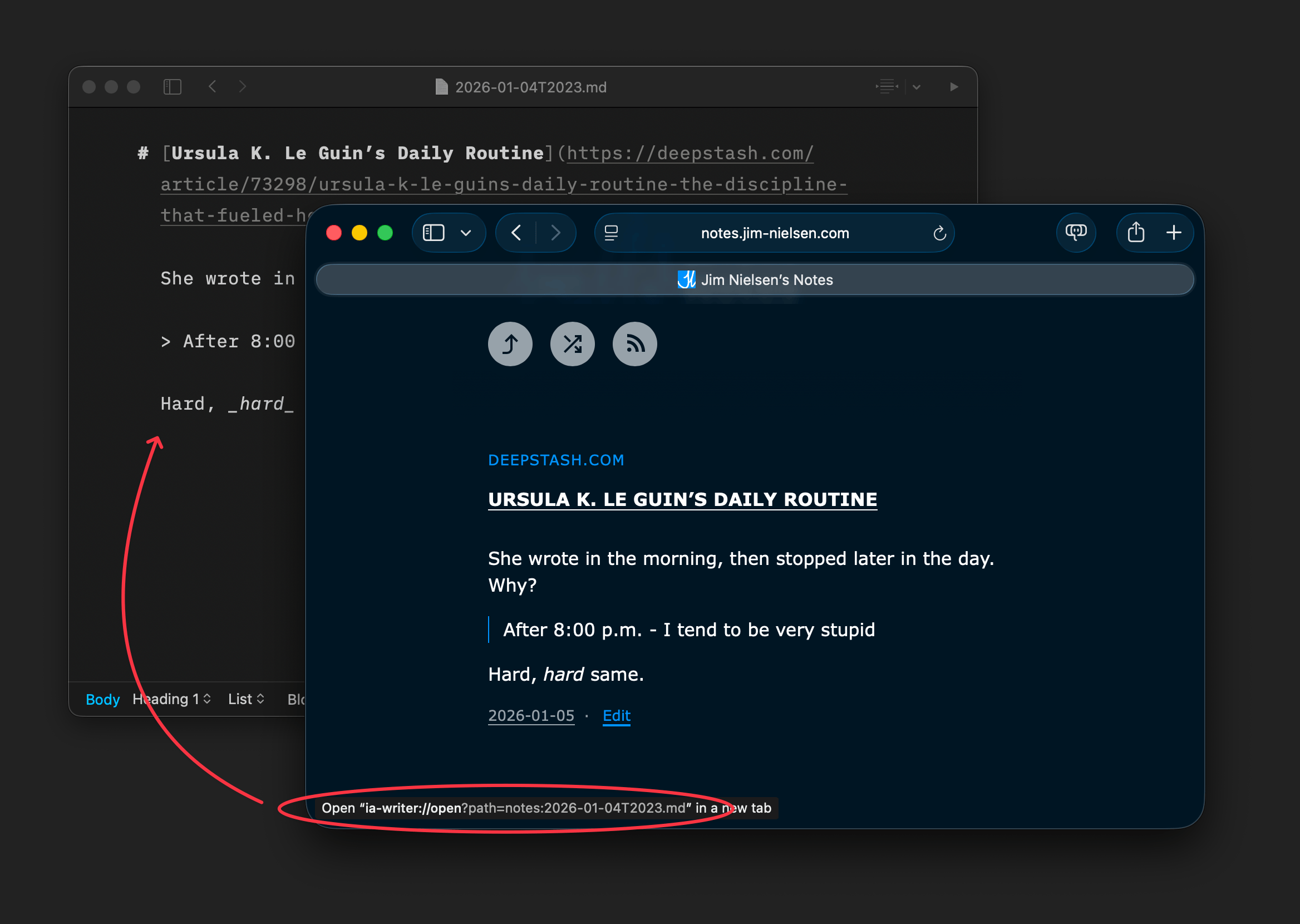
Creating “Edit” Links That Open Plain-Text Source Files in a Native App
Writing about the big beautiful mess that is making things for the world wide web.
Hypermedia Systems
The revolutionary ideas that empowered the Web. A simpler approach to building applications on the Web and beyond with htmx and Hyperview. Enhancing web applications without using SPA frameworks.
The Missing Building Blocks of the Web
At a time when millions are losing trust in the the web’s biggest sites, it’s worth revisiting the idea that the web was supposed to be…

Building on some of @chrisshank.com's work, what if we had browsers that were atproto-native? orange link = in your PDS green link = in the PDS of someone you follow Dreaming about the future of social hypertext ✨

𝕮
A web extension that colors any link you've saved on @semble.so orange.

