

Since my internet foo failed me, and the only workable example of a H2C client I can find was in the actual go test suite I’m going to lay…
Add Go 1.24+ native H2C support examples by AndrianBdn · Pull Request #6 · thrawn01/h2c-golang-example
Starting from Go 1.24, HTTP/2 Cleartext (H2C) is supported natively in the standard library, eliminating the need for golang.org/x/net/http2/h2c package or workarounds. Since this repository ranks ...

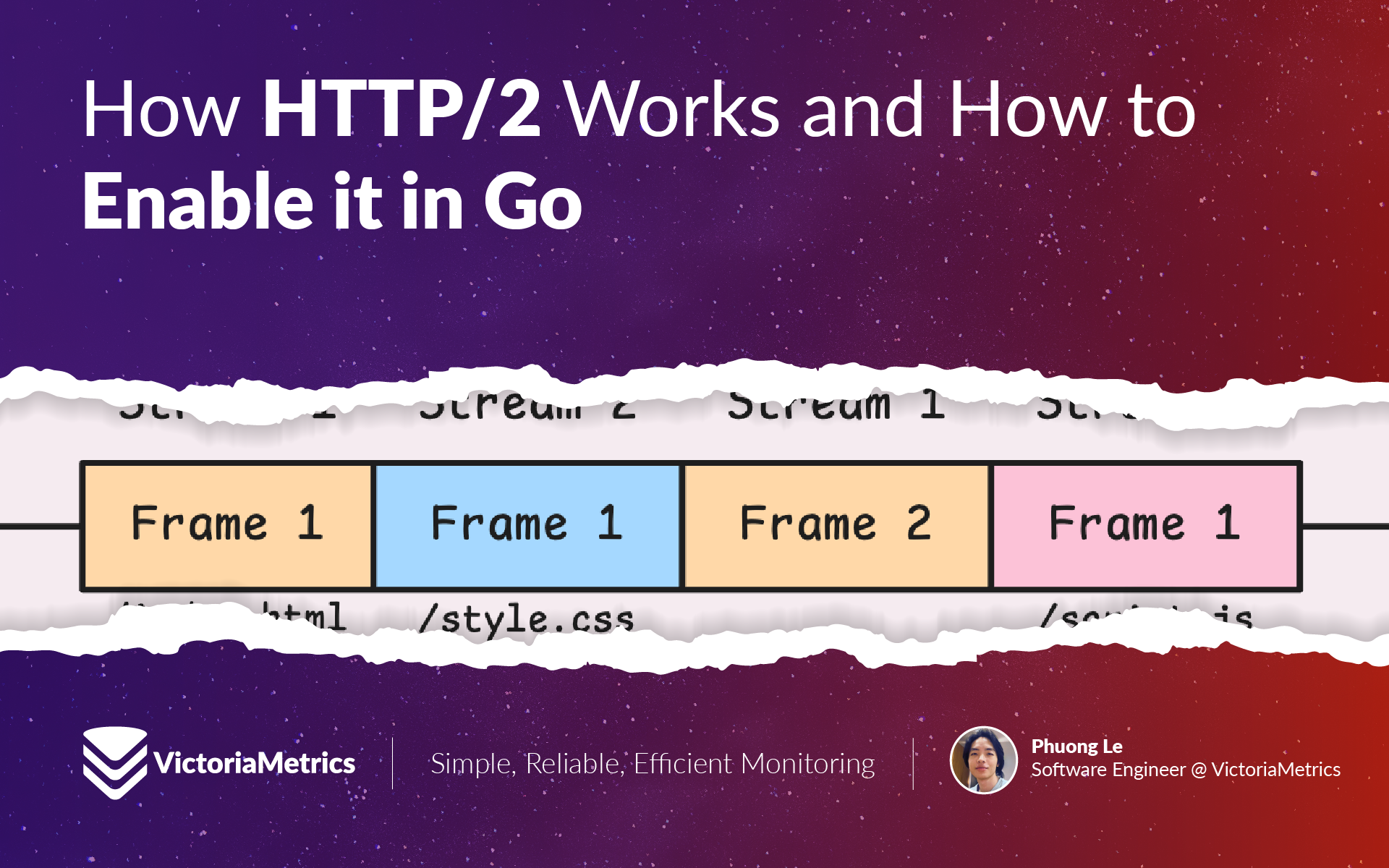
How HTTP/2 Works and How to Enable It in Go
HTTP/2 solves head-of-line blocking at the application layer by multiplexing multiple streams over a single TCP connection. While HTTP/1.1 requires requests to be processed sequentially, HTTP/2 allows parallel processing through independent streams, each with its own ID. The Go standard library supports HTTP/2 out of the box when using HTTPS, and with some configuration, it can work over plain HTTP too
http2/errors.go - net - Git at Google
What canceled my Go context?
How Go 1.20's WithCancelCause and Go 1.21's WithTimeoutCause let you attach a reason to context cancellation, plus a gotcha with manual cancel and the stdlib pattern that covers every path.

Go and wasm: generating and executing wasm with Go
Today we will see how we can interact with WebAssembly, from Go: how to execute WebAssembly bytecode from Go and how to generate WebAssembly bytecode with Go.
Lightweight gRPC on the Go Standard Library
Sidecar is a tiny Go package that can be used to make clients and servers that use the gRPC wire protocol.
Go 1.7 is released - The Go Programming Language
Go 1.7 adds faster x86 compiled code, context in the standard library, and more.
HTTP Semantics
The Hypertext Transfer Protocol (HTTP) is a stateless application-level protocol for distributed, collaborative, hypertext information systems. This document describes the overall architecture of HTTP, establishes common terminology, and defines aspects of the protocol that are shared by all versions. In this definition are core protocol elements, extensibility mechanisms, and the "http" and "https" Uniform Resource Identifier (URI) schemes. This document updates RFC 3864 and obsoletes RFCs 2818, 7231, 7232, 7233, 7235, 7538, 7615, 7694, and portions of 7230.
Just Fucking Use Go - Blain Smith
Hey, dipshit. You know what compiles in two seconds, deploys as a single binary, and doesn't shit itself when a transitive dependency gets yanked from npm at 3am? Go. The same way HTML has been sitting there since the dawn of the goddamn internet waiting for you to stop overcomplicating the frontend, Go has been sitting there for over a decade waiting for you to stop overcomplicating the backend.
Launch HN: Browser Use (YC W25) – open-source web agents | Hacker News
Check out this video to see it in action: https://preview.screen.studio/share/r1h4DuAk. There are lots more demos at https://github.com/browser-use/browser-use on how we control the web with prompts.
Building a simple load balancer in Go
Load balancers are crucial in modern software development. If you've ever wondered how requests are...


Go Web Programming
Build scalable, high-performance web apps in Go with modern design principles.

fun new little websocket client published under @atproto/ws-client. works in the browser or server-side. designed for long-lived connections and reconnects. care taken with flow control and backpressure. because, you know... atproto go wsssshh. tangled.org/strings/did:plc:l3rouwludahu3…
