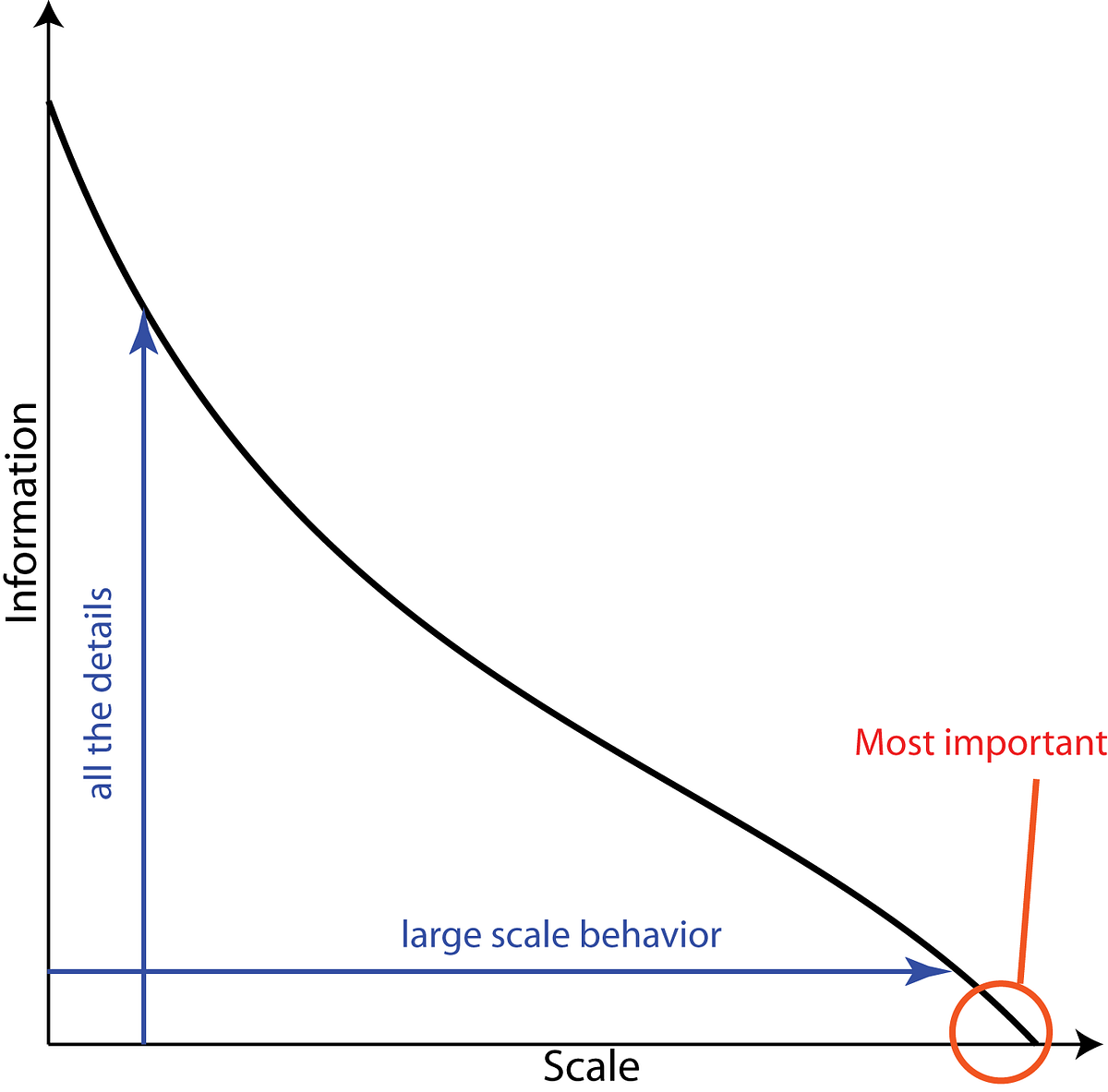
When we observe the largest scale behaviors of a system, we simplify the mathematical description of the system because there are fewer…
1.1 Separation of Scales: Why complex systems need a new mathematics
One of the central insights about complex systems is that the effect of dependencies among components cannot be fully represented by…

1.3 Representations and Information as a Function of Scale
A representation is a map of a system onto mathematical variables. More correctly, a representation should be understood as a map of the…
An Information-Theoretic Formalism for Multiscale Structure in Complex Systems — New England Complex Systems Institute
In searching for sense in the complexities of nature, science has often found success by identifying common aspects of diverse phenomena. When one principle explains how different things behave, nature becomes more comprehensible, and more manageable. Modern science took flight when Newton showed how one idea – universal gravitation – explained both the motions of celestial bodies and apples falling on Earth. Most important, it didn’t matter whether the apple was red or green, or even if it was an apple. Newton’s law described how everything else fell, from bricks to bullets. But Newton’s gravity, and his laws of motion, and the rest of science built on that foundation had limits. Newton’s science couldn’t cope with really strong gravity, extremely fast motion or supertiny particles. Relativity theory and quantum physics helped with that. But there remains a realm where standard science has struggled to find unifying principles among different behaviors. That would be the kingdom of complexity, the universe of systems that defy simplification. Such complex systems are everywhere, of course. Some are physical — the electric power grid, for instance. Many are biological — brains, bodies, ecosystems. And others are social — financial markets, interlocking corporate directorates, and yes, for God’s sake, Twitter. It’s hard to find simple scientific principles from which to deduce all the multifaceted things that such complex systems do. But there is, for sure, one thing that they do all have in common. They all have a structure. And it’s by quantifying structure, three scientists suggest in an intriguing new paper, that complexity can be tamed...

1.2 Revolution in Physics: Theory-experiment contradiction and multiscale insight
The importance of multiscale ideas is apparent in an approach developed in statistical physics beginning in the 1970s anchored in the…

Weirding Diary: 9
I'm noticing a resurgence of interest in classical systems theory that mildly worries me. I suspect it is being driven by an infectious desire to theorize the…

General Theory of Natural Equivalences
Samuel Eilenberg, Saunders MacLane, General Theory of Natural Equivalences, Transactions of the American Mathematical Society, Vol. 58, No. 2 (Sep., 1945), pp. 231-294
Donald MacKenzie · AI’s Scale
AI’s scale doesn’t matter just to specialists. The rest of us are being taken on a ride along the logarithmic curve...

Theory Beyond Theorems and Proofs: A Guest Post
Scott’s foreword: I’m extremely grateful to my brilliant colleagues, Pravesh Kothari, Raghu Meka, and Prasad Raghavendra, for sharing the guest post below about how theoretical computer…

The Umwelt Representation Hypothesis: rethinking Universality
Recent studies reveal striking representational alignment between artificial neural networks (ANNs) and biological brains, leading to proposals that all sufficiently capable systems converge on universal representations of reality. We argue that this claim of Universality is premature. We introduce the Umwelt Representation Hypothesis, which proposes that alignment arises not from convergence toward a single global optimum but from overlap in the ecological constraints under which systems develop. We review empirical evidence showing that representational differences between species, individuals, and ANNs are systematic and adaptive, which is difficult to reconcile with Universality. Finally, we reframe ANN model comparison as a method for mapping clusters of alignment in the ecological constraint space rather than as a search for a single optimal world model.

On the roles of function and selection in evolving systems
Physical laws—such as the laws of motion, gravity, electromagnetism, and thermodynamics—codify the general behavior of varied macroscopic natural systems across space and time. We propose that an additional, hitherto-unarticulated law is required to characterize familiar macroscopic phenomena of our complex, evolving universe. An important feature of the classical laws of physics is the conceptual equivalence of specific characteristics shared by an extensive, seemingly diverse body of natural phenomena. Identifying potential equivalencies among disparate phenomena—for example, falling apples and orbiting moons or hot objects and compressed springs—has been instrumental in advancing the scientific understanding of our world through the articulation of laws of nature. A pervasive wonder of the natural world is the evolution of varied systems, including stars, minerals, atmospheres, and life. These evolving systems appear to be conceptually equivalent in that they display three notable attributes: 1) They form from numerous components that have the potential to adopt combinatorially vast numbers of different configurations; 2) processes exist that generate numerous different configurations; and 3) configurations are preferentially selected based on function. We identify universal concepts of selection—static persistence, dynamic persistence, and novelty generation—that underpin function and drive systems to evolve through the exchange of information between the environment and the system. Accordingly, we propose a “law of increasing functional information”: The functional information of a system will increase (i.e., the system will evolve) if many different configurations of the system undergo selection for one or more functions.

Volume 384 Issue 2320 | Philosophical Transactions of the Royal Society A | The Royal Society
Influential themed journal issues across the physical mathematical and engineering sciences.

Playing with “game”
The world is full of systems. Often they exist below the threshold of what we perceive. It’s all a whirling clockwork of near-infinite complexity, from the tiny mysteries of quantum physics to the wonder of a single tree spanning miles, to the vastness of neurons that sit inside our relatively small skulls.
Why agent swarms could be the next “scaling law”
An OpenAI researcher called it “the most ‘feel the AGI’ moment that I had since reasoning models.”

alphaXiv on Twitter / X
"Small-Scale Experiments: Are We There Yet?"Scaling laws show up even in tiny 4M parameter models, but only when their hyperparameters are tuned well enough.This Meta paper found that small models are much more hyperparameter-sensitive. As scale increases, the hyperparameter… pic.twitter.com/vQfFS1TpMA— alphaXiv (@askalphaxiv) August 15, 2026

How physics at the roots of reality point to a grand unified theory | Aeon Essays
Physics displays an uncanny alignment at its very deepest levels. Is a grand theory of everything finally within reach?