


A friend got in touch with a question…
The 4 essential questions to ask yourself as a leader
Instead of seeking answers, becoming a better leader starts with asking ourselves the right questions. You want the answer. The silver bullet, the trick, the hack, the leadership best practice, the…

How did managers get introduced in 2014, and did it really change everything? · Issue #800 · holman/ama
Hi there, Well, you did say "ask anything" (how weird, opening an issue that is not about software development BTW). We all know that before 2014 Github was a "flat" organisatio...
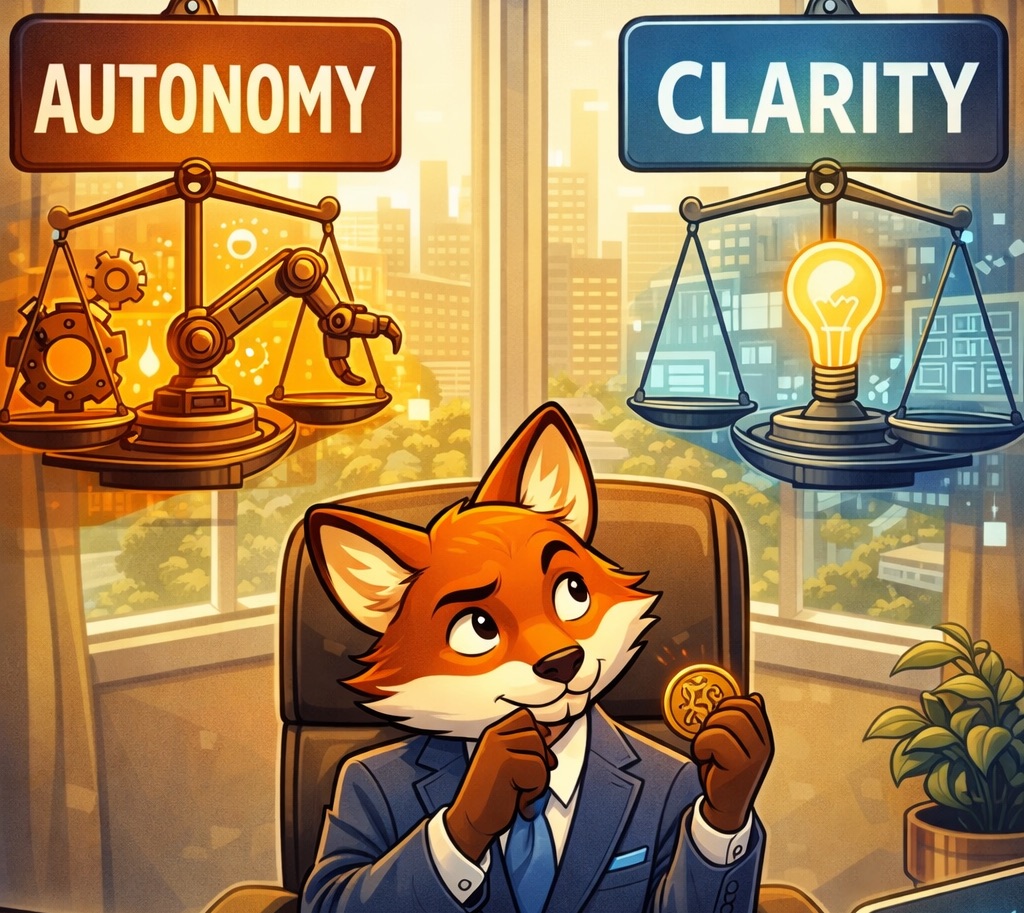
Autonomy and Clarity in Leadership Styles
There’s no one right style of leadership. Use the right style of at the right time.
Holacracy: a red herring in the quest for leadership
Does Holacracy liberate employees from the shackles of traditional management structures so they can perform like entrepreneurial leaders? Well, for me the answer’s a definite no. It’s a paradox that for Holacracy to succeed employees need a leadership mindset. But if they have that mindset in the first place they don’t actually need Holacracy. Let’s […]

Leadership Lessons: Five Insights from Directors Sharing Power
Can sharing executive leadership work in nonprofits? An interview with five leaders of progressive community organizations with shared leadership models.

The surprising traits of good remote leaders
Strong in-person leadership skills don’t necessarily translate to being a good virtual leader. Instead, organisation and competency reign supreme.

(PDF) Leadership Failure in the Eyes of Subordinates: Perception, Antecedents, and Consequences *
PDF | Effective leaders and leadership behaviors and practices are well-researched areas in the domain of leadership and management. However,... | Find, read and cite all the research you need on ResearchGate

Leaders are responsible for culture and strategy. Everything else is secondary.
Are you focused on serving a need or building a product? The difference matters more than you think.
Don't soften feedback.
When I talk about balancing being directive and empowering as a leader, the distinction between being kind and being nice often comes up.

How Old-School Management Kills Work Culture | TechCrunch
Early in my career, I had an encounter with a senior leader that left such a vivid impression on me that I can still remember it like it was yesterday. It was our first meeting as manager-employee. We were less than five minutes into our conversation when he abruptly and sharply interrupted, "Wait, is your chair higher than mine?”

Someone’s underperforming. Now what?
14 questions to ask an employee who’s struggling during your next one-on-one meeting so you can figure out how to best help. Someone’s slipping. You see it. You feel it. You’re not on the same page…

Pluralistic: The first days of Boss Politics Antitrust (24 Jan 2025) – Pluralistic: Daily links from Cory Doctorow
"Boss politics" are a feature of corrupt societies. When a society is dominated by self-dealing, corrupt institutions, strongman leaders can seize control by appealing to the public's fury and desperation. Then, the boss can selectively punish corrupt entities that oppose him, and since everyone is corrupt, these will be valid prosecutions.
The Manager’s Path in the Age of AI
This week, I gave a talk at LDX3 New York. When they asked me to speak and asked me for a topic, I said that it was probably time I finally…

Can Valve's 'Bossless' Company Model Work Elsewhere? - Slashdot
glowend writes "I just listened to a fascinating podcast with Valve's economist-in-residence, Yanis Varoufakis, about the unusual structure of the workplace at Valve where there is no hierarchy or bosses. Teams of software designers join spontaneously to create and ship video games without any top-d...

A letter from Larry and Sergey
“We’ve never been ones to hold on to management roles when we think there’s a better way to run the company.”

Why Software Development Requires Servant Leaders
The idea of “servant” leaders has been on the rise in the agile community of late. Robert K. Greenleaf coined the term in a 1970 essay, but the idea is timeless.