


To combat rising wealth inequality and ownership concentration we need new and innovative tools to create and support new and different…
Democratic Ownership Funds: Creating Shared Wealth and Power
Recent decades have seen a rapid and little-discussed transformation in corporate ownership structure, with vital consequences for company behaviour and inequality.

Who's Getting Rich Off Your Attention?
How concentrated ownership and automated manipulation reshape democracy

Introducing the Ownership Model Canvas
A new tool to re-align business success with ownership

Wealth Capture Policies | Windfall Policy Atlas
What mechanisms can ensure AI-driven productivity gains are captured for the public benefit?

The Owning Impact Project | MIT Sloan Sustainability Initiative | MIT Sloan
The Owning Impact Project examines the role that systemic investing strategies can have in fostering transformative change.

WSJ News Exclusive | Private-Equity Giants Back New Nonprofit Promoting Employee Ownership
More than 60 groups, including banks and pension funds, have also signed on to support Ownership Works, which aims to promote broad-based stock ownership as a means of curbing income inequality.

Work, Justice, and Collective Capital Institutions: Revisiting Rudolf Meidner and the Case for <span style="font-variant:small-caps;">Wage‐Earner</span> Funds
ABSTRACT This article makes the case for a specific variety of what we call Collective Capital Institutions (CCIs), by returning to the idea of Wage‐Earner Funds (WEFs) – a 1970s Swedish policy proposal designed gradually to shift ownership and control over parts of the economy to democratically controlled institutions. We identify two attractive rationales in favour of such a scheme and argue that both can fruitfully be transposed to the current worldwide economic situation. The egalitarian rationale is that WEFs could help in the pursuit of equality by giving a wider set of people a stake in collectively owned companies and a right to their profits. The democratic rationale is that WEFs redistribute not only these profits, but also the power over economic decisions made within companies. We then contrast such schemes for collective capital ownership with the similar but much more privatised proposals set out in, for instance, John Rawls's idea of a ‘property‐owning democracy’. We argue that CCIs ultimately are more likely to contribute to the development of the ‘sense of justice’ within society that is needed for a stable just society. We conclude that CCIs deserve a great deal more exploration in academic and political discussions of egalitarian economic systems.

Reasonable
A straightforward funding mechanism that rewards innovators and risk-takers while remaining sensitive to the social impact of new…

Company as a Commons
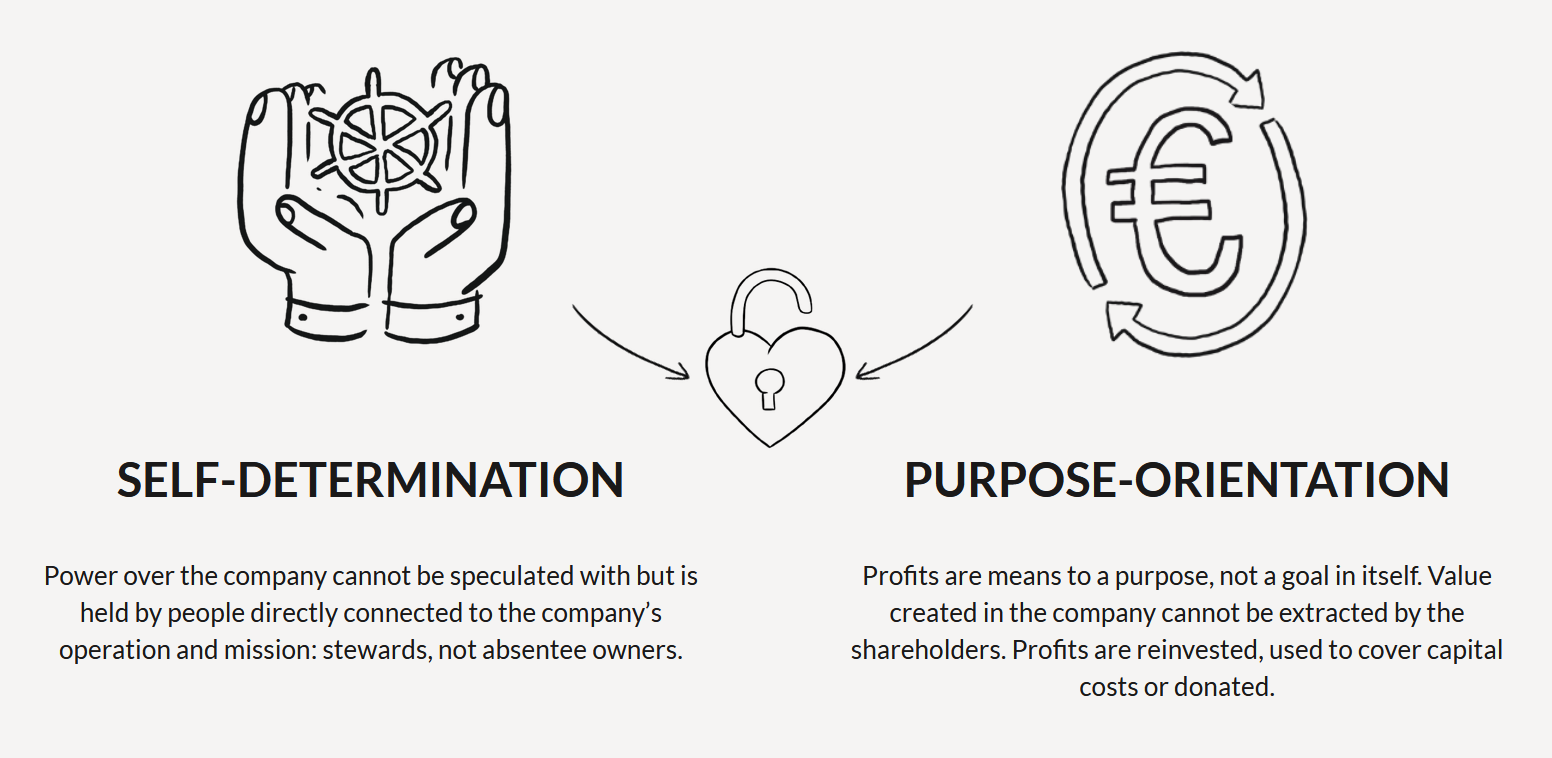
What if excess wealth derived from business couldn't be privatized? Through the levers of steward-ownership, companies can protect their purpose-oriented long term mission from the maligned incentives of absentee stakeholders.
Choosing a path for wealth redistribution | willowbl00
We’re all suffering under capitalism. There are lots of efforts out there to shift the world to a better place. And yet, it doesn’t yet feel like enough, at least to me. So I want to start logging what I’m seeing out there in the world, so far as fighting back. I know it’s there. Hell, I know a lot of people doing the actual work. I take small steps in my own life to help create a more just world. But I truly feel like we’re on the cusp of something different. As Saul Williams opened with when I saw him last year, we are the death doulas of empire.
Overcoming Barriers to Employee Ownership: Insights From Small and Medium-Sized Businesses
This research investigates the limited adoption of employee stock ownership plans (ESOPs) among small-to-medium sized businesses (SMBs) in the U.S. Through interviews with 30 SMB owners across various industries, we identify the key barriers to ESOP adoption as lack of time, money, and skills on the part of the owners. In doing so, the study suggests that a “shared ownership light” model, which involves sharing profits, information, and decision-making opportunities with employees, appears more feasible for SMBs than ESOPs. For SMBs that are interested in ESOP adoption, our research suggests that organizations providing employee ownership services could better assist SMBs by offering templatized models and best practices for profit-sharing plans, open-book management, and structured employee participation. The paper aims to broaden the discussion around shared ownership by considering a spectrum of options that have the potential to increase both value creation by and value-sharing among employees.

Investing in Enterprises That Work for Everyone (SSIR)
Impact investors can support a more just economy by prioritizing alternative ownership enterprises that shift power away from shareholders to workers, the community, and the planet. <meta property=


A Relentless Widening of Disparity in Wealth (Published 2014)
The economic forces concentrating more and more wealth into the hands of the fortunate few are almost sure to prevail for a long time, according to a new book by the economist Thomas Piketty.

Secure Property Titles with Owner Authority | Satoshi Nakamoto Institute
By Nick Szabo, 1998

cooperative ownership - funding


Database of Alternative Ownership Enterprise Investment Funds And Vehicles