


Thoughtful, empathetic language can make or break your business relationships
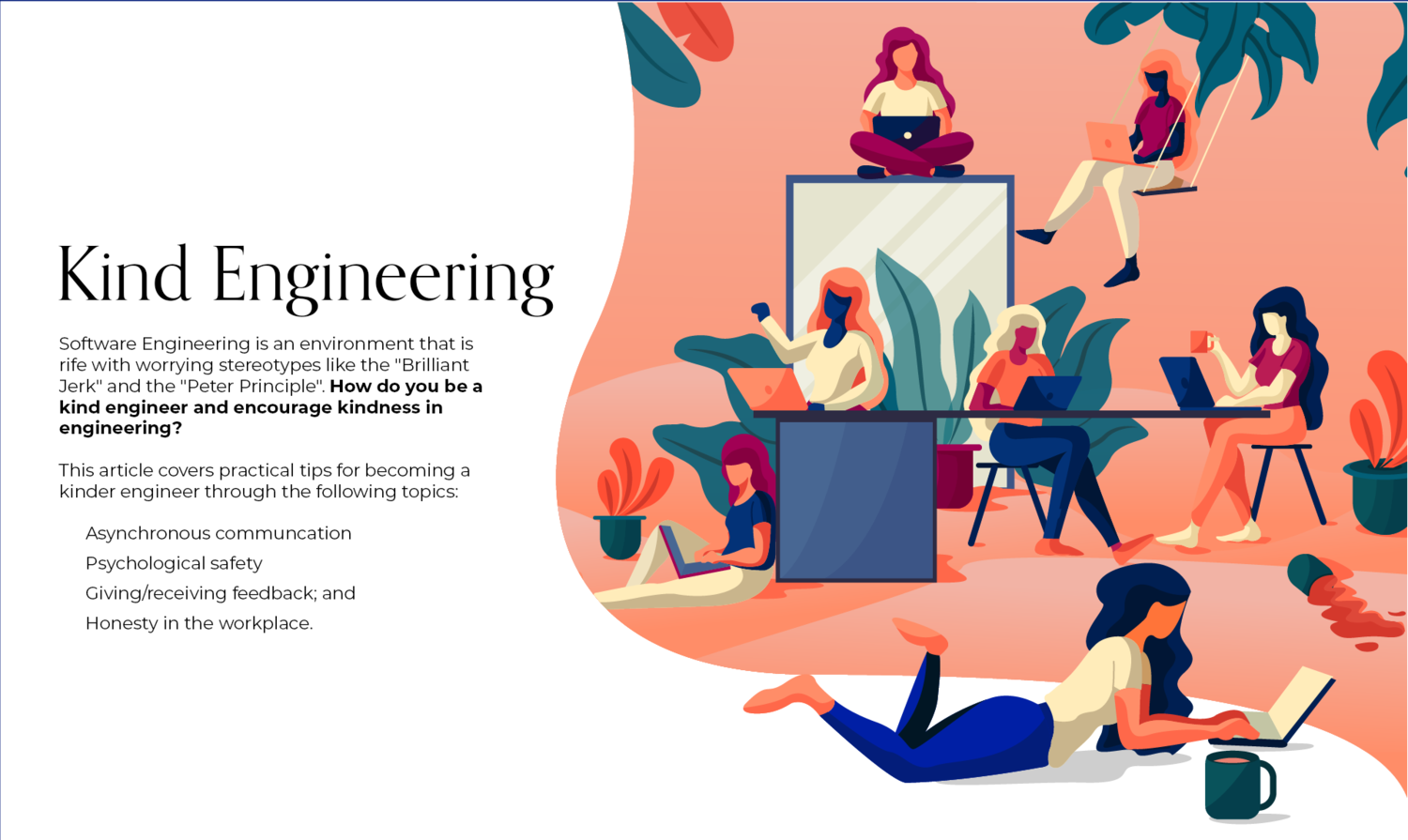
Kind Engineering: How To Engineer Kindness
How do you avoid becoming a Brilliant Jerk? Read this article to learn practical tips on communication, honesty and psychological safety.
Don't soften feedback.
When I talk about balancing being directive and empowering as a leader, the distinction between being kind and being nice often comes up.

Practicing with Language Models Cultivates Human Empathic Communication
Empathy is central to human connection, yet people often struggle to express it effectively. In blinded evaluations, large language models (LLMs) generate responses that are often judged more empathic than human-written ones. Yet when a response is attributed to AI, recipients feel less heard than when comparable responses are attributed to a human. We built a conversation platform in which participants are asked to offer empathic support to an LLM expressing realistic troubles and conducted a randomized experiment collecting 33,938 messages spanning 2,904 text-based conversations between 968 participants and their LLM conversational partners. We find participants report feeling empathy but systematically fail to express it, but an LLM coaching intervention offering personalized feedback on effective empathic communication significantly boosts it without homogenizing participants' responses. Moreover, we derive a data-driven taxonomy of idiomatic empathic expressions in naturalistic dialogues across personal and workplace trouble scenarios. These results advance the scientific understanding of how empathy is expressed and demonstrate a scalable, AI-based intervention for scaffolding and cultivating it.

Please Don’t Take Moral Advice from ChatGPT
Before turning to a large language model for ethical counsel, consider what makes for good advice

Who Can You Trust?
Reprint: R1403K Success in business unquestionably requires some willingness to cooperate through having faith in others. The question is how much faith and in whom? Decades of scientific research show that people’s accuracy in deciding if another can be trusted tends to be only slightly better than chance. But this isn’t because trustworthiness is completely unpredictable. It’s because the guidelines most of us use to make these predictions are flawed. We place too much emphasis on reputation and perceived confidence, ignoring the fact that human behavior is always sensitive to context and can often be better assessed by our own intuition. So when your company’s money and resources are on the line, how can you do a better job of gauging trustworthiness and thereby improve your likelihood of success? This article draws on emerging research to show how trustworthiness works and offers four points to keep in mind the next time you’re deciding whether or not to do business with a new partner: Integrity can vary, power does corrupt, confidence often masks incompetence, and it’s OK to trust your gut.
Your Most Important Skill: Empathy
TL;DR — Empathy is the most important skill you can practice. It will lead to greater success personally and professionally and will allow…
Why You Should Ignore Customer Feedback Sometimes
We’ve heard time and time again that one of the best ways to make sure your customers are happy with your products is to listen to what they tell you.

It’s Not Enough to Be Right. You Also Have to Be Kind.
Takedowns and clever quips are easy, but empathy and persuasion are better

How to take things less personally and avoid mind reading | Psyche Guides
Always blaming yourself or assuming others think ill of you? A CBT therapist shares ways to break these self-critical habits

Disappointed Optimists
Every time I give a talk on design, someone finds me afterward. They wait out the handshakes and the business cards, and then they ask a version of the same question. How do I make THEM do things the
Best practices: conversation design
An introduction to IBM Research’s Natural Conversation Framework

Michael Baym on Twitter / X
Remember that you, by definition, cannot distinguish between a good idea and a failure of your own knowledge, judgement, or taste. This is why external (ideally expert) feedback is crucial— Michael Baym (@baym) March 25, 2026
How I Learned to Read Way, Way More
I had to rethink my relationship to attention

Eliciting Advice Instead of Feedback Improves Developmental Input
Most organizations encourage employees to provide feedback to one another to support learning, personal growth, and career advancement. However, employee feedback often fails to improve performance because it lacks concrete, specific guidance. We provide a temporal explanation for why workplace input processes routinely fail to produce valuable and concrete developmental insights: they are insufficiently focused on the future. In this paper, we theorize and demonstrate that encouraging input providers to think about the future leads them to produce more concrete developmental input. Across a large scale, preregistered field experiment (n = 27,432 comments) and two laboratory studies (n = 806), people provide more concrete and actionable developmental input when they are prompted to provide future-looking “advice” rather than “feedback,” a common method of soliciting input in organizations. The effect of soliciting advice on input concreteness was mediated by providers’ future focus. Moreover, in a follow-up study, such concrete input was assessed by independent raters as more useful. These findings highlight the role of temporal orientation in driving the content of developmental input. In doing so, our data suggest that individuals and organizations have the potential to promote higher-quality developmental input by attending to the temporal orientation that their input systems encourage. This paper was accepted by Isabel Fernandez-Mateo, organizations. Funding: Funding for the laboratory experiments was provided by Harvard Business School. Supplemental Material: The supplementary appendix and data files are available at https://doi.org/10.1287/mnsc.2022.03207 .

be diligent
For individuals It's challenging to work a process when it moves slower than feels appropriate. In the context of computer conversations, the tactic of s...

being able to sit patiently with other people's thoughts, sit patiently with your own, and make both of those processes legible to someone who is not you is very valuable. if you can find a new way to do this that is fantastic news but I suspect it will at least resemble the model we've inherited
