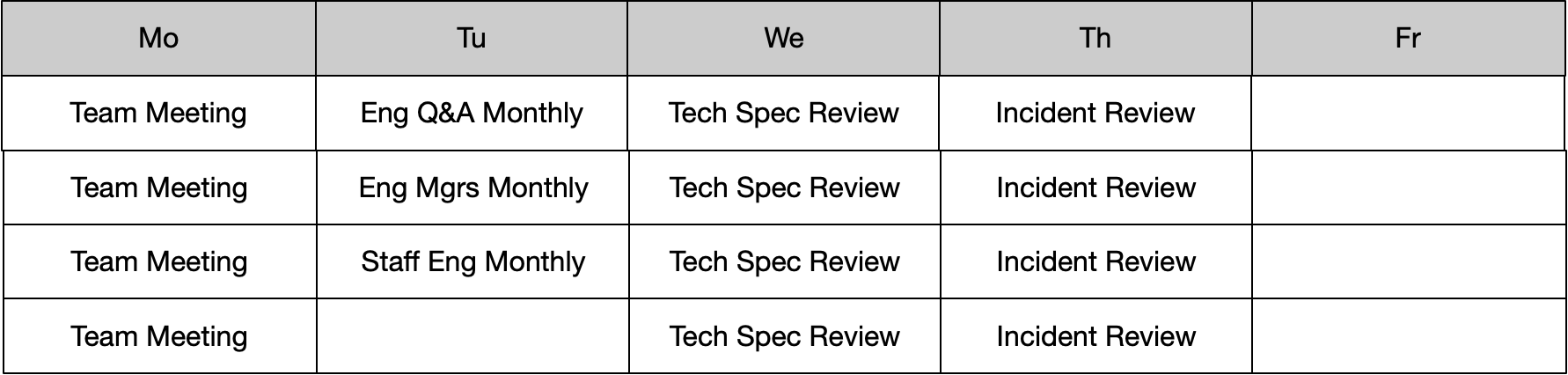
Meetings are undeniably the most important tool for build a high-performance team with shared values
Meetings for an effective eng organization.
Some engineers develop a strong point of view that meetings are a waste of their time. There’s good reason for that perspective, as many meetings are quite bad, but it’s also a bit myopic: meetings can also be an exceptionally valuable part of a well-run organization. If you’re getting feedback that any given meeting isn’t helpful, then iterate on it, and consider pausing it for the time being. It may not be useful for your organization yet, but don’t give up on the idea of meetings.
Adopt and scale Team Topologies: platform-as-a-product, templates, more. — Team Topologies - Organizing for fast flow of value
Accelerate value with Team Topologies: measure cognitive load, define team boundaries, apply inverse Conway, readiness assessments, and more for fast delivery.

Case Studies — Team Topologies - Organizing for fast flow of value
Examples of Team Topologies used in industry
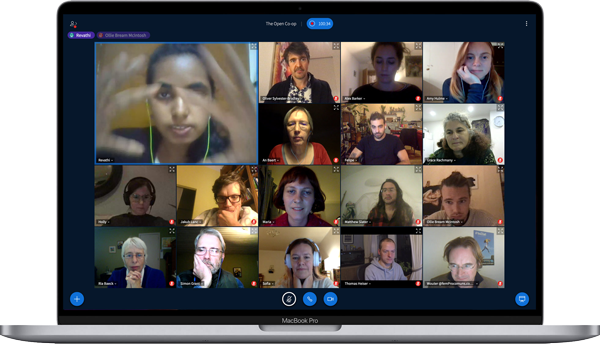
meet.coop - The Online Meeting Cooperative
Online meeting and conferencing tools, powered by renewable energy running on cooperatively owned and managed infrastructure.
Review: Team Topologies
Many organizations are struggling with their business agility transformation. One of the reasons is the way they have organized their teams. The focus was probably on efficiency and if these teams …

Habits of High-Functioning Teams
I often struggle to explain what it means to be part of a high-functioning software team. Sure, there are mountains of literature, and an entire genre of LinkedIn thought leadership that professes all kinds of guidelines and heuristics about what makes teams work, but in my experience, it’s hard to internalize these ideas and follow someone else’s model if you’ve never seen what good looks like.
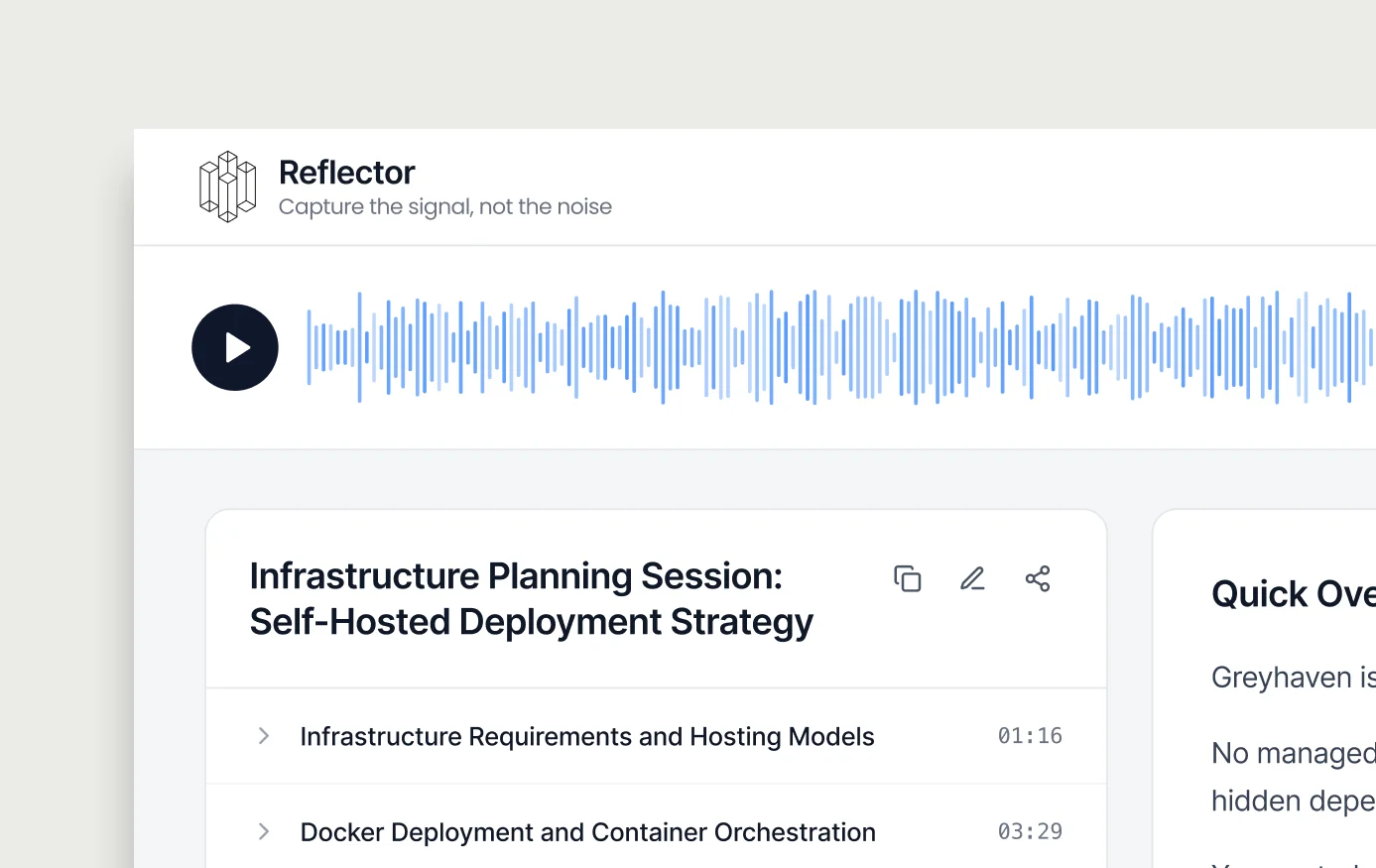
Reflector: Infrastructure for Meetings, by Greyhaven
Most organizations run on meetings. Strategy gets debated there. Decisions get made there. Context lives there. And yet...
Redundancy Protects Human Collaborations from Failure
In the name of efficiency, organizations and governments around the world are increasingly trimming redundancy---personnel or overlapping capabilities beyond what routine operations require. Drawing on distributed computing and cognitive science, we challenge this view. Using queueing simulations and a preregistered multiplayer experiment (N = 832 in 187 teams of 3–6), we show that redundancy improves performance through two distinct routes. Adding collaborators to a team improves resilience, with larger teams completing more tasks when members became temporarily unable to contribute. Giving team members overlapping capabilities also improved efficiency, with teams in which collaborators could perform multiple roles completing substantially more work. These findings suggest that efforts to improve short-term efficiency by reducing redundancy may come at a cost, quietly eroding a team’s capacity to withstand unexpected failures.
Rallly: Free Group Meeting Scheduling Tool
Rallly is the fastest and easiest scheduling and collaboration tool. Create a meeting poll in seconds, no login required.
A Guide to Measuring Engineering Team Performance
“You can’t manage what you can’t measure.” While software development practices constantly change, there will always be a tier of truly top engineering teams who stand above…

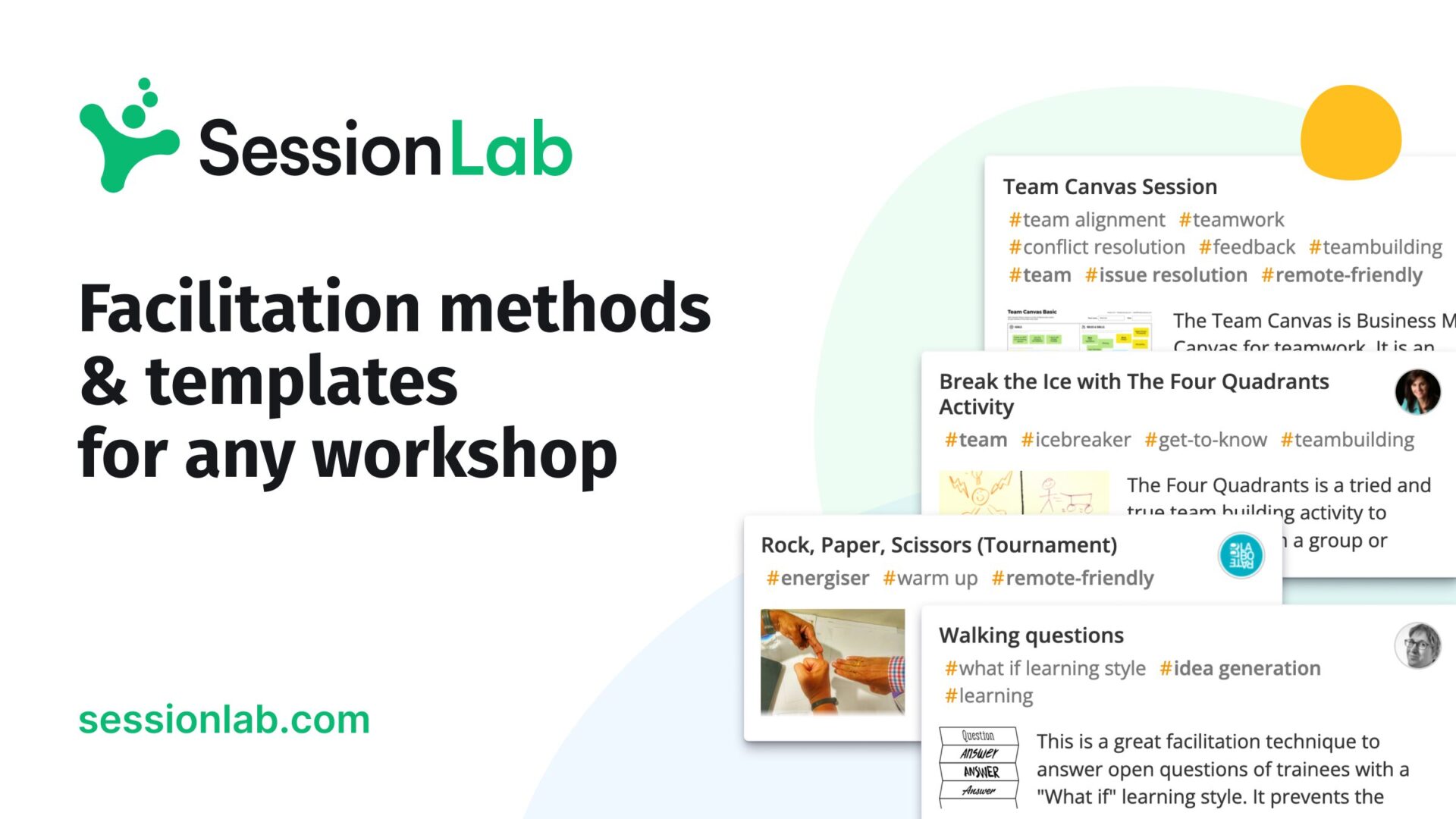
Facilitation Techniques and Workshop Activities | Library
Hundreds of group facilitation activities for workshops, meetings and training sessions. Find the best team building activities, energisers, process facilitation and leadership development...
Collaborative Groups Protocol
A practical formula for creating and sustaining small, effective groups — designed to work together at scale.
Collaborative Groups Protocol
A practical formula for creating and sustaining small, effective groups — designed to work together at scale.
Your roadmap was perfect. | Marc Baselga
Your roadmap was perfect. The strategy was aligned. Everyone was excited. Then the board meeting happened. Now you're starting from scratch. Again. Giff Constable (former CPO at Meetup) recently shared something at Supra that made this chaos finally make sense. "Most boards don't share their real financial goals with product leaders. They think it's too dangerous." Think about that for a second. You're trying to set strategy without knowing what game you're playing. No wonder your roadmap keeps getting blown up. Giff shared a wild example from Meetup that shows how this plays out: Meetup had this new high-ticket events product. Growing like crazy. Customers loved it. The team was thrilled. It was generating serious revenue. Then WeWork's IPO imploded and Meetup got sold to private equity. Overnight, this golden child product became poison. Why? Under WeWork (going for an $80B IPO), growth was everything. Who cares about margins when you're chasing that valuation? But private equity saw this 45% margin product contaminating their 80% margin marketplace business. It would make Meetup harder to flip in 2-3 years. Same product. Same metrics. Completely different verdict. The product got killed. The team was shocked. But once you understand the ownership game, it makes perfect sense. Here's what different owners actually optimize for: 💰VC-backed companies: Growth above everything. Burn money to capture market. Figure out profits later. (Classic Uber/DoorDash playbook) 💰Private equity owned: EBITDA and margins. They want to extract cash and flip to the next PE firm. No patience for long-term bets. 💰Founder funded: Could be anything. Sometimes mission-driven. Sometimes ego-driven. Often changes with their mood. 💰Public companies: Whatever Wall Street is rewarding this quarter. Used to be growth, now it's profitability. Changes with market cycles. Giff's advice on getting read in to what's really happening: Pick your moment. After you've built some trust, have this conversation with your CEO: "I know this stuff is sensitive and usually stays at the board level. But I need to understand - what are our owners optimizing for? What does success look like to them? I can't make the right product decisions without knowing what game we're playing." Most CEOs will resist at first. This information is "dangerous" because it could freak out employees if it leaked. But if you position it as "help me help you hit the targets that matter," many will open up. Once you understand the game, the chaos starts making sense. That random pivot to enterprise? PE firm wants higher ACVs. Sudden focus on free users? VC needs a growth story for next round. Killing profitable features? Someone's optimizing for margins. The roadmap changes aren't random. You just weren't told the rules changed.
It's time to kill the daily stand-up meeting
Daily stand-up meetings might be the quickest way to waste your time as a leader. Here's why a daily stand-up meeting doesn't work and what to do instead.

Status meetings are the scourge
Status meetings are the worst kinds of meetings. Eliminate them and you’ll actually know more, save a pile of money, and regain dozens of hours a month. A status meeting — sometimes called a s…