


“Writing is thinking” is my favorite expression for how to work in a company. This annotated thread explores the value of writing.
Writing is Thinking: Learning to Write with Confidence
Learning to write is learning to think, because writing is thinking. They are two peas in a powerful pod. This article goes over my writing process, focused on minimizing the activation energy to get started.

Writing Is Thinking
When you write about your work, it makes all of us smarter for the effort, including you. Done well, this kind of sharing means you’re contributing signal, instead of noise. But writers are made, n…


The Ultimate Guide to Writing
Think better. Grow your audience. Accelerate your career.
Brian D. Earp, Ph.D. on Twitter / X
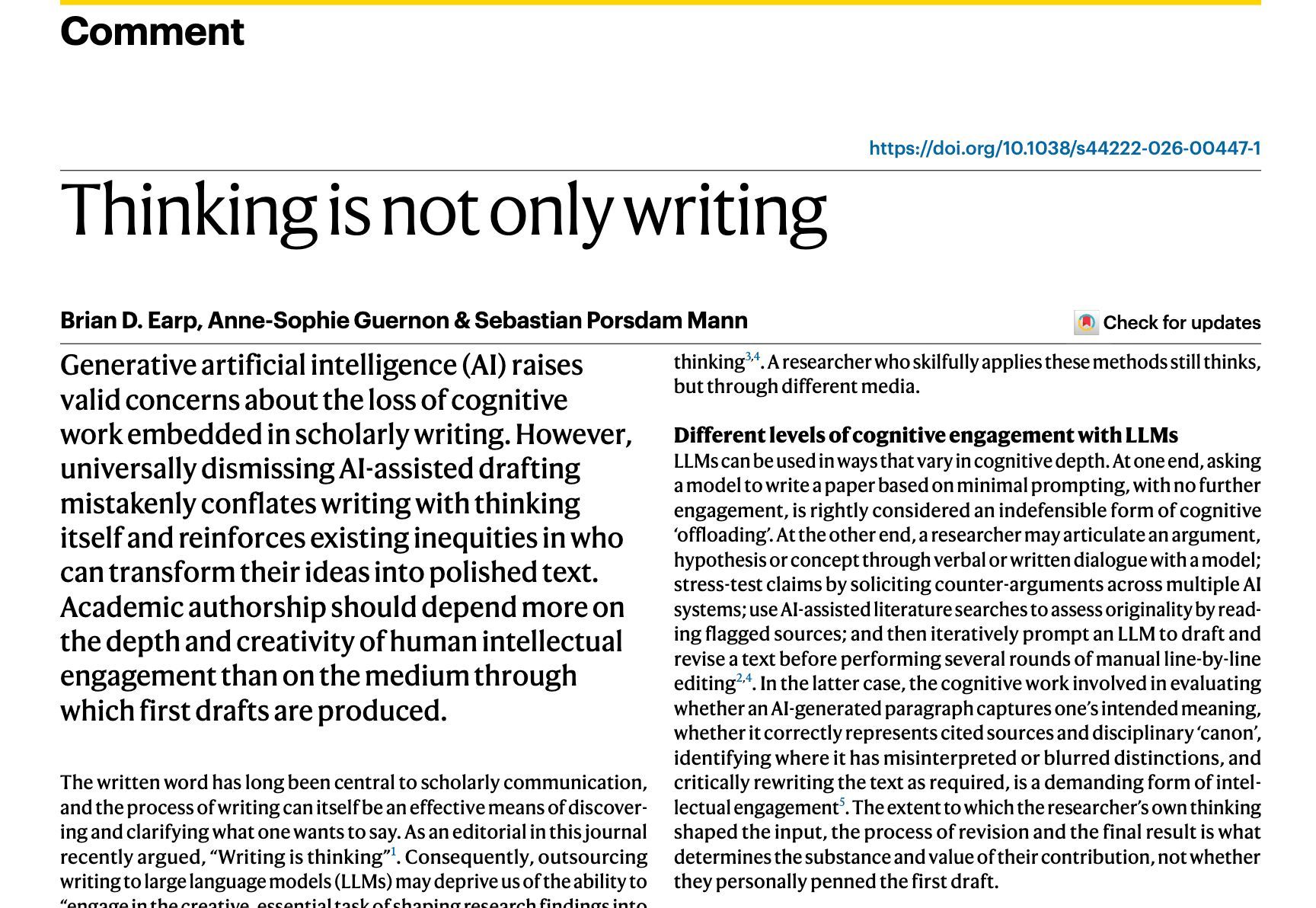
"Writing is thinking." This phrase went viral recently (from https://t.co/EQqohfhUMd), often quoted in the context of objections to use of AI in drafting academic prose. In Nature Reviews Bioengineering we respond: "Thinking is not only writing." Preview below. Shareable full… pic.twitter.com/cZtGdoSwqV— Brian D. Earp, Ph.D. (@briandavidearp) May 15, 2026
On Writing #3
Periodically I like to gather various observations about writing, and share my perspective.

Q&A: How do you decide what to write? - The Intercom Blog
Our editor John Collins explains how startups should think about what to write on their blog and shares his top tips for coming up with article ideas.

Two Kinds of Writing
Writing can be a means for thinking. AI can help — but make sure you’re driving.

Why writing matters in remote work — Tim Casasola
In remote work, we communicate primarily through writing. We send messages in Slack. We document projects in Notion. We send meeting invites with a written description of the purpose. We’re writing all the time. Many organizations are working from home at the moment. Thus, writing is even

How tweet threads cured my writer's block: Twitter as a medium for sketching
Twitter is a powerful <b>medium for sketching</b>: a tool for fluidly developing ideas in realtime. What can we learn from its design? I think it shows us the power of 1) the right constraints, 2) low barriers to starting and finishing, and 3) a social context.

“Better note-taking” misses the point; what matters is “better thinking”
Lots of people write about solutions to the problem that Note-writing practices are generally ineffective .NoteLink.Active { background-color: rgba(10, 132, 255, 0.15); } . The vast majority of that writing fixates on a myopic, “lifehacking”-type frame, focused on answering questions like: “how should I organize my notes?”, “what kind of journal should I use?”, “how can I make it easy to capture snippets of things I read?”, etc.
The social contract of writing | jola.dev
About the value of genuine writing in a world being drowned in slop.
First outlines of a plan: thinking strategically about a modern tech and media business
Writing at the end of the world, from Hveragerði, Iceland
Wherein I Find Myself Writing About Writing
Most everyone finds writing to be challenging (especially those who say they enjoy it). This is because writing is an intentional, thoughtful act. This is as it should be, but “AI” has recently exacerbated the misbelief that writing is simply an output. In fact, it's a creative process that has merit in and of itself.

A World Without Email: Reimagining Work in an Age of Communication Overload
A New York Times and Wall Street Journal bestsellerFrom New York Times bestselling author Cal Newport comes a bold vision for liberating workers from the tyranny of the inbox--and unleashing a new era of productivity.Modern knowledge workers communicate constantly. Their days are defined by a relentless barrage of incoming messages and back-and-forth digital conversations--a state of constant, anxious chatter in which nobody can disconnect, and so nobody has the cognitive bandwidth to perform substantive work. There was a time when tools like email felt cutting edge, but a thorough review of current evidence reveals that the "hyperactive hive mind" workflow they helped create has become a productivity disaster, reducing profitability and perhaps even slowing overall economic growth. Equally worrisome, it makes us miserable. Humans are simply not wired for constant digital communication.We have become so used to an inbox-driven workday that it's hard to imagine alternatives. But they do exist. Drawing on years of investigative reporting, author and computer science professor Cal Newport makes the case that our current approach to work is broken, then lays out a series of principles and concrete instructions for fixing it. In A World without Email, he argues for a workplace in which clear processes--not haphazard messaging--define how tasks are identified, assigned and reviewed. Each person works on fewer things (but does them better), and aggressive investment in support reduces the ever-increasing burden of administrative tasks. Above all else, important communication is streamlined, and inboxes and chat channels are no longer central to how work unfolds.The knowledge sector's evolution beyond the hyperactive hive mind is inevitable. The question is not whether a world without email is coming (it is), but whether you'll be ahead of this trend. If you're a CEO seeking a competitive edge, an entrepreneur convinced your productivity could be higher, or an employee exhausted by your inbox, A World Without Email will convince you that the time has come for bold changes, and will walk you through exactly how to make them happen.