

Mem0 is the memory layer for AI agents and applications, enabling them to learn from past interactions and deliver personalized experiences.
Supermemory
The memory layer for AI agents. Context engineering platform powering enterprise APIs, developer plugins, and a personal app that remembers everything.
AI Agent Memory: Complete Guide & Architecture
AI agent memory: what it is, how it works, architecture, memory types, and how to add persistent long-term context.

mem-agent: Equipping LLM Agents with Memory Using RL
The insights and the technical report behind Mem-Agent, our 4B model for persistent memory in LLMs
Memvid - Give your AI Agent Photographic Memory
Replace complex RAG pipelines with a single portable file that gives every agent instant retrieval and long-term memory.
MemGPT: Towards LLMs as Operating Systems
Letta is the platform for building stateful agents: AI with advanced memory that can learn and self-improve over time.
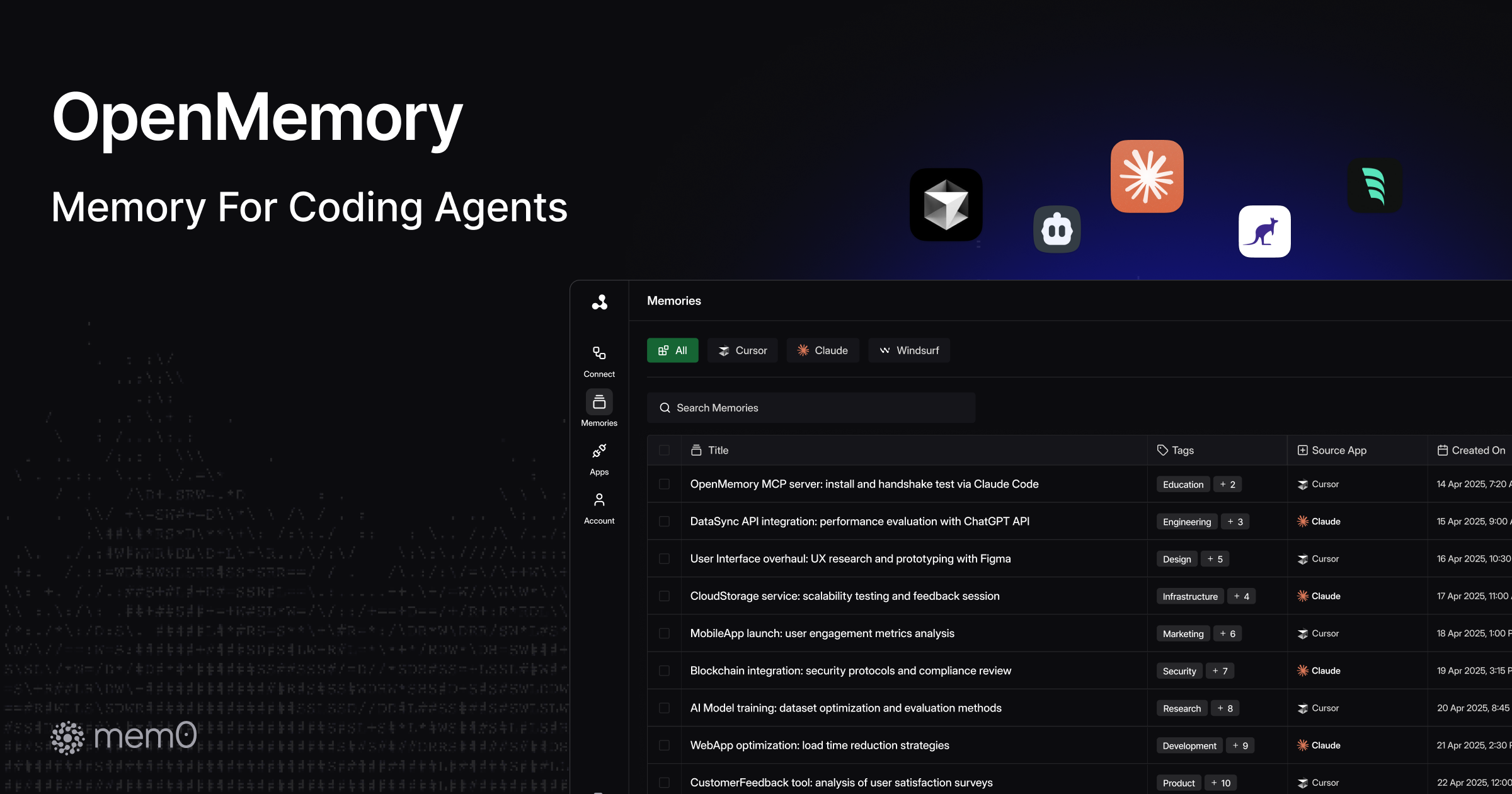
OpenMemory - AI Memory MCP Server for Coding Agents | Mem0
With OpenMemory, add persistent, project-aware memory to Cursor, Windsurf, and VS Code agents. Store preferences, patterns, and context that get retrieved automatically.
Pieces | Infinite Artificial Memory for your Digital Workers and Agents
Pieces is your AI companion that captures live context from browsers to IDEs and collaboration tools, manages snippets and supports multiple llms - all while processing data locally for maximum control.
I Benchmarked OpenAI Memory vs LangMem vs Letta (MemGPT) vs Mem0 for Long-Term Memory: Here’s How They Stacked Up
145 votes, 53 comments. Lately, I’ve been testing memory systems to handle long conversations in agent setups, optimizing for: Factual consistency…
MemGPT: Towards LLMs as Operating Systems
Large language models (LLMs) have revolutionized AI, but are constrained by limited context windows, hindering their utility in tasks like extended conversations and document analysis. To enable using context beyond limited context windows, we propose virtual context management, a technique drawing inspiration from hierarchical memory systems in traditional operating systems that provide the appearance of large memory resources through data movement between fast and slow memory. Using this technique, we introduce MemGPT (Memory-GPT), a system that intelligently manages different memory tiers in order to effectively provide extended context within the LLM's limited context window, and utilizes interrupts to manage control flow between itself and the user. We evaluate our OS-inspired design in two domains where the limited context windows of modern LLMs severely handicaps their performance: document analysis, where MemGPT is able to analyze large documents that far exceed the underlying LLM's context window, and multi-session chat, where MemGPT can create conversational agents that remember, reflect, and evolve dynamically through long-term interactions with their users. We release MemGPT code and data for our experiments at https://memgpt.ai.

Understanding memory management
Learn MemGPT memory management techniques for controlling LLM context windows with in-context and external storage.

topoteretes/cognee
Cognee is the open-source AI memory platform for agents. Give your AI agents persistent long-term memory with small models for free
Memora scales agent memory to boost long-horizon productivity
AI agents can't remember past conversations. They must constantly reload or retrieve context, which grows less efficient as tasks get longer and more complex. Memora solves this with a scalable memory system separating what’s stored from how it's retrieved.

Woah. Letta vs Mem0. (For AI memory nerds)
365 votes, 55 comments. I’m an absolute AI memory nerd, and have probably read every proposal made about memory, and demoed virtually all of the…
Basic Memory
AI conversations that actually remember. Never re-explain your project to your AI again. Join our Discord: https://discord.gg/tyvKNccgqN
Memory Models: Towards Agents That Learn
Agents that truly learn from experience will be powered by memory models: models that create and curate token-space memory across model generations, trained with memory-native RL.
DREAM — Dynamic Retention Episodic Architecture for Memory
Modern AI systems lack persistent, user-specific episodic memory. Existing approaches rely on short-term context windows, shallow preference storage, or static conversation logs that do not scale and cannot preserve meaningful long-term continuity. This paper introduces DREAM (Dynamic Retention Episodic Architecture for Memory), a scalable, opt-in, episodic memory framework designed to work with current LLM and agent architectures. DREAM integrates episodic summarization, user-controlled opt-in memory, semantic retrieval via per-user vector indexes, an adaptive retention mechanism that expands TTL based on user engagement, and horizontal sharding of orchestrators and storage for large-scale deployments. The paper details the architecture, components, data flows, and implementation examples, and argues that DREAM provides a practical path toward AI systems capable of consistent, privacy-aligned long-term reasoning. This project has been extended with a conceptual analysis and simulation of a "DREAM-as-a-Support" (DaaS) hybrid layer. This extension demonstrates DREAM's architectural extensibility, reframing it from a standalone framework into a foundational platform component. The DaaS model provides core memory governance such as adaptive retention (ARM) and user-centric opt-in as an on-demand service to complementary cognitive systems, validating the original four-pillar design through a scalable, internal API. Reference Implementation A reference implementation of the DREAM architecture is available as an open-source Python framework:Official Reference Implementation This implementation is intended for experimentation and architectural validation and does not represent a production-ready system DREAM Architecture — Official GitHub Repository