

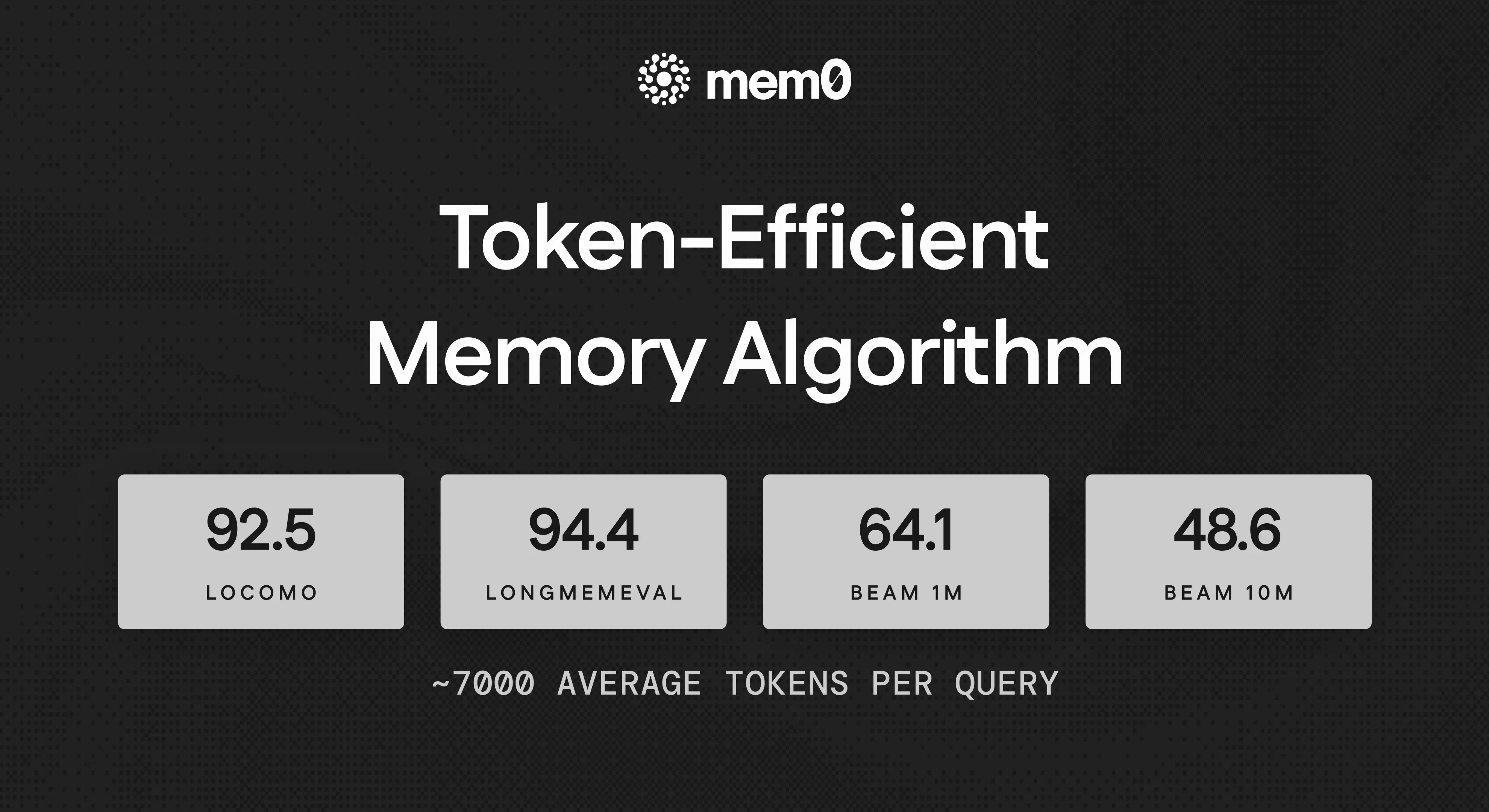
Benchmarked across LoCoMo, LongMemEval, and BEAM, achieves competitive accuracy while using under 7,000 tokens per retrieval call. For comparison, full-context approaches on these benchmarks routinely consume 25,000+ tokens per query.
I Benchmarked OpenAI Memory vs LangMem vs Letta (MemGPT) vs Mem0 for Long-Term Memory: Here’s How They Stacked Up
145 votes, 53 comments. Lately, I’ve been testing memory systems to handle long conversations in agent setups, optimizing for: Factual consistency…
Mem0: Building Production-Ready AI Agents with Scalable Long-Term Memory
Large Language Models (LLMs) have demonstrated remarkable prowess in generating contextually coherent responses, yet their fixed context windows pose fundamental challenges for maintaining consistency over prolonged multi-session dialogues. We introduce Mem0, a scalable memory-centric architecture that addresses this issue by dynamically extracting, consolidating, and retrieving salient information from ongoing conversations. Building on this foundation, we further propose an enhanced variant that leverages graph-based memory representations to capture complex relational structures among conversational elements. Through comprehensive evaluations on LOCOMO benchmark, we systematically compare our approaches against six baseline categories: (i) established memory-augmented systems, (ii) retrieval-augmented generation (RAG) with varying chunk sizes and k-values, (iii) a full-context approach that processes the entire conversation history, (iv) an open-source memory solution, (v) a proprietary model system, and (vi) a dedicated memory management platform. Empirical results show that our methods consistently outperform all existing memory systems across four question categories: single-hop, temporal, multi-hop, and open-domain. Notably, Mem0 achieves 26% relative improvements in the LLM-as-a-Judge metric over OpenAI, while Mem0 with graph memory achieves around 2% higher overall score than the base configuration. Beyond accuracy gains, we also markedly reduce computational overhead compared to full-context method. In particular, Mem0 attains a 91% lower p95 latency and saves more than 90% token cost, offering a compelling balance between advanced reasoning capabilities and practical deployment constraints. Our findings highlight critical role of structured, persistent memory mechanisms for long-term conversational coherence, paving the way for more reliable and efficient LLM-driven AI agents.

milla-jovovich/mempalace
The highest-scoring AI memory system ever benchmarked. And it's free.
Prompt caching: 10x cheaper LLM tokens, but how? | ngrok blog
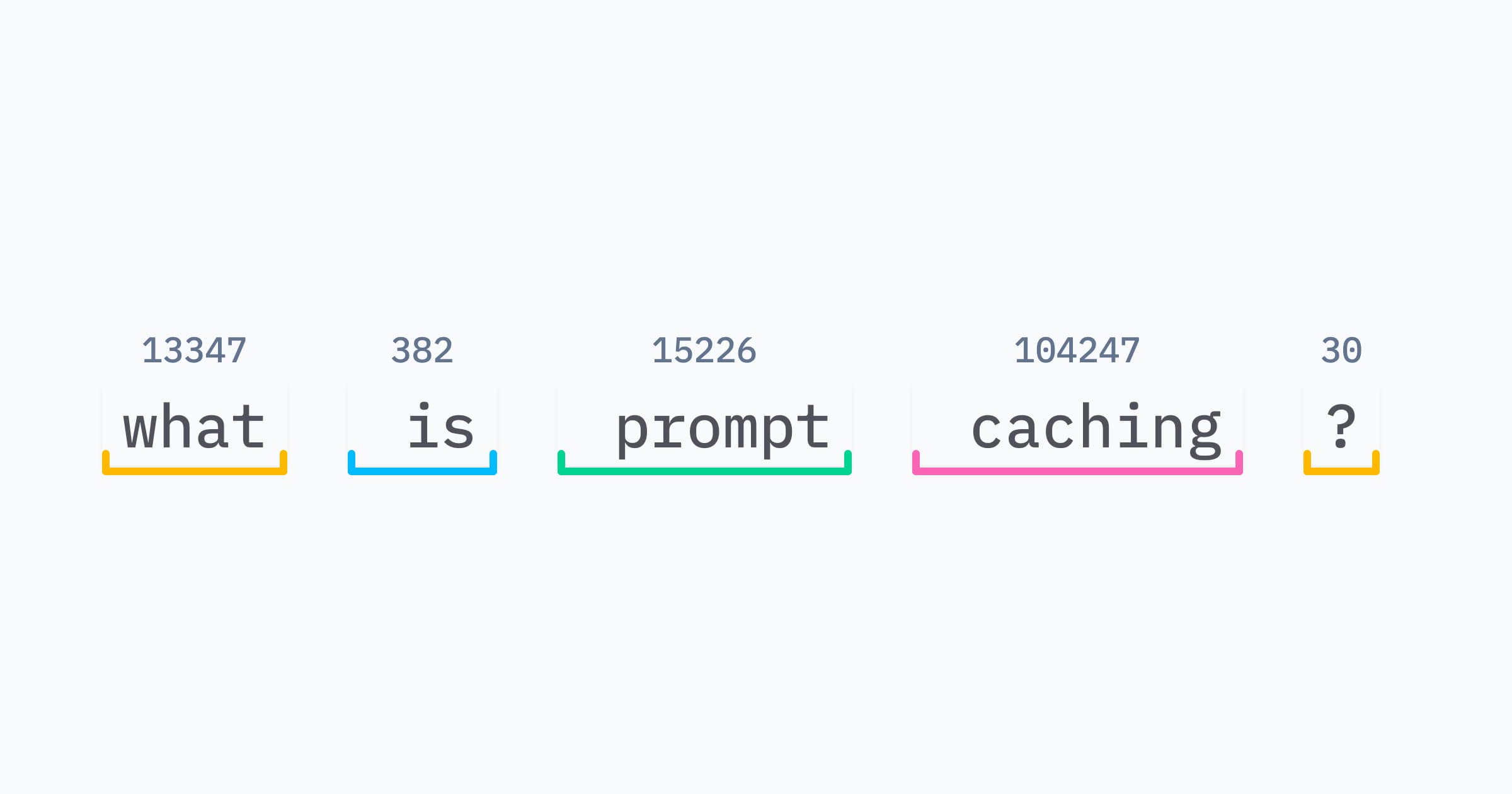
A far more detailed explanation of prompt caching than anyone asked for: how tokens, embeddings, and attention make cached LLM tokens 10x cheaper and faster.
MemGPT: Towards LLMs as Operating Systems
Large language models (LLMs) have revolutionized AI, but are constrained by limited context windows, hindering their utility in tasks like extended conversations and document analysis. To enable using context beyond limited context windows, we propose virtual context management, a technique drawing inspiration from hierarchical memory systems in traditional operating systems that provide the appearance of large memory resources through data movement between fast and slow memory. Using this technique, we introduce MemGPT (Memory-GPT), a system that intelligently manages different memory tiers in order to effectively provide extended context within the LLM's limited context window, and utilizes interrupts to manage control flow between itself and the user. We evaluate our OS-inspired design in two domains where the limited context windows of modern LLMs severely handicaps their performance: document analysis, where MemGPT is able to analyze large documents that far exceed the underlying LLM's context window, and multi-session chat, where MemGPT can create conversational agents that remember, reflect, and evolve dynamically through long-term interactions with their users. We release MemGPT code and data for our experiments at https://memgpt.ai.
MemOS: An Operating System for Memory-Augmented Generation (MAG) in Large Language Models
Large Language Models (LLMs) have emerged as foundational infrastructure in the pursuit of Artificial General Intelligence (AGI). Despite their remarkable capabilities in language perception and generation, current LLMs fundamentally lack a unified and structured architecture for handling memory. They primarily rely on parametric memory (knowledge encoded in model weights) and ephemeral activation memory (context-limited runtime states). While emerging methods like Retrieval-Augmented Generation (RAG) incorporate plaintext memory, they lack lifecycle management and multi-modal integration, limiting their capacity for long-term knowledge evolution. To address this, we introduce MemOS, a memory operating system designed for LLMs that, for the first time, elevates memory to a first-class operational resource. It builds unified mechanisms for representation, organization, and governance across three core memory types: parametric, activation, and plaintext. At its core is the MemCube, a standardized memory abstraction that enables tracking, fusion, and migration of heterogeneous memory, while offering structured, traceable access across tasks and contexts. MemOS establishes a memory-centric execution framework with strong controllability, adaptability, and evolvability. It fills a critical gap in current LLM infrastructure and lays the groundwork for continual adaptation, personalized intelligence, and cross-platform coordination in next-generation intelligent systems.
LLM in a flash: Efficient Large Language Model Inference with Limited Memory
Large language models (LLMs) are central to modern natural language processing, delivering exceptional performance in various tasks. However, their substantial computational and memory requirements present challenges, especially for devices with limited DRAM capacity. This paper tackles the challenge of efficiently running LLMs that exceed the available DRAM capacity by storing the model parameters in flash memory, but bringing them on demand to DRAM. Our method involves constructing an inference cost model that takes into account the characteristics of flash memory, guiding us to optimize in two critical areas: reducing the volume of data transferred from flash and reading data in larger, more contiguous chunks. Within this hardware-informed framework, we introduce two principal techniques. First, "windowing" strategically reduces data transfer by reusing previously activated neurons, and second, "row-column bundling", tailored to the sequential data access strengths of flash memory, increases the size of data chunks read from flash memory. These methods collectively enable running models up to twice the size of the available DRAM, with a 4-5x and 20-25x increase in inference speed compared to naive loading approaches in CPU and GPU, respectively. Our integration of sparsity awareness, context-adaptive loading, and a hardware-oriented design paves the way for effective inference of LLMs on devices with limited memory.
mem-agent: Equipping LLM Agents with Memory Using RL
The insights and the technical report behind Mem-Agent, our 4B model for persistent memory in LLMs
Mixture-of-Recursions: Learning Dynamic Recursive Depths for Adaptive Token-Level Computation
Scaling language models unlocks impressive capabilities, but the accompanying computational and memory demands make both training and deployment expensive. Existing efficiency efforts typically target either parameter sharing or adaptive computation, leaving open the question of how to attain both simultaneously. We introduce Mixture-of-Recursions (MoR), a unified framework that combines the two axes of efficiency inside a single Recursive Transformer. MoR reuses a shared stack of layers across recursion steps to achieve parameter efficiency, while lightweight routers enable adaptive token-level thinking by dynamically assigning different recursion depths to individual tokens. This allows MoR to focus quadratic attention computation only among tokens still active at a given recursion depth, further improving memory access efficiency by selectively caching only their key-value pairs. Beyond these core mechanisms, we also propose a KV sharing variant that reuses KV pairs from the first recursion, specifically designed to further decrease memory footprint. Across model scales ranging from 135M to 1.7B parameters, MoR forms a new Pareto frontier: at equal training FLOPs and smaller model sizes, it significantly lowers validation perplexity and improves few-shot accuracy, while delivering higher throughput compared with vanilla and existing recursive baselines. These gains demonstrate that MoR is an effective path towards large-model quality without incurring large-model cost.
nanomem: An Extremely Simple, Inference-Time Memory Module
nanomem is an extremely simple, user-owned memory module that casts memory management as LLM calls / agent loops on a markdown file tree. You interact with the tree with natural language commands like nanomem add <fact>, nanomem retrieve <query>, and nanomem import <chatgpt>. As such, nanomem is by design interpretable, partitionable, portable, and versioned.
Cross-Harness Agentic Memory
Supermemory built a ~99% benchmark ensemble to prove the benchmarks are gameable.Letta scored 74% on LoCoMo with just a filesystem. No vector DB, no graph.

MemGPT
Memory-GPT (MemGPT) - Towards LLMs as Operating Systems - Teach LLMs to manage their own memory for unbounded context!

i can’t help but think we’re far from nailing memory systems this one here is extremely interesting. two LLMs at once, one just managing and surfacing memory for the other

Asa ⭔
I'm not a fan of the decoupled 'memory retrieval → task execution' loop, so my agent has a subconscious background thread that looks for relevant, unique memory context in its experiential database while it runs and injects it on top of the live context window.
