

NUTELCH measures chroma relative to the gamut shell — the cusp — in OKLCH and LCH. You ask for a fraction of the way to the boundary (relC) instead of an absolute chroma, so “saturation” means the same thing at every lightness and hue and never accidentally lands out of gamut, while the result stays a native oklch() / lch() color. It's dependency-free and LUT-backed: the boundaries are precomputed, so lookups are fast. nutelch on GitHub →
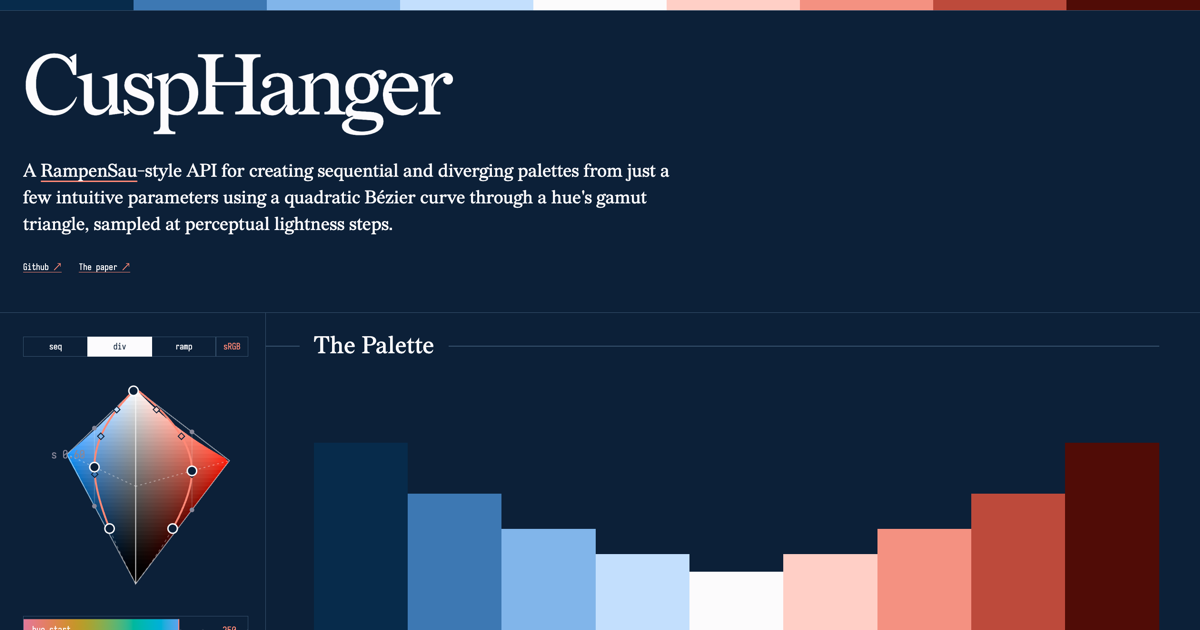
CuspHanger — palettes from intuitive parameters
Sequential and diverging OKLCH palettes from a few intuitive parameters — the Wijffelaars et al. 2009 model, in-gamut by construction, for sRGB and Display-P3.
Generating a Color Spectrum for an Image — Amanda Hinton
Walkthrough of building the Chromaculture Spectrimage analyzer that extracts and displays the color composition of an uploaded image.

What nobody tells you about RGB
oklch() CSS function - CSS | MDN
The oklch() functional notation expresses a given color in the Oklab color space. oklch() is the cylindrical form of oklab(), using the same L axis, but with polar Chroma (C) and Hue (h) coordinates.

Too Much Color
I spent too much time looking at too many colo(u)rs to try and optimise them for csskit. Here are some interesting findings.
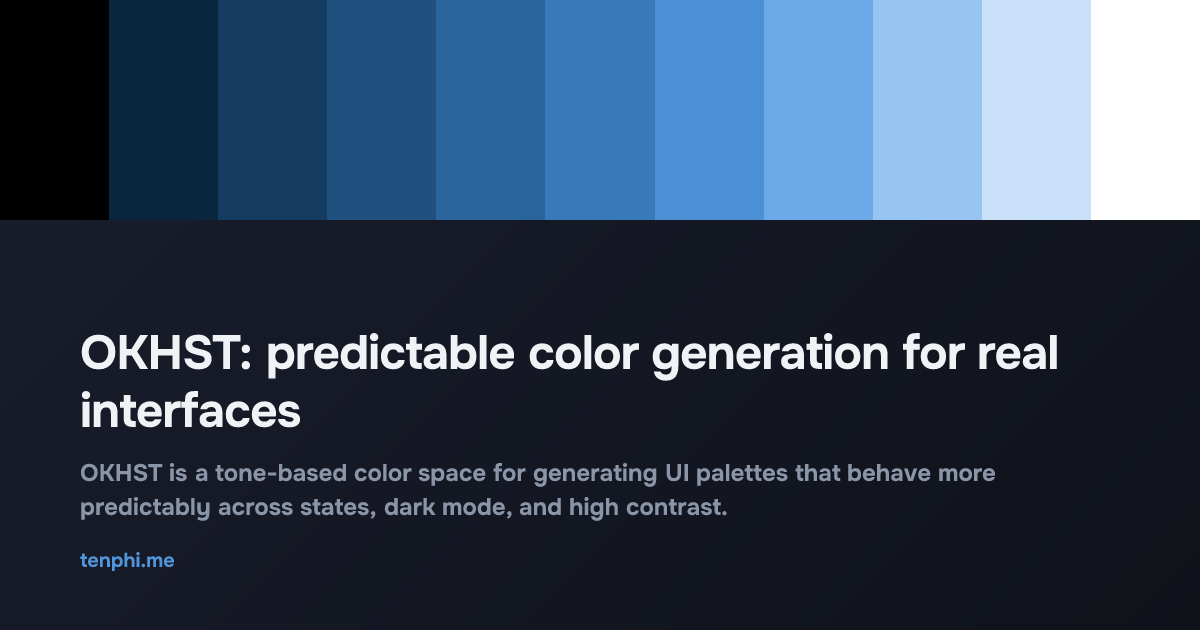
OKHST: predictable color generation for user interfaces — tenphi.me
OKHST is a tone-based color space for generating UI palettes that behave more predictably across states, dark mode, and high contrast.
modular and versioned GLSL
a WebGL demo of glsl-lut, for efficient color transforms on the GPU. source code here Contents # Intro glslify Installing Dependencies Compiling The Shader Relative Requires Example Modules The Awesomeness of NPM Unit Testing Extras As a Source...

OKLCH in CSS: why we moved from RGB and HSL—Martian Chronicles, Evil Martians’ team blog
CSS Color Module 4 adds oklch(), and we gain P3 wide-gamut support, boost code readability, and improve developer-designer communication.

loukesio/ltc-color-palettes
Artistic and nature-inspired colour palettes for R, on CRAN as 'ltc'. Curated for clarity and impact in scientific figures.
The Secret to Rendering Vibrant Colors with AgX in Blender is the Raw Workflow
Many artists have heard about how Blender’s AgX color transform is technically better than standard sRGB, Filmic, ACES, and others, but, in practice, struggle to actually get the colors they want while using it because the default results can look a bit dull, and certain colors like neon yellow are hard to produce.

Color Palette Generator – Color Wheel Tool | Adobe Express
Use the color palette generator to create harmonious color schemes with the interactive color wheel. Choose a base color, apply a harmony, and design with confidence in Adobe Express.

Visualizing GL_NV_shader_sm_builtins
Using GL_NV_shader_sm_builtins to visualize Streaming Multiprocessors and Warps
oklch() has only one problem left. If a user chooses a color that this screen can’t display, browsers will look for the nearest alternative using a simplified algorithm instead of the one from the CSS spec: clipping instead of chroma reduction. evilmartians.com/chronicles/oklch-in-css-why-q…

OKLCH in CSS: why we moved from RGB and HSL—Martian Chronicles, Evil Martians’ team blog
evilmartians.comAn infinite zooming color space taataa.github.io/tapspace/examples/cielab/inde…
Lovely Set of #rstats color pallets: ltc-color-palettes


