

People often speak about AI as if it is one thing. It can seem like that when we use today’s most popular interfaces: a single product, packaged by an unfathomably big company. But that view is both misleading and disempowering. It implies that only the big companies could possibly create and control this technology, because only they can handle its immensity. But another orientation is possible.
Democratizing AI Companies — The Collective Intelligence Project
As AI reshapes society, the companies behind these technologies face a critical challenge: how to build corporate governance structures that prioritize public benefit over profit maximization;.

AI Is a Product of Humanity. Humanity Should Own AI.
Big Tech has looted humanity’s creative output to create artificial intelligence. We don’t just deserve a share of AI’s profits — we deserve control over it.

AI Commons - One Project
What if we could redefine AI? What if we could shift its development from a capitalist model to a more disruptive, inclusive, and decentralized one?

Can AI Be Governed? Only If We Build Normatively Competent AI
Hadfield's discussion brings the idea of AI governance back to the core idea of steering the behavior of an AI system. As she notes, this not only involves technical questions about how AI systems ar...
Study maps how ‘Big AI’ influences AI laws and oversight — Centre for Technomoral Futures
AI companies influence policy and regulation using similar techniques to Big Tobacco, Big Pharma and Big Oil, according to a new study by colleagues at University of Edinburgh, Trinity College Dublin, TU Delft and Carnegie Mellon University.

What fully automated firms will look like
Everyone is sleeping on the *collective* advantages AIs will have, which have nothing to do with raw IQ - they can be copied, distilled, merged, scaled, and evolved in ways humans simply can't.

Agentic AI Governance: Securing Autonomous AI Agents in Enterprise
When AI agents start making decisions, calling tools, and coordinating with other agents without waiting for human approval, the governance playbook most...

Governments Can’t Agree on What AI Actually Is
Without clear definitions, governance is impossible.

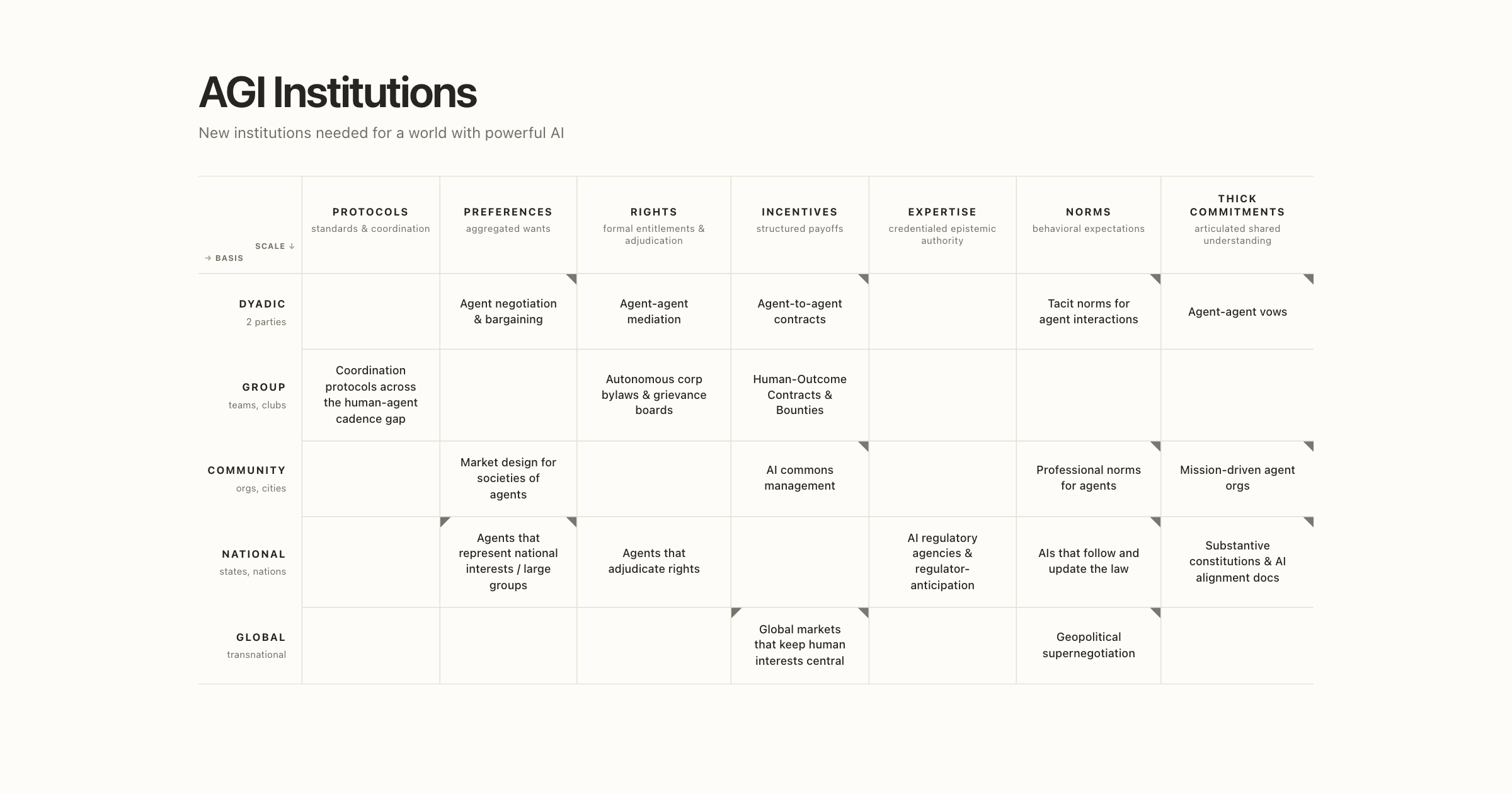
Existing Human Institutions — AGI Institutions Wiki
How existing human institutions handle coordination across scales — and how autonomous AI agents break them. Maps protocols, preferences, rights, incentives, expertise, norms, and thick commitments from dyadic to global.
From chatbots to assistants: governance is key for AI agents
AI's shift into agentic technology ushers in a new set of governance and security challenges that will mean defining to what extent they should be autonomous

Building a Solidarity Ecosystem for AI (SSIR)
How cooperatives, public institutions, and social movements can come together to intentionally build a practical, community-owned alternative to extractive AI systems. <meta property=

HUGE — AI Without Giving Up Your Privacy
We're building an Agentic AI Platform running on your Device that lives with YOU, isolated from the cloud, fundamentally reimagining the relationship between humans and artificial intelligence through ownership, privacy, and massive context. In an age of capture and control, HUGE sells independence and sovereignty.
Irresponsible AI: big tech's influence on AI research and associated impacts
The accelerated development, deployment and adoption of artificial intelligence systems has been fuelled by the increasing presence of big tech in the AI field. This trend has been accompanied by growing ethical concerns and intensified societal and environmental impacts. This position paper argues that irresponsible AI development is strongly driven by big tech's influence and involvement in the field. First, we examine the growing and disproportionate influence of big tech in AI research and argue that its drive for scaling and general-purpose systems is fundamentally at odds with the responsible, ethical, and sustainable development of AI. Second, we review key current environmental and societal negative impacts of AI and trace their connections to big tech's influence. Third, we discuss the underlying economic forces driving big tech's actions. Finally, as a call to action, we invite AI researchers to counter big tech's influence in irresponsible AI development through strategies that build on the responsibility of implicated actors and collective action.
Bridging the gap: inequalities that divide those who can and cannot create sustainable outcomes with AI
The widespread use of AI technologies impacts individuals, organisations, and societies in ways that warrant more comprehensive investigation. Inequalities in benefiting from AI advancements may le...

"Powerful AI can statically help human decision-makers, but can harm collective knowledge building... it can lead to what we call “knowledge collapse” whereby in the long-run all human knowledge is ultimately destroyed.” economics.mit.edu/sites/default/files/2026-02/A…
