

Home - FAIR
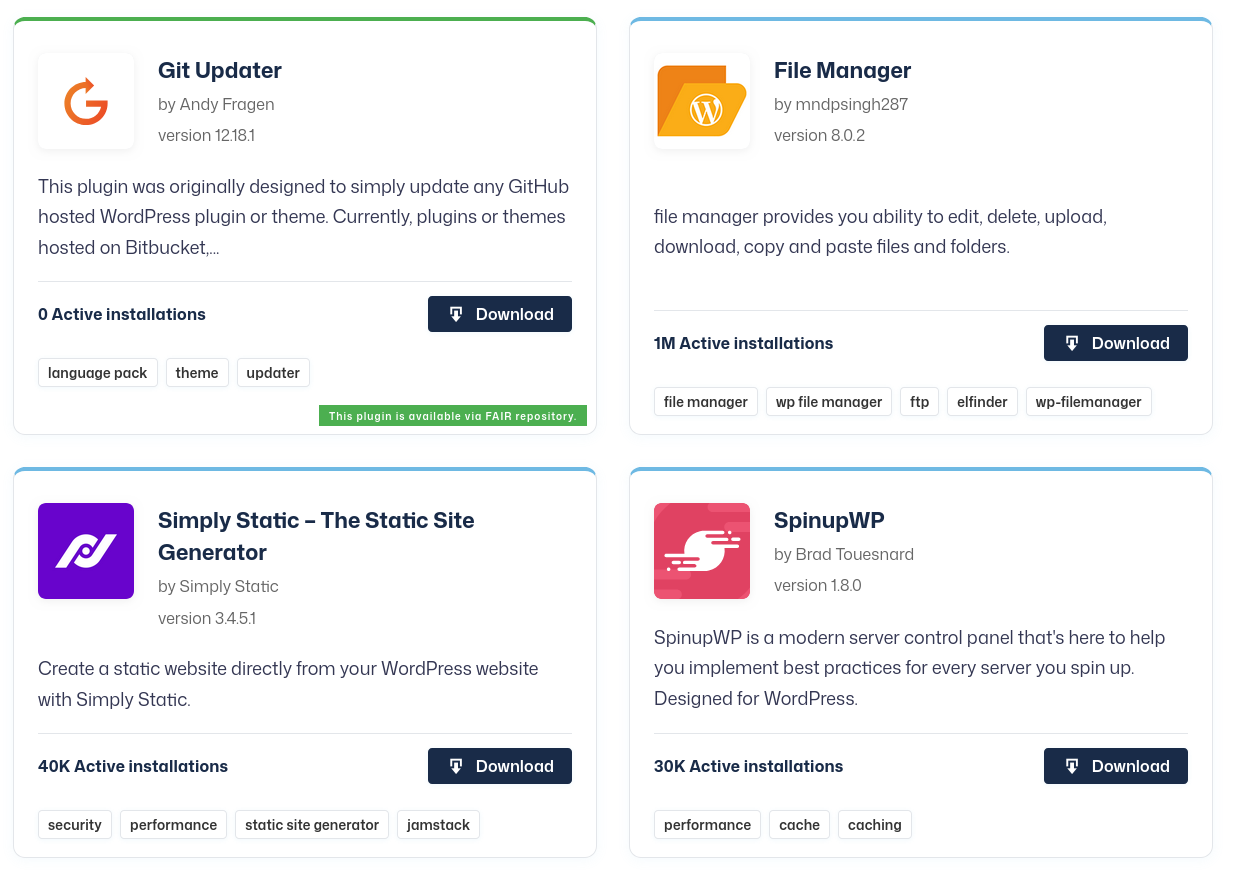
FAIR.pm is a groundbreaking new way of distributing software from a decentralized group of repositories. Discover, trust, install: FAIR 1.4.1 is here Decentralised WordPress packages are here. The working group for Federated And Independent Repositories is excited to announce its 1.4.1 Release. FAIR’s primary goal is to improve security in the software supply chain while […]
Software Sharing for Modern Companies | Fair.io
Fair Source is an alternative to closed source, allowing you to safely share access to your core products. Fair Source Software (FSS) can be used with minimal restrictions, and becomes Open Source after a period of time.
Software Sharing for Modern Companies | Fair.io
Fair Source is an alternative to closed source, allowing you to safely share access to your core products. Fair Source Software (FSS) can be used with minimal restrictions, and becomes Open Source after a period of time.
Some startups are going ‘fair source’ to avoid the pitfalls of open source licensing | TechCrunch
New alternative category to 'closed source' could help companies monetize software in the open -- without going all-in on open source.

SemRepo: A Knowledge Graph for Research Software and Its Scholarly Ecosystem
We present SemRepo, an RDF knowledge graph comprising over 81 million triples describing nearly 200,000 GitHub repositories associated with scientific research. SemRepo captures repository-level metadata, such as contributors, issues, and programming languages, and interlinks this information with external scholarly knowledge graphs. In particular, repository authors are linked to their profiles in SemOpenAlex, repositories are connected to scholarly publications in LPWC, and research artifacts, such as datasets and experiments, are linked via MLSea-KG. This integration enables queries that span publications and their scholarly artifacts, which are typically fragmented across separate platforms. SemRepo supports analyses that are difficult to perform with existing resources in isolation, including provenance reconstruction across repositories and publications, as well as the systematic identification of risks to research reproducibility and software sustainability. By unifying research software with its scholarly context in a single graph, SemRepo provides an important infrastructure for large-scale analysis of software within the broader scientific research ecosystem.

The Metacheck Manual
A guide to Metacheck, an R package providing a module based tool for checking scientific manuscripts and data repositories for best practices using text search, R code, and optional LLM queries.
FAIR Principles - GO FAIR
In 2016, the ‘FAIR Guiding Principles for scientific data management and stewardship’ were published in Scientific Data. The authors intended to provide guidelines to improve the Findability, Accessibility, Interoperability, and Reuse of digital assets. The principles emphasise machine-actionability (i.e., the capacity of… Continue reading →

FAIRdata.ai — FAIR Data Assessment
Assess your research data's FAIRness. Automated pipeline using F-UJI + Claude AI. Free to use.

Manuscript submission systems and metadata completeness in Crossref: Patterns and associations
The importance of open research information, particularly publication metadata, is widely recognised. Crossref is one of the most important infrastructures for registering open metadata as part of DOI record registration. It is widely known, however, that the metadata of many publications is far from complete, with many publishers making certain metadata openly available, but failing to do so for other metadata elements. Publishers’ ability to register this metadata with Crossref depends on their capacity to capture and retain this data in their production workflows. Manuscript submission systems are an important, yet largely overlooked, factor in the extent to which publishers make metadata available through Crossref. In this paper, we present the results of an analysis investigating the relation between the level of metadata that publishers deposit with Crossref and the submission systems that they deploy for their journals. We have looked at the 153 publishers with the largest amounts of publications in Crossref and concentrate on the four most commonly used systems: Editorial Manager, ScholarOne, Open Journal Systems (OJS) and eJournalPress. We show that some submission systems appear better suited to capturing certain metadata elements. However, there are always cases where publishers using the same system differ widely in the level of metadata they register, suggesting that technology is not the only prohibiting factor and other considerations are at play.
CCFS cryptographically curated file system
The Internet was originally designed to be a next-generation phone system that could withstand a Soviet attack. Today, we ask the Internet to perform tasks that no longer resemble phone calls in the face of threats that no longer resemble Soviet bombardment. However, we have come to rely on names that can be subverted at every level of the stack or simply be allowed to rot by their original creators. It is possible for us to build networks of content that serve the content distribution needs of today while withstanding the hostile environment that all modern systems face. This dissertation presents the Cryptographically Curated File System (CCFS), which offers five properties that we feel a modern content distribution system should provide. The first property is Strong Links, which maintains that only the owner of a link can change the content to which it points. The second property, Permissionless Distribution, allows anyone to become a curator without dependence on a naming or numbering authority. Third, Independent Validation arises from the fact that the object seeking affirmation need not choose the source of trust. Connectivity, the fourth property, allows any curator to delegate and curate the right to alter links. Each curator can delegate the control of a link and that designee can do the same, leaving a chain of trust from the original curator to the one who assigned the content. Lastly, with the property of Collective Confidence, trust does not need to come from a single source, but can instead be an aggregate affirmation. Since CCFS embodies all five of these properties, it can serve as the foundational technology for a more robust Web. CCFS can serve as the base of a web that performs the tasks of today’s Web, but also may outperform it. In the third chapter, we present a number of scenarios that demonstrate the capacity and potential of CCFS. The system can be used as a publication platform that has been re-optimized within the constraints of the modern Internet, but not the constraints of decades past. The curated links can still be organized into a hierarchical namespace (e.g., a Domain Naming System (DNS)) and de jure verifications (e.g., a Certificate Authority (CA) system), but also support social, professional, and reputational graphs. This data can be distributed, versioned, and archived more efficiently. Although communication systems were not designed for such a content-centric system, the combination of broadcasts and point-to-point communications are perfectly suited for scaling the distribution, while allowing communities to share the burdens of hosting and maintenance. CCFS even supports the privacy of friend-to-friend networks without sacrificing the ability to interoperate with the wider world. Finally, CCFS does all of this without damaging the ability to operate search engines or alert systems, providing a discovery mechanism, which is vital to a usable, useful web. To demonstrate the viability of this model, we built a research prototype. The results of these tests demonstrate that while the CCFS prototype is not ready to be used as a drop-in replacement for all file system use cases, the system is feasible. CCFS is fast enough to be usable and can be used to publish, version, archive, and search data. Even in this crude form, CCFS already demonstrates advantages over previous state-of-the-art systems. When the Internet was designed, there were relatively fewer computers that were far weaker than the computers we have now. They were largely connected to each other over reliable connections. When the Internet was first created, computing was expensive and propagation delay was negligible. Since then, the propagation delay has not improved on a Moore’s Law Curve. Now, latency has come to dominate all other costs of retrieving content; specifically, the propagation time has come to dominate the latency. In order to improve the latency, we are paying more for storage, processing, and bandwidth. The only way to improve propagation delay is to move the content closer to the destination. In order to have the content close to the demand, we store multiple copies and search multiple locations, thus trading off storage, bandwidth, and processing for lower propagation delay. The computing world should re-evaluate these trade-offs because the situation has changed. We need an Internet that is designed for the technologies used today, rather than the tools of the 20th century. CCFS, which regards the trade-off for lower propagation delay, will be better suited for 21st-century technologies. Although CCFS is not preferable in all situations, it can still offer tremendous value. Better robustness, performance, and democracy make CCFS a contribution to the field. Robustness comes from the cryptographic assurances provided by the five properties of CCFS. Performance comes from the locality of content. Democracy arises from the lack of a centralized authority that may grant the right of Free Speech only to those who espouse rhetoric compatible with their ideals. Combined, this model for a cryptographically secure, content-centric system provides a novel contribution to the state of communications technology and information security.
Attack Resistant Trust Metric Metadata HOWTO
3 Jul 2002: Advogato is now running an implementation of the generic metadata engine described below. The code is available at the mod_virgule CVS, hosted on casper.

Crossref: The sustainable source of community-owned scholarly metadata
This paper describes the scholarly metadata collected and made available by Crossref, as well as its importance in the scholarly research ecosystem. Containing over 106 million records and expanding at an average rate of 11% a year, Crossref’s metadata has become one of the major sources of scholarly data for publishers, authors, librarians, funders, and researchers. The metadata set consists of 13 content types, including not only traditional types, such as journals and conference papers, but also data sets, reports, preprints, peer reviews, and grants. The metadata is not limited to basic publication metadata, but can also include abstracts and links to full text, funding and license information, citation links, and the information about corrections, updates, retractions, etc. This scale and breadth make Crossref a valuable source for research in scientometrics, including measuring the growth and impact of science and understanding new trends in scholarly communications. The metadata is available through a number of APIs, including REST API and OAI-PMH. In this paper, we describe the kind of metadata that Crossref provides and how it is collected and curated. We also look at Crossref’s role in the research ecosystem and trends in metadata curation over the years, including the evolution of its citation data provision. We summarize the research used in Crossref’s metadata and describe plans that will improve metadata quality and retrieval in the future.
SemRepo.org
SemRepo is a large-scale RDF knowledge graph of GitHub repositories linked to scientific research. SemRepo captures fine-grained repository-level metadata (e.g., contributors, issues, programming languages) and interlinks this with external scholarly knowledge graphs: repositories to publications in LPWC, repository authors to their profiles in SemOpenAlex, and research artifacts (e.g., datasets, experiments) are linked via MLSea.
What if a PDS became more than a repository for posts? We propose using AT Protocol as a creator-controlled publication layer for declaration metadata describing digital works, making rights, provenance, and other trusted metadata independently verifiable and easier to discover.

From Personal Data Server to Personal Metadata Server
liccium.leaflet.pub