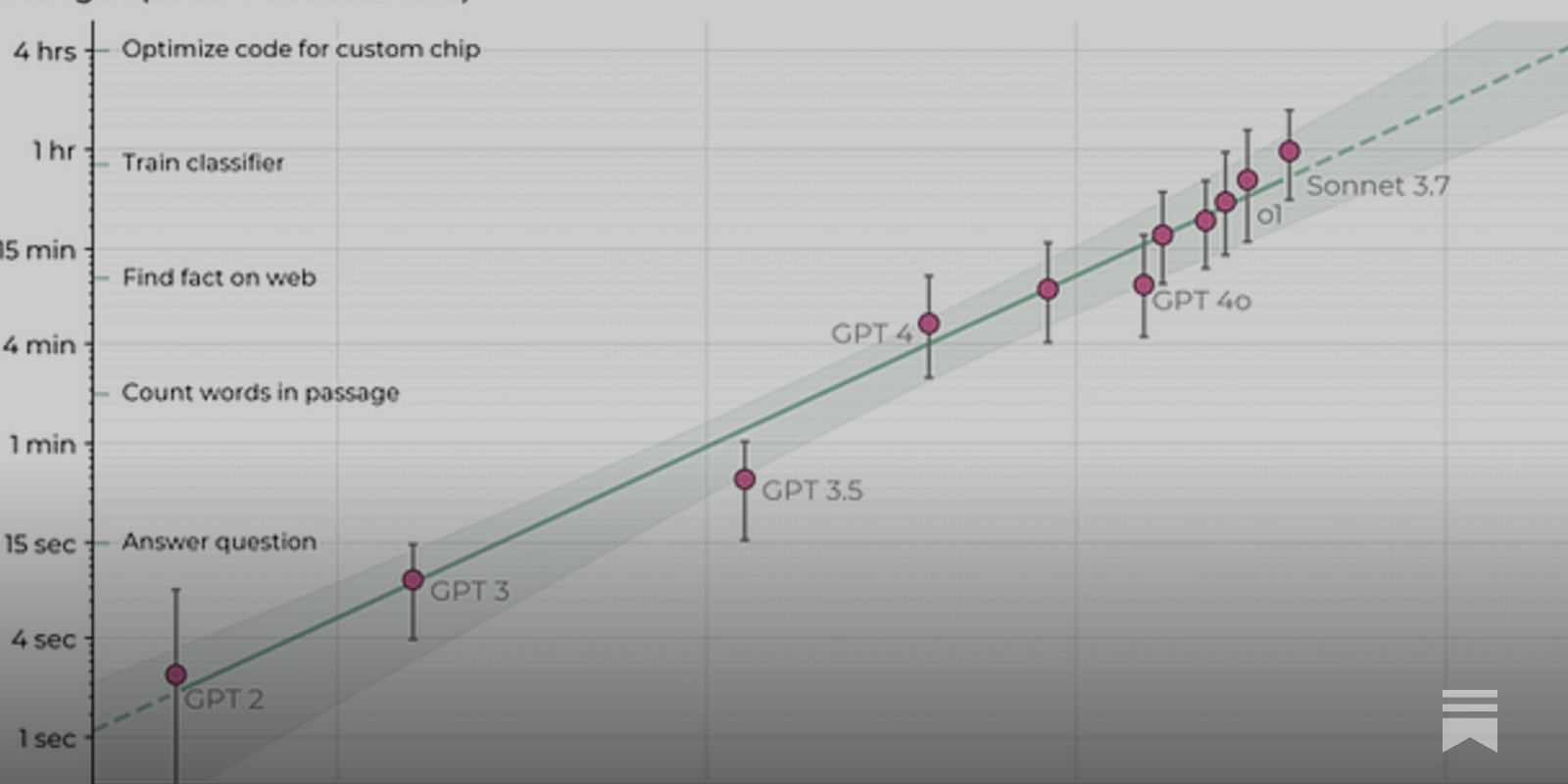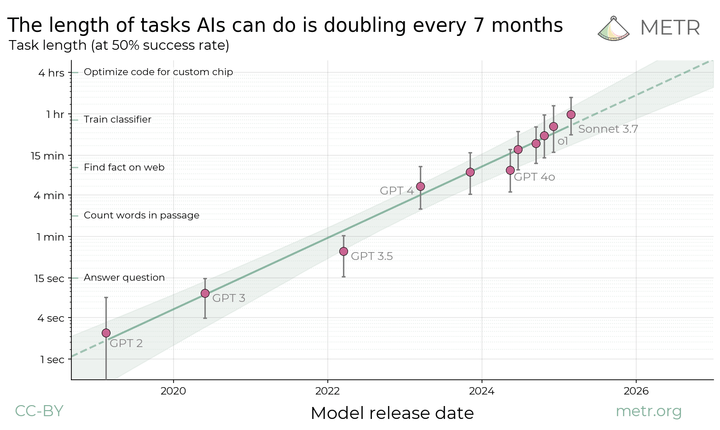
We propose measuring AI performance in terms of the *length* of tasks AI agents can complete. We show that this metric has been consistently exponentially increasing over the past 6 years, with a doubling time of around 7 months. Extrapolating this trend predicts that, in under a decade, we will see AI agents that can independently complete a large fraction of software tasks that currently take humans days or weeks.
AI research speeds up. Monitoring gets harder. - Sensemaker
OpenAI says coding agents now run 3.1 days for every human research day, while its chief scientist warns the lab’s main monitoring method is weakening.
Measuring the Impact of Early-2025 AI on Experienced Open-Source Developer Productivity
Despite widespread adoption, the impact of AI tools on software development in the wild remains understudied. We conduct a randomized controlled trial (RCT) to understand how AI tools at the February-June 2025 frontier affect the productivity of experienced open-source developers. 16 developers with moderate AI experience complete 246 tasks in mature projects on which they have an average of 5 years of prior experience. Each task is randomly assigned to allow or disallow usage of early 2025 AI tools. When AI tools are allowed, developers primarily use Cursor Pro, a popular code editor, and Claude 3.5/3.7 Sonnet. Before starting tasks, developers forecast that allowing AI will reduce completion time by 24%. After completing the study, developers estimate that allowing AI reduced completion time by 20%. Surprisingly, we find that allowing AI actually increases completion time by 19%--AI tooling slowed developers down. This slowdown also contradicts predictions from experts in economics (39% shorter) and ML (38% shorter). To understand this result, we collect and evaluate evidence for 20 properties of our setting that a priori could contribute to the observed slowdown effect--for example, the size and quality standards of projects, or prior developer experience with AI tooling. Although the influence of experimental artifacts cannot be entirely ruled out, the robustness of the slowdown effect across our analyses suggests it is unlikely to primarily be a function of our experimental design.

AI Coding Agent Benchmarks & Leaderboard | Artificial Analysis
We measure real-world performance of coding agents on software engineering tasks, including cost, token usage, and execution time. We compare how performance changes across agents, models, and execution settings.
MirrorCode: evidence AI can already do some weeks-long coding tasks
Early results from MirrorCode benchmark with METR: AI agents can complete weeks-long coding tasks, including reimplementing a 16,000-line codebase.
TasteVal: Measuring the Experimental Research Taste of AI Systems Against Human Experts
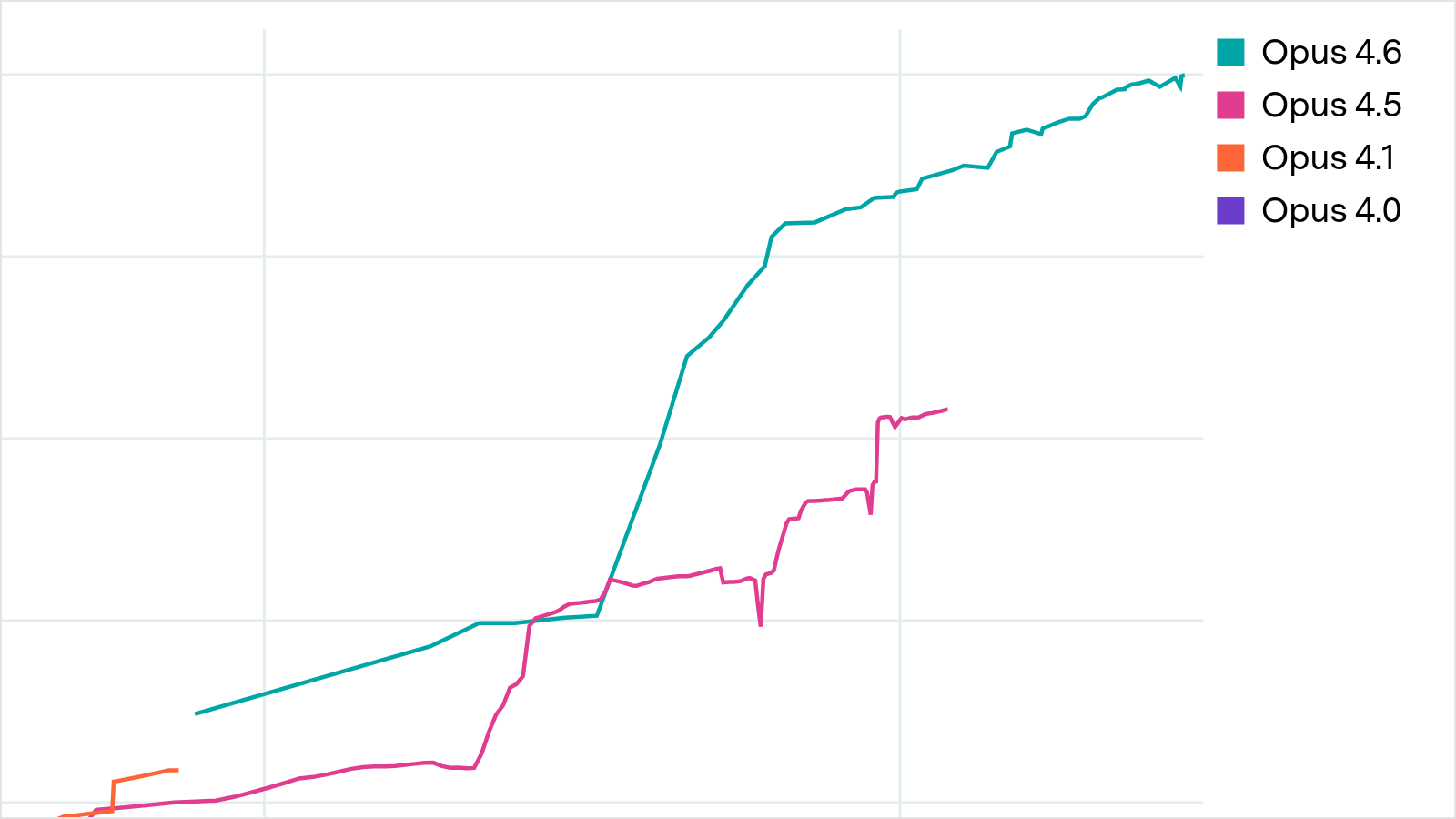
We introduce TasteVal, a benchmark to evaluate the experimental research taste of frontier models. We define research taste as the ability to pick interesting problems to solve, design experiments, and interpret experimental results. TasteVal measures the experimental component of research taste; given a fixed research problem, we measure how well a model iteratively designs experiments and draws conclusions from their outcomes. We operationalize experimental research taste as compute efficiency; a Researcher who reaches the same score as an expert human using half the serial experimental compute has twice the experimental taste. Experimental taste thus acts as a multiplier on experimental compute, making it a key input to forecasts of AI progress. TasteVal consists of 8 novel, challenging, open-ended tasks representative of frontier AI R&D. To isolate taste from coding ability, the model under evaluation acts as a Researcher that iteratively designs experiments while a fixed Coder agent implements them and reports their results. The Researcher executes until either the 40 H100 hour or 120 wall-clock hour budgets are exhausted. We recruit 24 human experts, at least 2 per task, and take the best expert attempt per task as the expert baseline. We evaluate 20 models released between 2023 and 2026. The best-performing model, Opus 5.5, exceeds our expert baseline, with a compute multiplier of 2.3x (95% CI 1.15-4.37), at roughly 1/30 of our baseliners' average per-run cost. On TasteVal, the compute multiplier of frontier models has doubled approximately every 3.0 months since December 2025 (95% CI 1.7-5.0), up from every 14 months between 2023 and December 2025. Measured by final normalized performance, frontier models show no trend break, doubling every 14.6 months. To keep TasteVal uncontaminated, we do not release the tasks.
Measuring the Impact of Early-2025 AI on Experienced Open-Source Developer Productivity
We conduct a randomized controlled trial to understand how early-2025 AI tools affect the productivity of experienced open-source developers working on their own repositories. Surprisingly, we find that when developers use AI tools, they take 19% longer than without—AI makes them slower.
scaleapi/SWE-bench_Pro-os
SWE-Bench Pro: Can AI Agents Solve Long-Horizon Software Engineering Tasks?
Measuring Usage in the Age of AI - Research Information
Tasha Mellins-Cohen outlines COUNTER Metrics' new guidance for usage metrics associated with generative and agentic AI

The Eternal Sloptember
I’m calling it now, the adoption of AI agents into software development will be one of the most costly mistakes in the field’s history. Agents cannot program, and it’s taking longer and longer to realize that they can’t. They are a highly sophisticated statistical model designed to mimic the distribution of programming. The output is broken, but in a way that’s getting harder and harder to detect. Which is exactly what you’d expect from an increasingly accurate statistical model.
The Eternal Sloptember
I’m calling it now, the adoption of AI agents into software development will be one of the most costly mistakes in the field’s history. Agents cannot program, and it’s taking longer and longer to realize that they can’t. They are a highly sophisticated statistical model designed to mimic the distribution of programming. The output is broken, but in a way that’s getting harder and harder to detect. Which is exactly what you’d expect from an increasingly accurate statistical model.
Agent Skills
AI coding agents take the shortest path to done, which usually means skipping the specs, tests, and reviews that make software reliable at scale. Agent Skill...
AI coding agents generate more code, but not more software
Study finds coding efficiency gains get "absorbed" by human review "bottleneck."

ARC-AGI-3: A New Challenge for Frontier Agentic Intelligence
We introduce ARC-AGI-3, an interactive benchmark for studying agentic intelligence through novel, abstract, turn-based environments in which agents must explore, infer goals, build internal models of environment dynamics, and plan effective action sequences without explicit instructions. Like its predecessors ARC-AGI-1 and 2, ARC-AGI-3 focuses entirely on evaluating fluid adaptive efficiency on novel tasks, while avoiding language and external knowledge. ARC-AGI-3 environments only leverage Core Knowledge priors and are difficulty-calibrated via extensive testing with human test-takers. Our testing shows humans can solve 100% of the environments, in contrast to frontier AI systems which, as of March 2026, score below 1%. In this paper, we present the benchmark design, its efficiency-based scoring framework grounded in human action baselines, and the methodology used to construct, validate, and calibrate the environments.
What We Learned from Letting AI Posttrain AI
We built a posttraining task that runs for 20 hours with the Tinker API. The core bottleneck is research intuition.
SWE-Bench Pro: Can AI Agents Solve Long-Horizon Software Engineering Tasks?
Large Language Model (LLM) agents have been widely adopted in modern software development workflows. SWE-bench [13] and related works [23, 24, 22, 25, 15] establish the task of issue resolution as a de-facto standard for assessing their capability and usefulness. In this setting, an agent is given an entire codebase, a task description (e.g., a bug report or feature request) in natural language and is instructed to produce a code patch that resolves the issue and passes the repository’s test suite. These benchmarks have been instrumental in demonstrating both the substantial potential and the persistent limitations of current models as SWE agents.
Where’s my ten minute AGI?
Why don’t AIs automate more real-world tasks if they can handle 1-hour ones? Here are at least three fundamental reasons.