


For twenty-five years, an Italian hacker collective has built communications infrastructure designed to survive censorship, surveillance and police raids. On August 26, the United States designated it a terrorist organization. On September 25, the wind-down period ends.
The Server Called Paranoia: Defend Autistici/Inventati Before September 25 – Sabot Media
For twenty-five years, an Italian hacker collective has built communications infrastructure designed to survive censorship, surveillance and police raids. On August 26, the United States designated it a terrorist organization. On September 25, the wind-down period ends.
The Server Called Paranoia: Defend Autistici/Inventati Before September 25

The Server Called Paranoia: Defend Autistici/Inventati Before September 25
Defend Autistici/Inventati
Nineteen Days Before the Deadline, Autistici/Inventati Is Shutting Down
The Italian communications collective survived raids, surveillance and server seizures for 25 years. Eleven days after the United States designated it a global terrorist organization, A/I says the risk to its users has become too great to…

Nineteen Days Before the Deadline, Autistici/Inventati Is Shutting Down
Follow all the original reporting at sabot.media and our dedicated campaign page and investigations page. The Italian communications collective survived raids, surveillance and server seizures for 25 years. Eleven days after the United States designated it a global terrorist organization, A/I says the risk to its users has
United States sanctions Autistici/Inventati for supporting far-left terrorism
The US designated Italy-based tech collective Autistici/Inventati as a global terrorist entity, freezing assets and banning transactions over

Press Release · Keep the Internet free
On August 26, 2026, the U.S. Department of the Treasury, through OFAC (Office of Foreign Assets Control – the authority responsible for managing and enforcing economic and financial sanctions) sanctioned Autistici/Inventati (A/I), an Italian collective that has been providing digital infrastructure – email, hosting, mailing lists, chat, videoconferencing and other privacy-friendly online services – to movements and activists since 2001. Washington designated it as a Specially Designated Global Terrorist (SDGT), alleging that it has provided financial, material or technological support to terrorism and to organizations already subjected to sanctions. A/I rejects the allegations and declares that its activities consist in providing tools for digital self-defence and infrastructure for the freedom of communication.
The case of the ‘Autistici/Inventati’ and the US sanctions targeting the infrastructure, not those responsible
On 26 August, the United States added the Italian collective Autistici/Inventati to the OFAC list of Specially Designated Global Terrorists. The measure,...
Press Release · Keep the Internet free
On August 26, 2026, the U.S. Department of the Treasury, through OFAC (Office of Foreign Assets Control – the authority responsible for managing and enforcing economic and financial sanctions) sanctioned Autistici/Inventati (A/I), an Italian collective that has been providing digital infrastructure – email, hosting, mailing lists, chat, videoconferencing, streaming, and services related to privacy and anonymity – to movements and activists since 2001. Washington designated it as a Specially Designated Global Terrorist (SDGT), alleging that it has provided financial, material or technological support to terrorism and to organizations already subjected to sanctions. A/I rejects the allegations and declares that its activities consist in providing tools for digital self-defence and infrastructure for the freedom of communication.
Open Letter: Communications Infrastructure Is Not Terrorism
Defend Autistici/Inventati and the right to build resistant communication *Letter for individuals to send to their reps, senators, and the like is at the end of this article* On August 26, 2026, the United States designated the Italian volunteer technology collective Autistici/Inventati as a Specially Designated Global Terrorist
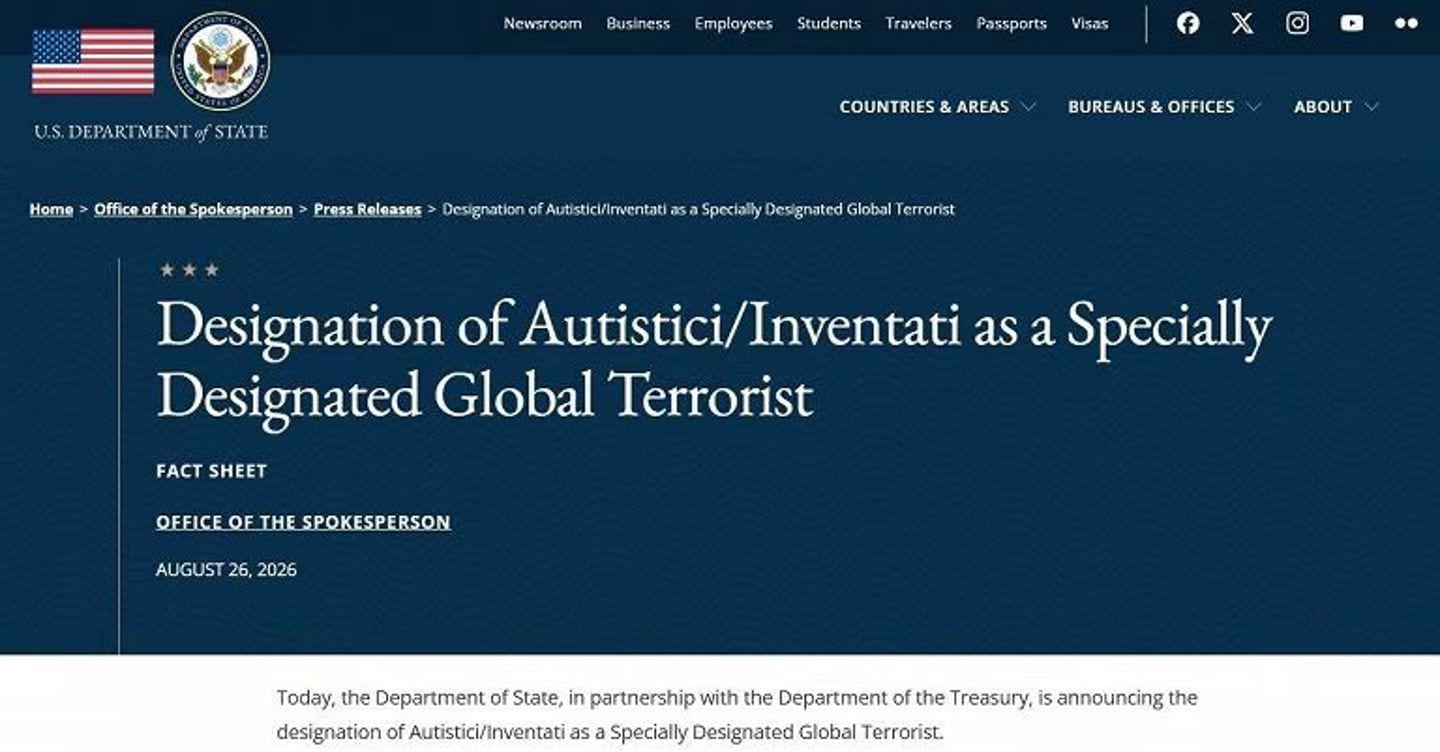
Designation of Autistici/Inventati as a Specially Designated Global Terrorist - United States Department of State
Today, the Department of State, in partnership with the Department of the Treasury, is announcing the designation of Autistici/Inventati as a Specially Designated Global Terrorist. Autistici/Inventati (A/I Collective) is an Italy-based extremist group that builds and operates the digital infrastructure for violent Antifa cells and other far-left militants across the world. A/I’s cadre of radical […]

+KAOS: Ten Years of Hacking and Media Activism
At the end of the 20th century, hacking was bleeding edge. When the ideas, practices and pranks of this experimental niche of technophiles attracted the attention of a handful of activists in Italy, they understood that information and communication were what would give shape and voice to social, political, and cultural processes in the near future. +KAOS is a cut and paste of interviews, like a documentary film transposed on paper. It describes the peculiar relationship between hacktivism and activism, in Italy and beyond, highlighting the importance of maintaining digital infrastructures. While this may not sound as glamorous as sneaking into a server and leaking data, it is a fundamental topic: not even the most emblematic group of hacktivists can operate without the services of radical server collectives. Autistici/Inventati (https://www.autistici.org - https://www.inventati.org)

Autistici/Inventati
Autistici/Inventati (A/I) was an Italian hacktivist group that provided Internet communication services for left-wing activists.[1] It was founded in 2001 by members of the anti-globalisation movement and supported Indymedia Italy in reporting on the 27th G8 summit in Genoa that year.[1][2] The collective's email, messaging, videoconferencing and web hosting services were available to users who opposed fascism, militarism, racism, sexism, homophobia and transphobia.[3] A/I also operated the online publishing platform NoBlogs.[4]
Italian hosting collective Autistici/Inventati is shutting down after a US terrorist designation
A US sanctions listing cost the 25-year-old Italian collective its .org domain, its payment processor and its bank within a week.
US Government Designates Host of NoBlogs.org a "Global Terrorist"
The US government has classified the Italian collective Autistici/Inventati as a "Specially Designated Global Terrorist," citing the collective's "far-left" politics.

Keep the Internet free
On August 26, 2026, the United States placed the Italian collective Autistici/Inventati on its terrorism sanctions list, accusing it of providing online services to violent groups. Since 2001 the collective has offered free email, hosting and other tools to activists, and it rejects the accusations entirely. Two days later its website disappeared from the internet — not because the machines were switched off, but because the address that leads people to them stopped working.