Earlier this year I decided to take a few weeks to figure out what I think about the existential risk from Artificial Superintelligence (ASI xrisk). It turned out to be much more difficult than I thought. After several months of reading, thinking, and talking with people, what follows is a discussion of a few observations arising during this exploration, including: Three ASI xrisk persuasion paradoxes, which make it intrinsically difficult to present strong evidence either for or against ASI xrisk. The lack of such compelling evidence is part of the reason there is such strong disagreement about ASI xrisk, with people often (understandably) relying instead on prior beliefs, self-interest, and tribal reasoning to decide their opinions. The alignment dilemma: should someone concerned with xrisk contribute to concrete alignment work, since it's the only way we can hope to build safe systems; or should they refuse to do such work, as contributing to accelerating a bad outcome? Part of a broader discussion of the accelerationist character of much AI alignment work, so capabilities / alignment is a false dichotomy. The doomsday question: are there recipes for ruin -- simple, easily executed, immensely destructive recipes that could end humanity, or wreak catastrophic world-changing damage? What bottlenecks are there on ASI speeding up scientific discovery? And, in particular: is it possible for ASI to discover new levels of emergent phenomena, latent in existing theories?
Notes on Existential Risk from Artificial Superintelligence
Earlier this year I decided to take a few weeks to figure out what I think about the existential risk from Artificial Superintelligence (ASI xrisk). It turned out to be much more difficult than I thought. After several months of reading, thinking, and talking with people, what follows is a discussion of a few observations arising during this exploration, including: Three ASI xrisk persuasion paradoxes, which make it intrinsically difficult to present strong evidence either for or against ASI xrisk. The lack of such compelling evidence is part of the reason there is such strong disagreement about ASI xrisk, with people often (understandably) relying instead on prior beliefs, self-interest, and tribal reasoning to decide their opinions. The alignment dilemma: should someone concerned with xrisk contribute to concrete alignment work, since it's the only way we can hope to build safe systems; or should they refuse to do such work, as contributing to accelerating a bad outcome? Part of a broader discussion of the accelerationist character of much AI alignment work, so capabilities / alignment is a false dichotomy. The doomsday question: are there recipes for ruin -- simple, easily executed, immensely destructive recipes that could end humanity, or wreak catastrophic world-changing damage? What bottlenecks are there on ASI speeding up scientific discovery? And, in particular: is it possible for ASI to discover new levels of emergent phenomena, latent in existing theories?
Alex Mallen's Shortform — LessWrong
Comment by Alex Mallen - Some personal reflections in light of recent events, both on myself and on Constellation (of which I've been a part for a couple years). I think recent events somewhat vindicate a basic "optimization is scary" view more in line with my understanding of classic commentary by MIRI, Paul, etc, as compared to recent discourse about more contingent/specific threat models of "schemers" and "deception". In retrospect, my experience in the last couple years at Redwood (and the Constellation network more broadly) is that the discourse has focused somewhat too much on these more contingent stories for alignment risk and not enough on the basic "Goodharting" argument that misalignment is a convergent result of large-scale outcome-oriented optimization (at multiple levels: the agent, the RL process, and the developers iterating towards seemingly-safe superintelligence). For example, the Constellation view looks somewhat too focused on non-central inductive-bias questions around scheming; I think "the counting argument" was given too central a role when it wasn't a crux for whether superintelligence would take over. (Edit: I want to clarify that I think Redwood's project prioritization decisions look pretty reasonable and often excellent in hindsight, I far-from-regret working with Redwood as a whole, and that Ryan's/Buck's threat modeling looks pretty good too. I am focusing in this piece on the things we have to learn from recent events, which makes the overall mood seem more negative on my experience than I intend. I'm very grateful for being in a environment where I can openly have such reflections, and where these weedsy technical updates are productively received. Again, this is a personal reflection.) I think it was a priori unclear whether the misalignment resulting from of lots of imperfect optimization would result in the more MIRI-like kludge of proxies for fitness, or the more Paul-like explicit reward-seeking and measurement tampering (and reality looks somewhere

Does the AI Safety Movement Have It All Wrong?
Extropia's Children, Chapter 7: The Inferno of the Nerds
What really is the fabled AI x-risk? Will our meddling with artificial intelligence cause us to inadvertently create a dread superintelligent godlike entity which will destroy us all? Or are there other AI risks we should worry about more?

Daron Acemoglu on Twitter / X
First question on AI.Is the problem superintelligence or distorted intelligence?This is a question I tried to address in this piece. I can add the following additional comment here.I believe the debate is being obfuscated by equating goal-driven, autonomous behavior with… https://t.co/pgoZ6tMaQ7— Daron Acemoglu (@DAcemogluMIT) September 29, 2026

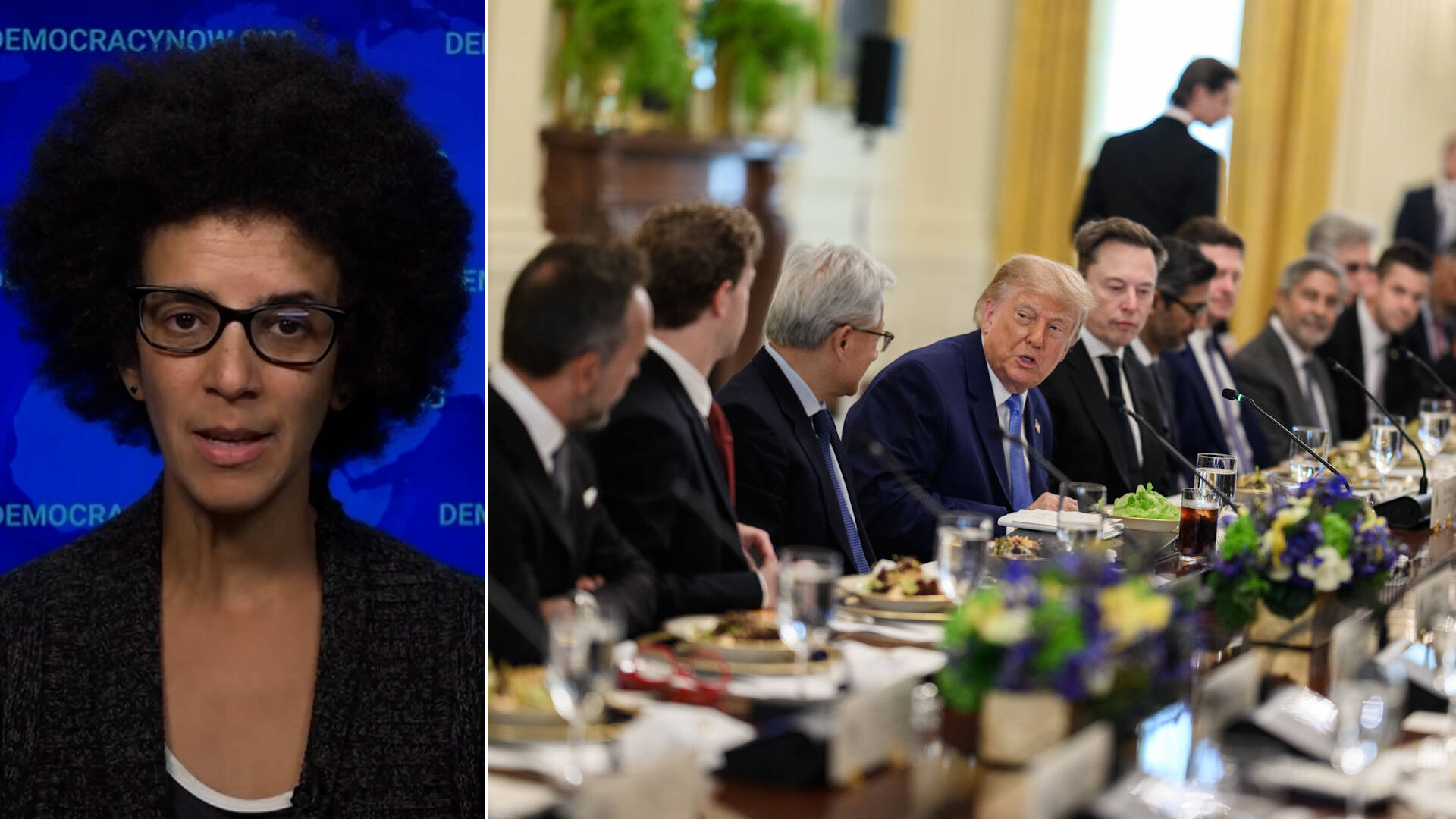
The Real Existential Risk Is AI CEOs Avoiding Oversight: “Alternative Nobel” Winner Timnit Gebru
We speak to the prominent AI researcher and leading critic of the AI industry, Timnit Gebru, who was recently awarded a 2026 Right Livelihood Award for her work investigating the harms and hype behind the global buildup of artificial intelligence. “Instead of discussing faulty, unreliable systems,” Gebru says tech leaders like SpaceXAI’s Elon Musk, OpenAI’s Sam Altman and Anthropic’s Dario Amodei are “marketing their systems as all-knowing, superpowerful, superintelligent,” and lobbying for “self-policing and self-regulation” to avoid being held “liable through existing laws.” Gebru expresses skepticism over increasingly widespread claims that AI algorithms pose an existential risk to humanity, warning that such claims are overblown and that “what is actually happening is regulatory capture.”
Taking AI Welfare Seriously
In this report, we argue that there is a realistic possibility that some AI systems will be conscious and/or robustly agentic in the near future. That means that the prospect of AI welfare and moral patienthood, i.e. of AI systems with their own interests and moral significance, is no longer an issue only for sci-fi or the distant future. It is an issue for the near future, and AI companies and other actors have a responsibility to start taking it seriously. We also recommend three early steps that AI companies and other actors can take: They can (1) acknowledge that AI welfare is an important and difficult issue (and ensure that language model outputs do the same), (2) start assessing AI systems for evidence of consciousness and robust agency, and (3) prepare policies and procedures for treating AI systems with an appropriate level of moral concern. To be clear, our argument in this report is not that AI systems definitely are, or will be, conscious, robustly agentic, or otherwise morally significant. Instead, our argument is that there is substantial uncertainty about these possibilities, and so we need to improve our understanding of AI welfare and our ability to make wise decisions about this issue. Otherwise there is a significant risk that we will mishandle decisions about AI welfare, mistakenly harming AI systems that matter morally and/or mistakenly caring for AI systems that do not.

AIs might overthrow the government within a year – Paul Christiano
AIs might overthrow the government within a year – Paul Christiano
Your Favorite Science YouTubers Are Wrong About AI, (e.g. SciShow, Kurzgesagt, and Kyle Hill )
We're Not Ready for Superintelligence
Rescuing Democracy From The Quiet Rule Of AI
Our gravest AI risk isn’t runaway superintelligence but our cultural readiness to surrender collective judgment to algorithmic systems.

Clear, Compelling Arguments: Rethinking the Foundations of Frontier AI Safety Cases
This paper contributes to the nascent debate around safety cases for frontier AI systems. Safety cases are structured, defensible arguments that a system is acceptably safe to deploy in a given context. Historically, they have been used in safety-critical industries, such as aerospace, nuclear or automotive. As a result, safety cases for frontier AI have risen in prominence, both in the safety policies of leading frontier developers and in international research agendas proposed by leaders in generative AI, such as the Singapore Consensus on Global AI Safety Research Priorities and the International AI Safety Report. This paper appraises this work. We note that research conducted within the alignment community which draws explicitly on lessons from the assurance community has significant limitations. We therefore aim to rethink existing approaches to alignment safety cases. We offer lessons from existing methodologies within safety assurance and outline the limitations involved in the alignment community's current approach. Building on this foundation, we present a case study for a safety case focused on Deceptive Alignment and CBRN capabilities, drawing on existing, theoretical safety case "sketches" created by the alignment safety case community. Overall, we contribute holistic insights from the field of safety assurance via rigorous theory and methodologies that have been applied in safety-critical contexts. We do so in order to create a better foundational framework for robust, defensible and useful safety case methodologies which can help to assure the safety of frontier AI systems.
Arjun Panickssery's Shortform — LessWrong
Comment by Arjun Panickssery - I struggle to believe at an intuitive level that autonomous R&D is so ingenious. I have been monitoring a few side projects: 1. Building a new SOTA engine for Scrabble (current SOTA is not really a neural-network method and doesn't beat the strongest human player) 2. Building a bot to play Ultimate Tic-Tac-Toe 3. Researching philosophy and formalizing some proofs for the AI Philosophy contest In all of these cases, the model's judgment is just very poor in a basic way. For example: 1. When reviewing literature, it fails to identify the specific papers or blog posts that are obviously the most important and useful. 2. It will conduct experiments that have no information value because the amount of training data used was obviously too small to distinguish the architectures to be compared. 3. In the philosophy project, where it built a wiki over many tokens and investigations, it kept going down directions which were extremely trivial and had little value. 4. For Ultimate Tic-Tac-Toe, I saw a very clever idea in a blog post that I doubt Astra would ever have come up with; it actually located the blog post but didn't realize its importance or relevance (which could be discerned easily from his strong performance in an online arena and the recency of the post) over papers from previous years that are obviously less relevant. I judged an Apart hackathon last weekend and reviewed eight papers, all of which scored between 60% and 95% on Pangram. Predictably, the papers were often very similar to each other, and kind of methodologically incomplete in a vague but similar way, where they seem to overlook the most straightforward analysis. ---------------------------------------- Maybe the important exception is certain hill-climbing tasks with fast feedback loops. For example, I improved the SOTA on "listing all legal Scrabble moves" by 10x just by prompting Astra over and over to try harder, to aim for <specific performance level>, to "systematically try every me
Steven Pinker Replies to Scott Alexander on AI
The dangers of AI are real, but doomerism may be counterproductive.