

A (very) belated follow up to Getting Started with Microformats 2, covering the basics of consuming and using microformats 2 data. Originally posted on waterpigs.co.uk.
WDC - RDFa, Microdata, and Microformat Data Sets
More and more websites have started to embed structured data describing products, people, organizations, places, and events into their HTML pages using markup standards such as Microdata, JSON-LD, RDFa, and Microformats. The Web Data Commons project extracts this data from several billion web pages. So far the project provides 12 different data set releases extracted from the Common Crawls 2010 to 2023. The project provides the extracted data for download and publishes statistics about the deployment of the different formats.
h-card - Microformats Wiki
h-card is a simple, open format for publishing people and organisations on the web. h-card is often used on home pages and individual blog posts. h-card is one of several open microformat draft standards suitable for embedding data in HTML.
h-feed
h-feed is a microformats2 specification for marking up HTML as a feed with optional with name, photo, common author, that contains h-entry items (or other root (h-*) objects), and published by numerous personal sites and consumed by social readers.
GreenGale Kitchen Sink
Check out all the formatting styles, text options, blocks, and features available for your posts on this platform.
Micro.blog Surpasses Kickstarter Funding Goal, Set to Launch New Social Network for Independent Microblogs
Developer Manton Reece is on a mission to take back short form content for the open web by providing better tools for independent microblogging. Most short form content today is posted through cent…

mmm.page — Your Corner of the Internet
Websites don't have to be so cookie cutter. Make a website that feels uniquely you in under five minutes.

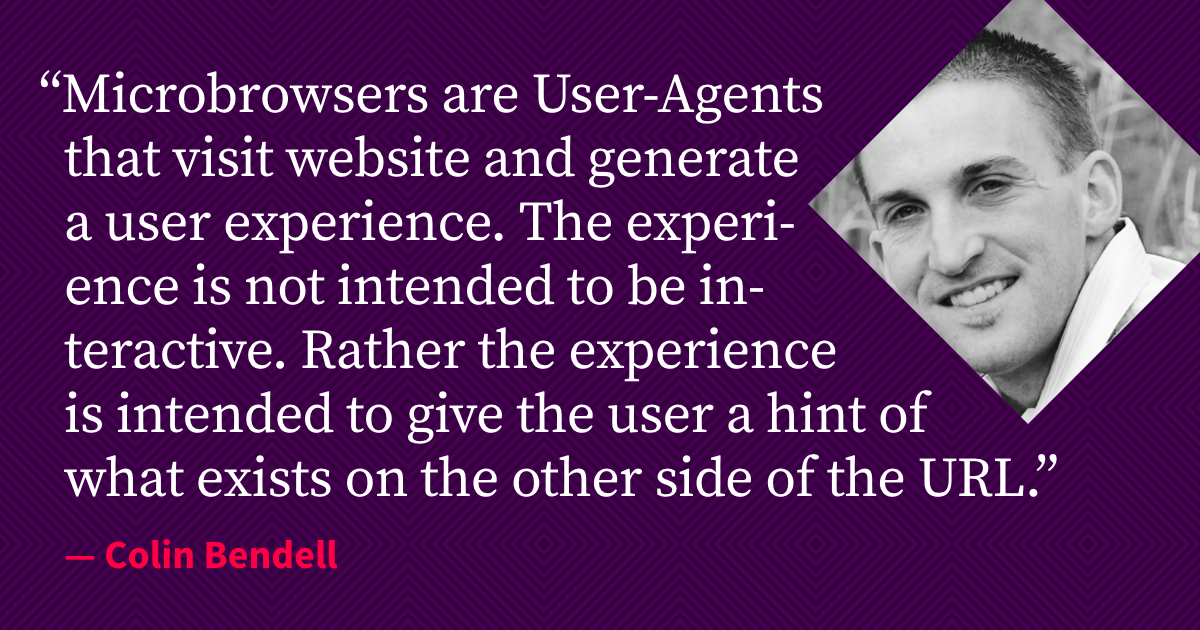
Microbrowsers are Everywhere
Colin Bendell gets into the minutia of microbrowsers - the small previews of your site that are pervasive all around the web and through social media apps and search engines whenever an item of content on your site is referenced.
Blendle: A radical experiment with micropayments in journalism, 365 days later
One year of journalism without subscriptions, without ads and without clickbait

granary: the social web translator
Fetches and converts data between social networks, HTML and JSON with microformats2, ActivityStreams 1 and 2 (including ActivityPub), Atom, RSS, JSON Feed, and more.

Mochott_ Kitchen Sink
Check out all the formatting styles, text options, blocks, and features available for your posts on this platform.


Vision and Reality of Hypertext and GUIs: 2.1.13 Microcosm @mprove
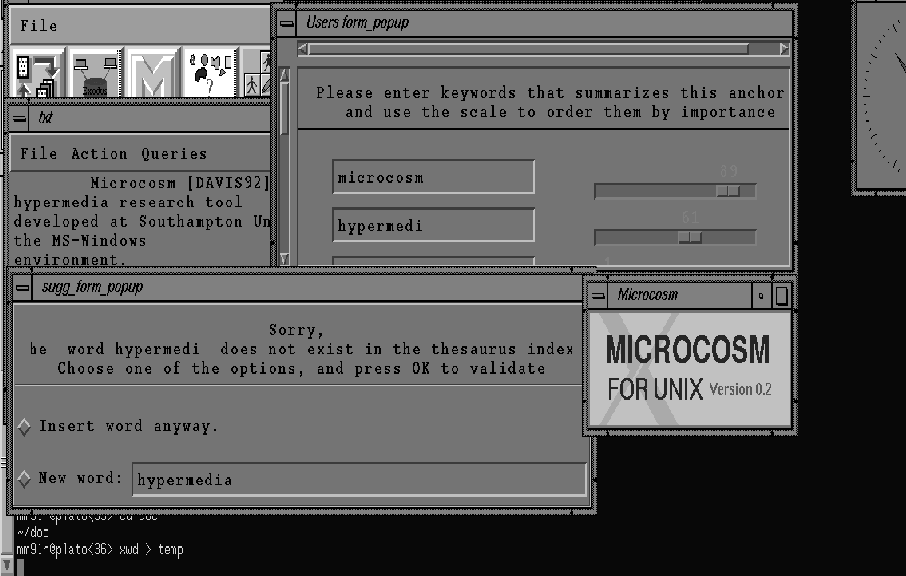
Microcosm (cf. 2.1.13) is a research project at the University of Southampton. Like Intermedia five years before, Microcosm is designed around the idea that material of diverse sources and formats should be tied together into one hypertext. To achieve this goal links have to be separated from the documents. They are stored and maintained in special link databases. In contrast to Intermedia, Microcosm plays the active role in gathering the necessary data out of the documents. For each topic it stores data on which documents contain information about it and also where inside the documents the information is located. This elaborated conception of links can be seen more as a kind of Memex’ trails than simple one-to-one links. Given this structure dynamic linking becomes possible. This means that links can be associated with generic text strings. Wherever this string shows up a link is placed automatically. This has the effect that documents that are imported for the first time into Microcosm can have links immediately.

The Micro-Paper: Towards cheaper, citable research ideas and conversations
Academic, peer-reviewed short papers are a common way to present a late-breaking work to the academic community that outlines preliminary findings, research ideas, and novel conversations. By comparison, blogging or writing posts on social media are an unstructured and open way to discuss ideas and start new conversations. Both have limitations in the proliferation of research ideas. The short paper format relies on the conference and journal submission process while blogging does not operate within a structured format or set of expectations at all. However, at times the demand exists for late-breaking ideas and conversations to arise in a raw form or with urgency but should still be archived and recorded in a way that promotes citational honesty and integrity. To address this, I present: The Micro-Paper, as a micro-paper itself. The Micro-Paper is a small, cheap, accessible, digital document that is self-published and archived, akin to a pre-print of a short paper. This meta micro-paper discusses the context, goals, and considerations of micro-paper authoring.

One thing I left out of my The Everything Account piece was a whole section on Bridgy Fed. Short version: As Bridgy Fed adds more lexicons, it makes the Atmosphere the most versatile and data-owning Fediverse instance in the open social web. Perhaps in a future piece 😉

Anuj Ahooja
I wrote about what I've been calling "The Everything Account" If you're familiar with The Atmosphere, you already know how to get one, and this should hopefully help you explain it to others. For those of you who aren't, you'll be surprised to know you already have one; here's how you use it:
Grain photos in Micro.blog: manton.org/2026/07/23/grain-photos-in-mi…
