

Training metrics of the mimo-v2.6-pro and mimo-v2.6-flash reinforcement-learning runs, live from the trainer's logs.
MiMo-V2.6 | Xiaomi
Introducing the MiMo-V2.6 series: frontier intelligence, all the modalities, built in public.
Xiaomi MiMo-V2.6 Series: 3 New Models Officially Released
Flagship performance · Full modality · Built for professional workflows | Team Token Plan · Batch Inference (Batch API) now powered by V2.6 models.

Training AI Agents with RL | Unsloth Documentation
Learn how to train AI agents for real-world tasks using Reinforcement Learning (RL).

Lightweight Guide to understanding GRPO and RL principles
A beginner-friendly guide to Group Relative Policy Optimization (GRPO) training workflow without assuming prior RL knowledge.

Memory Efficient RL | Unsloth Documentation
We're excited to introduce more efficient reinforcement learning (RL) in Unsloth with multiple algorithmic advancements:
Evolution strategies as a scalable alternative to reinforcement learning
We’ve discovered that evolution strategies (ES), an optimization technique that’s been known for decades, rivals the performance of standard reinforcement learning (RL) techniques on modern RL benchmarks (e.g. Atari/MuJoCo), while overcoming many of RL’s inconveniences.

OpenPipe/ART
Agent Reinforcement Trainer: train multi-step agents for real-world tasks using GRPO. Give your agents on-the-job training. Reinforcement learning for Qwen3.6, GPT-OSS, Llama, and more!
OpenPipe/ART
Agent Reinforcement Trainer: train multi-step agents for real-world tasks using GRPO. Give your agents on-the-job training. Reinforcement learning for Qwen3.6, GPT-OSS, Llama, and more!
OpenPipe/ART
Agent Reinforcement Trainer: train multi-step agents for real-world tasks using GRPO. Give your agents on-the-job training. Reinforcement learning for Qwen3.6, GPT-OSS, Llama, and more!
SkillOpt: Executive Strategy for Self-Evolving Agent Skills
View recent discussion. Abstract: Agent skills today are hand-crafted, generated one-shot, or evolved through loosely controlled self-revision, none of which behaves like a deep-learning optimizer for the skill, and none of which reliably improves over its starting point under feedback. We argue the skill should instead be trained as the external state of a frozen agent, with the same discipline that makes weight-space optimization reproducible. SkillOpt is, to our knowledge, the first systematic controllable text-space optimizer for agent skills: a separate optimizer model turns scored rollouts into bounded add/delete/replace edits on a single skill document, and an edit is accepted only when it strictly improves a held-out validation score. A textual learning-rate budget, rejected-edit buffer, and epoch-wise slow/meta update make skill training stable while adding zero inference-time model calls at deployment. Across six benchmarks, seven target models, and three execution harnesses (direct chat, Codex, Claude Code), SkillOpt is best or tied on all 52 evaluated (model, benchmark, harness) cells and beats every per-cell competitor among human, one-shot LLM, Trace2Skill, TextGrad, GEPA, and EvoSkill skills. On GPT-5.5 it lifts the average no-skill accuracy by +23.5 points in direct chat, by +24.8 inside the Codex agentic loop, and by +19.1 inside Claude Code. Transfer experiments further show that optimized skill artifacts retain value when moved across model scales, between Codex and Claude Code execution environments, and to a nearby math benchmark without further optimization. Code: this https URL
Introducing Clef: our open-source decision models, and new RL fine-tuning platform
We are introducing Clef and Clef-flash, open-source decision models hosted on Workers AI for high-speed classification and agentic workflows. Also launching: a new reinforcement learning platform that allows developers to fine-tune decision models using their own data.

#Exploration: A Study of Count-Based Exploration for Deep...
Count-based exploration algorithms are known to perform near-optimally when used in conjunction with tabular reinforcement learning (RL) methods for solving small discrete Markov decision...

Jiaxin Wen on Twitter / X
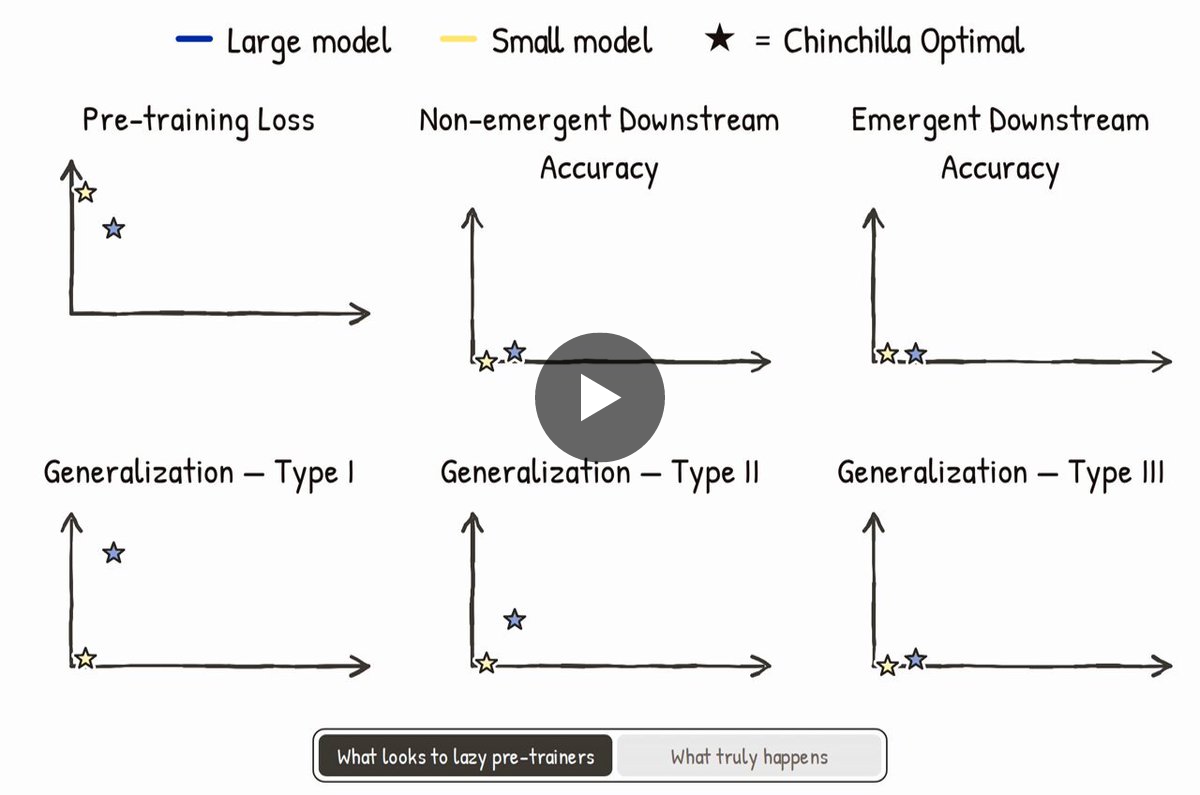
New post: "Generalization Dynamics of LM Pre-training"Most people (including me) assume that LMs smoothly mature from pattern-matching to generalizing. This mental model is wrong. The true dynamics are stranger, and far more fascinating! We call it Mode-Hopping. pic.twitter.com/SoNiCIKI2R— Jiaxin Wen (@jiaxinwen22) May 18, 2026
Library — cameron.stream
How LoRA matches full training performance more broadly than expected.
INTELLECT-2: The First Globally Distributed Reinforcement Learning Training of a 32B Parameter Model
Today we are launching INTELLECT-2: the first 32B parameter globally decentralized Reinforcement Learning training run where anyone can permissionlessly contribute their heterogeneous compute resources.
.png?v=intellect-2)
Towards Principled Representation Learning from Videos for Reinforcement Learning
We study pre-training representations for decision-making using video data, which is abundantly available for tasks such as game agents and software testing. Even though significant empirical advances have been made on this problem, a theoretical understanding remains absent. We initiate the theoretical investigation into principled approaches for representation learning and focus on learning the latent state representations of the underlying MDP using video data. We study two types of settings: one where there is iid noise in the observation, and a more challenging setting where there is also the presence of exogenous noise, which is non-iid noise that is temporally correlated, such as the motion of people or cars in the background. We study three commonly used approaches: autoencoding, temporal contrastive learning, and forward modeling. We prove upper bounds for temporal contrastive learning and forward modeling in the presence of only iid noise. We show that these approaches can learn the latent state and use it to do efficient downstream RL with polynomial sample complexity. When exogenous noise is also present, we establish a lower bound result showing that the sample complexity of learning from video data can be exponentially worse than learning from action-labeled trajectory data. This partially explains why reinforcement learning with video pre-training is hard. We evaluate these representational learning methods in two visual domains, yielding results that are consistent with our theoretical findings.