

Every year, I spend some time introducing students to the mechanics of machine learning with neural nets. I definitely don’t go into great depth; I usually only have one class for this. But I try to unpack at least some of the major concepts, so that ML isn’t quite such a black box.
huggingface/ml-intern
🤗 ml-intern: an open-source ML engineer that reads papers, trains models, and ships ML models
Machine Learning | Google for Developers

ml5 - A friendly machine learning library for the web.
ml5.js aims to make machine learning approachable for a broad audience of artists, creative coders, and students. The library provides access to machine learning algorithms and models in the browser, building on top of TensorFlow.js with no other external dependencies.
The Applied Machine Learning Collective of the Rockies
We're building a hands-on, community-led space where AI/ML practitioners actually grow together. A modern guild where newcomers learn from journeymen, journeymen sharpen their skills alongside experts, and everyone works on real problems that matter.
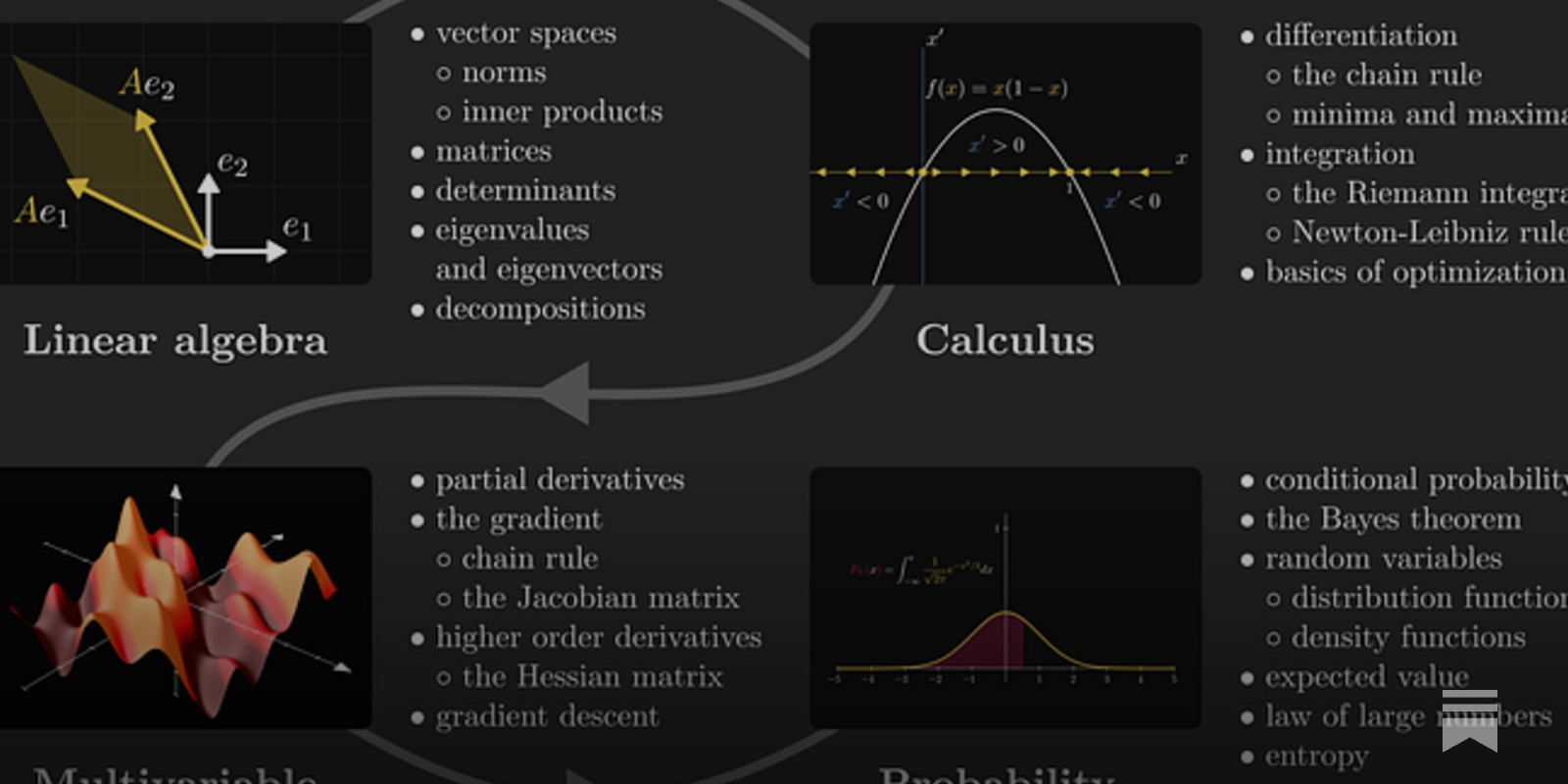
The Roadmap of Mathematics for Machine Learning
A complete guide to linear algebra, calculus, and probability theory
Designing machine learning systems: an iterative process for production-ready applications
"Machine learning systems are both complex and unique. Complex because they consist of many different components and involve many different stakeholders. Unique because they're data dependent, with data varying wildly from one use case to the next. In this book, you'll learn a holistic approach to designing ML systems that are reliable, scalable, maintainable, and adaptive to changing environments and business requirements. Author Chip Huyen, co-founder of Claypot AI, considers each design decision--such as how to process and create training data, which features to use, how often to retrain models, and what to monitor--in the context of how it can help your system as a whole achieve its objectives. The iterative framework in this book uses actual case studies backed by ample references."--Amazon.com
Learnable Programming
Here's a trick question: How do we get people to understand programming?
How to do hard things
A fully general system for learning to do things you currently find difficult, only somewhat tongue-in-cheek.
Programming principles for self taught front-end developers
The majority of us are a bunch of self taught people with rather spotty knowledge and that's fine! Kilian (also self taught) is here to share some of the computer science fundamentals you probably are missing with the aim to improve your code in the long term.
NeuroAI
Neuroscience, cognitive science, and AI are all questing for principles that help generalization. Learn more through a live, synchronous program designed for focused, hands-on learning.
Introducing Nested Learning: A new ML paradigm for continual learning
Ali Behrouz, Student Researcher, and Vahab Mirrokni, VP and Google Fellow, Google Research

What Parents Need to Know About AI in the Classroom | Stanford HAI
From immersive learning and personalized tutors to lesson plans and grading, AI is everywhere in K-12 education.

Learning to Learn: You, Too, Can Rewire Your Brain (Published 2017)
How an engineering professor who “flunked my way” through high school math and science went on to create the world’s most popular online course.

I'm creating a series of short form videos about how language models work technically. The goal is to be something in between "you know it's next token prediction" and "now you've taken a machine learning class." I'd love your thoughts so here are the first few! 🧵 youtube.com/shorts/VZB8XCcyllE

How does ChatGPT work? Or rather, language models in general- Part 1 attempting a lay explanation.
www.youtube.com