

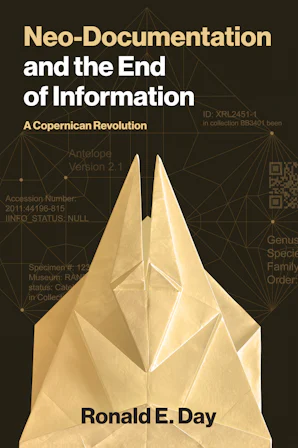
Ronald Day’s Neo-Documentation and the End of Information critiques the modern conception of information as representational “content.” The...
Living in Data: A Citizen's Guide to a Better Information Future (Paperback)
Jer Thorp’s analysis of the word “data” in 10,325 New York Times stories written between 1984 and 2018 shows a distinct trend: among the words most closely associated with “data,” we find not only its classic companions “information” and “digital,” but also a variety of new neighbors—from “scandal” and “misinformation” to “ethics,” “friends,” and “play.”To live in data in the twenty-first century
Everything is miscellaneous : the power of the new digital disorder
Includes bibliographical references (p. [235]-257) and index; Prologue : information in space -- The new order of order -- Alphabetization and its discontents -- The geography of knowledge -- Lumps and splits -- The laws of the jungle -- Smart leaves -- Social knowing -- What nothing says -- Messiness as a virtue -- The work of knowledge -- Coda : misc; Philosopher Weinberger shows how the digital revolution is radically changing the way we make sense of our lives. Human beings constantly collect, label, and organize data--but today, the shift from the physical to the digital is mixing, burning, and ripping our lives apart. In the past, everything had its one place--the physical world demanded it--but now everything has its places: multiple categories, multiple shelves. Everything is suddenly miscellaneous. Weinberger charts the new principles of digital order that are remaking business, education, politics, science, and culture. He examines how Rand McNally decides what information not to include in a physical map (and why Google Earth is winning that battle), how Staples stores emulate online shopping to increase sales, why your children's teachers will stop having them memorize facts, and how the shift to digital music stands as the model for the future.--From publisher description; From A to Z, Everything Is Miscellaneous will completely reshape the way you think - and what you know - about the world. Includes information on alphabetical order, Amaxon.com, animals, Aristotle, authority, Bettmann Archive, blogs (weblogs), books, broadcasting, British Broadcasting Corporation (BBC), business, card catalog, categories and categorization, clusters, companies, Colon Classification, conversation, Melvil Dewey, Dewey Decimal Classification system, Encyclopaedia Britannica, encyclopedia, essentialism, experts, faceted classification system, first order of order, Flickr.com, Google, Great Books of the Western World, ancient Greeks, health and medical information, identifiers, index, inventory tracking, knowledge, labels, leaf and leaves, libraries, Library of Congress, links, Carolus Linnaeus, lumping and splitting, maps and mapping, marketing, meaning, metadata, multiple listing services (MLS), names of people, neutrality or neutral point of view, New York Public Library, Online Computer Library Center (OCLC), order and organization, people, physical space, everything having place, Plato, race, S.R. Ranganathan, Eleanor Rosch, Joshua Schacter, science, second order of order, simplicity, social constructivism, social knowledge, social networks, sorting, species, standardization, tags, taxonomies, third order of roder, topical categorization, tree, Uniform Product Code (UPC), users, Jimmy Wales, web, Wikipedia, etc

Information scraps: How and why information eludes our personal information management tools
In this article we investigate information scraps —personal information where content has been scribbled on Post-it notes, scrawled on the corners of sheets of paper, stuck in our pockets, sent in email messages to ourselves, and stashed in miscellaneous digital text files. Information scraps encode information ranging from ideas and sketches to notes, reminders, shipment tracking numbers, driving directions, and even poetry. Although information scraps are ubiquitous, we have much still to learn about these loose forms of information practice. Why do we keep information scraps outside of our traditional PIM applications? What role do information scraps play in our overall information practice? How might PIM applications be better designed to accommodate and support information scraps' creation, manipulation and retrieval? We pursued these questions by studying the information scrap practices of 27 knowledge workers at five organizations. Our observations shed light on information scraps' content, form, media, and location. From this data, we elaborate on the typical information scrap lifecycle, and identify common roles that information scraps play: temporary storage, archiving, work-in-progress, reminding, and management of unusual data. These roles suggest a set of unmet design needs in current PIM tools: lightweight entry, unconstrained content, flexible use and adaptability, visibility, and mobility.


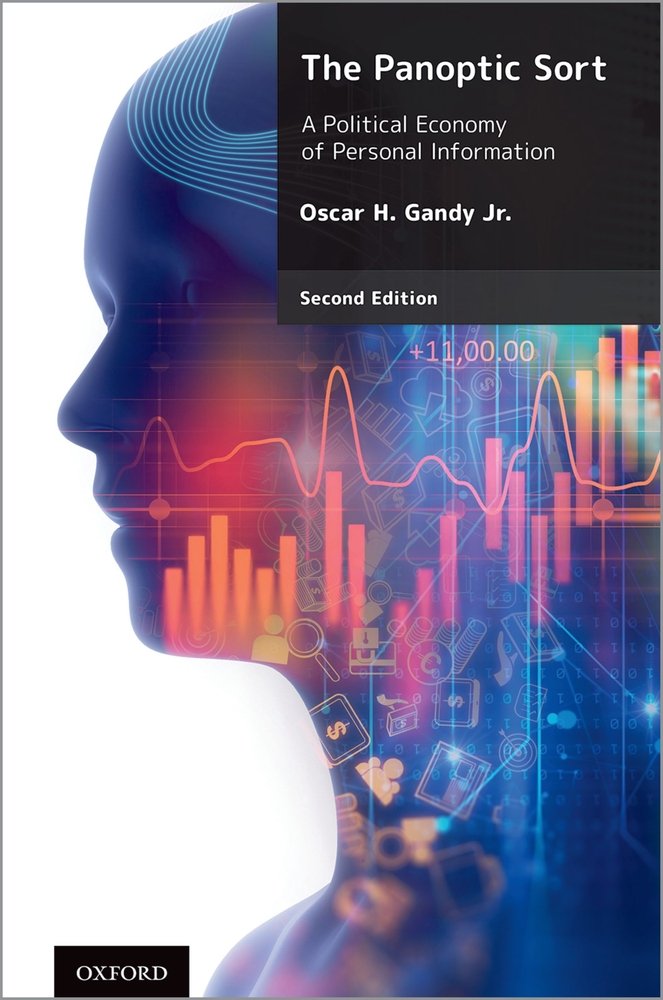
The Panoptic Sort: A Political Economy of Personal Information
A Political Economy of Personal Information
The History of Information - Chris Haughton
disinformation, chris haughton, information, noam chomsky

Practicing Information Sensibility: How Gen Z Engages with Online Information
Assessing the trustworthiness of information online is complicated. Literacy-based paradigms are both widely used to help and widely critiqued. We conducted a study with 35 Gen Zers from across the U.S. to understand how they assess information online. We found that they tended to encounter -- rather than search for -- information, and that those encounters were shaped more by social motivations than by truth-seeking queries. For them, information processing is fundamentally a social practice. Gen Zers interpreted online information together, as aspirational members of social groups. Our participants sought information sensibility: a socially-informed awareness of the value of information encountered online. We outline key challenges they faced and practices they used to make sense of information. Our findings suggest that like their information sensibility practices, solutions and strategies to address misinformation should be embedded in social contexts online.

How to Make Sense of Any Mess
Information Architecture for Everybody. Based on a book by Information Architect, Abby Covert.
Debate Maps — The Society Library
While The Society Library is dedicated to enabling access to information through our libraries, we recognize the difficult and tricky work of organizing that content into formal deliberation. There are hundreds of cognitive biases and logical pitfalls that can get in our way as human beings. Therefore, as a part of our service, The Society Library endeavors to map the knowledge we collect into “debate maps,” which essentially means we are organizing the arguments, claims, evidence, and opinions from all points of view into a formal debate - and effectively enabling “societal-scale debate.” A feat which may be otherwise impossible to organize in comparable levels of comprehensiveness with the existing limits of media, language, and human bandwidth to which we are confined.

Creative Reading: Scaffolding Reading for Transformation
However, recent work on augmenting reading largely focuses on making reading more efficient, especially in knowledge-intensive contexts where people must rapidly make sense of research papers and other complex documents (Lo et al., 2024). These systems often aim to help readers skim, summarize, and synthesize large volumes of information in order to reduce cognitive effort and accelerate document- and corpus-level sensemaking at scale (Gu et al., 2025; Lo et al., 2024; Fok et al., 2023). At one extreme, the form of reading implicitly envisioned by these systems may resemble what we call “reading to discard”: extracting the essential, actionable informational core of a document as quickly and efficiently as possible, so that the rest can be swiftly tossed aside—much like we often process inbound mail. This motivates us to ask what scaffolding approaches might resist “reading to discard,” what alternative forms of reading we might scaffold, and what alternative views and values of reading might guide the conversation.
No Longer No Sense of an Ending
This is my first feature piece on Contents Magazine, about harnessing the properties of hypertext and the Web for superior reader experiences and business results.
Documentation is more than you think
Everything that is involved in making great documentation everywhere and all at once.
OASIS Darwin Information Typing Architecture (DITA) TC — Subcommittee | OASIS
Advancing a document creation and management specification that builds content reuse into the authoring process
“‘Information’ is a relational concept that assumes meaning only when related to the cognitive structure of the observer.” -- Heinz von Foerster
Control Information Theory: The “Missing Link” In the Science Of Cybernetics | Institute for the Study of Complex Systems
complexsystems.orgGoogle: Organize the world's information Atmosphere: Let the world's information self-organize

TJ
In some ways, atproto, bluesky, @semble.so, @sill.social, @standard.site and so on are building new indexes for the web. I really hope atproto succeeds and goes fully mainstream. Think of the amazing search engines that can be built on such rich index data. Maybe web3 can actually happen.

