


LLaDA is a diffusion model with an unprecedented 8B scale, rivaling LLaMA3 8B in performance.
Continuous diffusion language models
Fully discrete methods dominated for a few years, but language models based on continuous diffusion are making a comeback.

Continuous diffusion language models
Fully discrete methods dominated for a few years, but language models based on continuous diffusion are making a comeback.
Research – Inception
We are leveraging diffusion technology to develop a new generation of LLMs. Our dLLMs are much faster and more efficient than traditional autoregressive LLMs.

Scaling Laws Across Model Architectures: A Comparative Analysis of...
The scaling of large language models (LLMs) is a critical research area for the efficiency and effectiveness of model training and deployment. Our work investigates the transferability and...

The Case Against LLMs as Rerankers
Authors: Apoorva Joshi, Zhenmei Shi, Akshay Goindani, Hong LiuResearch Leads: Zhenmei Shi, Akshay Goindani, Hong Liu Large language models are increasingly being used for a broad range of tasks, in…

Large language model
A large language model (LLM) is a neural network trained on a vast amount of text for natural language processing tasks, especially language generation. LLMs can typically generate, summarize, translate, and analyze text in many contexts, and are a foundational technology behind modern chatbots.[1] Biased or inaccurate training data can make an LLM's output less reliable.[2]
Take caution in using LLMs as human surrogates | PNAS
Recent studies suggest large language models (LLMs) can generate human-like responses, aligning with human behavior in economic experiments, survey...

How to Make Small Language Models Outperform Large Language Models Using DSPy!
How a 3B Language Model Surpasses an 8B Counterpart with DSPy? “In an era where language models (LMs) are revolutionising countless tasks, their potential is only as powerful as we interpret …
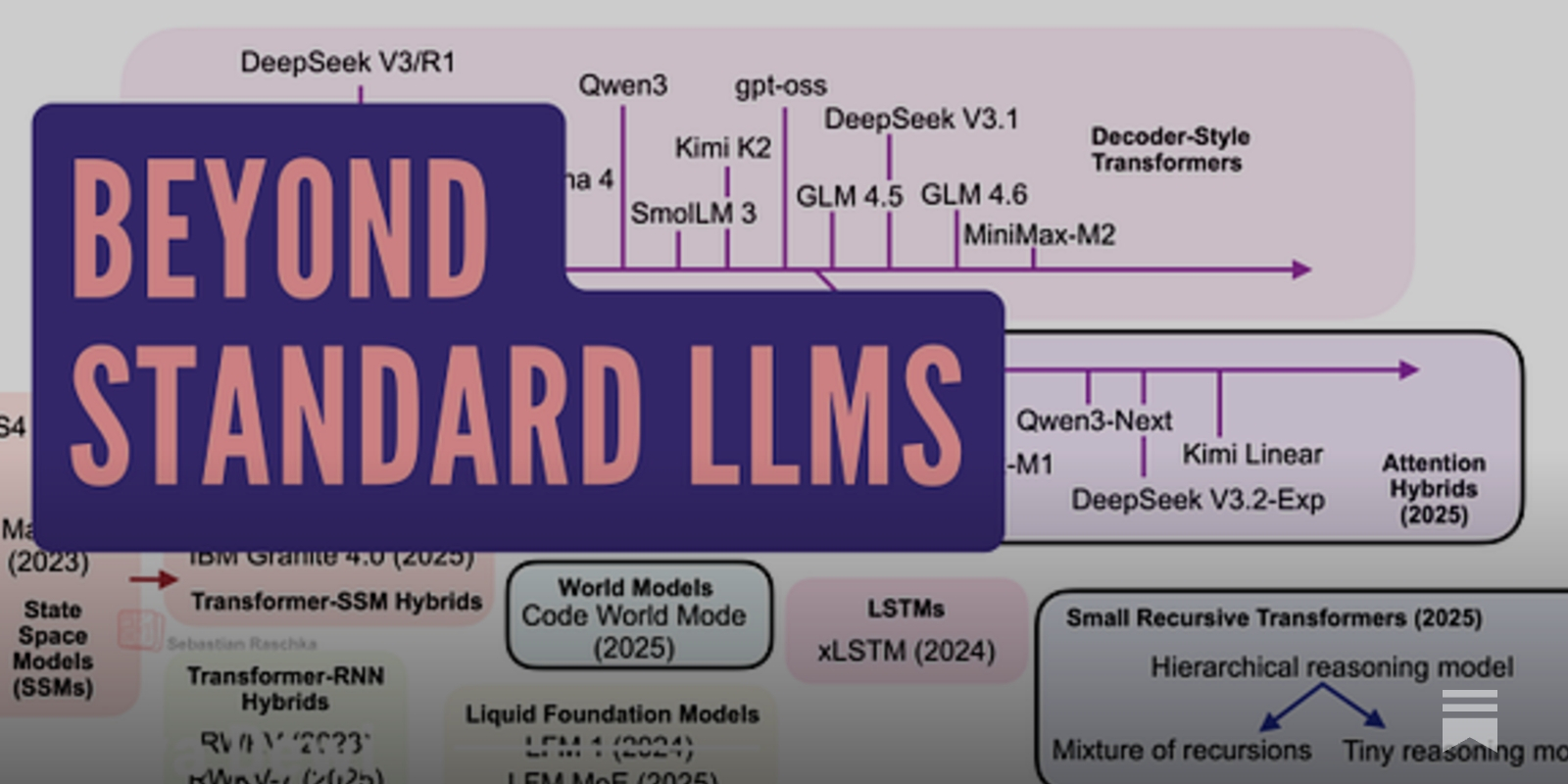
Beyond Standard LLMs
Linear Attention Hybrids, Text Diffusion, Code World Models, and Small Recursive Transformers
Mitigating Cross-Lingual Cultural Inconsistencies in LLMs via...
Despite their impressive capabilities, multilingual large language models (MLLMs) frequently exhibit inconsistent behaviour when the prompt's language changes. While such adaptation is generally...

The diffusion of large language models in published academic articles
Large language models (LLMs) are rapidly changing academic research, raising questions of who is adopting these tools and under what conditions. This article analyzes full texts of 7.3 million journal articles published from 2020–2025 by four major publishers (Elsevier, Frontiers, MDPI, and PLoS) to track the prevalence of LLM-associated language and identify social and institutional correlates of adoption. A corpus of 228 focal words exhibiting sharp post-2022 frequency increases consistent with LLM output was developed; articles were scored on their rate of focal word usage. By 2025, an estimated 57% of published articles exhibited evidence of LLM influence, up from 12% in 2023. Among articles exhibiting LLM-influenced text, there is substantial heterogeneity, ranging from subtle linguistic influence to articles mostly or entirely LLM-generated. Difference-in-differences models reveal that LLM-associated language varies markedly across regions, institutional ranks, publishers, disciplines, and journal tiers. Economic development and proximity to English as a primary language are key predictors of regional variation. Lower-ranked institutions exhibit higher rates than elite universities, young for-profit publishers show elevated rates vis-à-vis competitors, and academic fields differ widely in adoption. LLM adoption in academic writing is pervasive but socially stratified. As models grow more powerful and their use becomes further entrenched in academic research, understanding social dynamics of adoption will be essential for governing the evolving relationship between AI and academic knowledge production.

Introducing Mercury 2.5 – Inception
Mercury 2.5 is the most capable diffusion LLM on the market. It runs at 1,107 tokens/sec and offers a 40% increase in intelligence over Mercury 2, comparable to cost-optimized frontier models.

How Large Language Models Actually Work
On-Device LLM Throughput Calculator - a Hugging Face Space by FL33TW00D-HF
This tool estimates and visualizes the throughput of Large Language Models on devices with memory bandwidth constraints. Users input device and model configurations, and the tool generates a plot s...
Replication Data for "State Media Control Influences Large Language Models"
Replication dataset for "State Media Control Influences Large Language Models," forthcoming in Nature (https://doi.org/10.1038/s41586-026-10506-7). We show through six studies that government control of the media across the world influences the output of large language models (LLMs) via their training data.