


Recognize that, while extremely beneficial, diversity-in-tech work exacts an emotional and mental toll on the well-being of the people who do it.
How Bad Are Things?
One “advantage” of working in psychiatry is getting a window into an otherwise invisible world of really miserable people. I work in a wealthy, mostly-white college town consistently ra…

Remote workers report the highest well-being in study of 7,700 employees
Many employers worry remote workers feel disconnected. A new study found they reported higher well-being and were no more likely to feel isolated than their

Working remotely, coworking spaces, and mental health - bitquabit
This should be a hard blog post to write–after all, it’s the one where I openly admit I had an emotional breakdown and saw a mental health professional–but it’s actually easy. And it’s easy because it has a good ending: facing long odds and a frustrating situation, I ended up turning everything around and getting a place where I love my job and I’m a happy person again.
Coding Bootcamps and Emotional Labor
Bootcamps are a micro example of how the tech industry is built on the emotional labor of the same groups who are marginalized within it.
A Deceptively Simple Way to Find More Happiness at Work (Published 2019)
You don’t need to change everything about your job to see major benefits. A few changes here and there can be all you need.

Diversity in Open Source Is Even Worse Than in Tech Overall
The open source world's diversity problem could actually make the larger tech industry's entrenched imbalances worse.

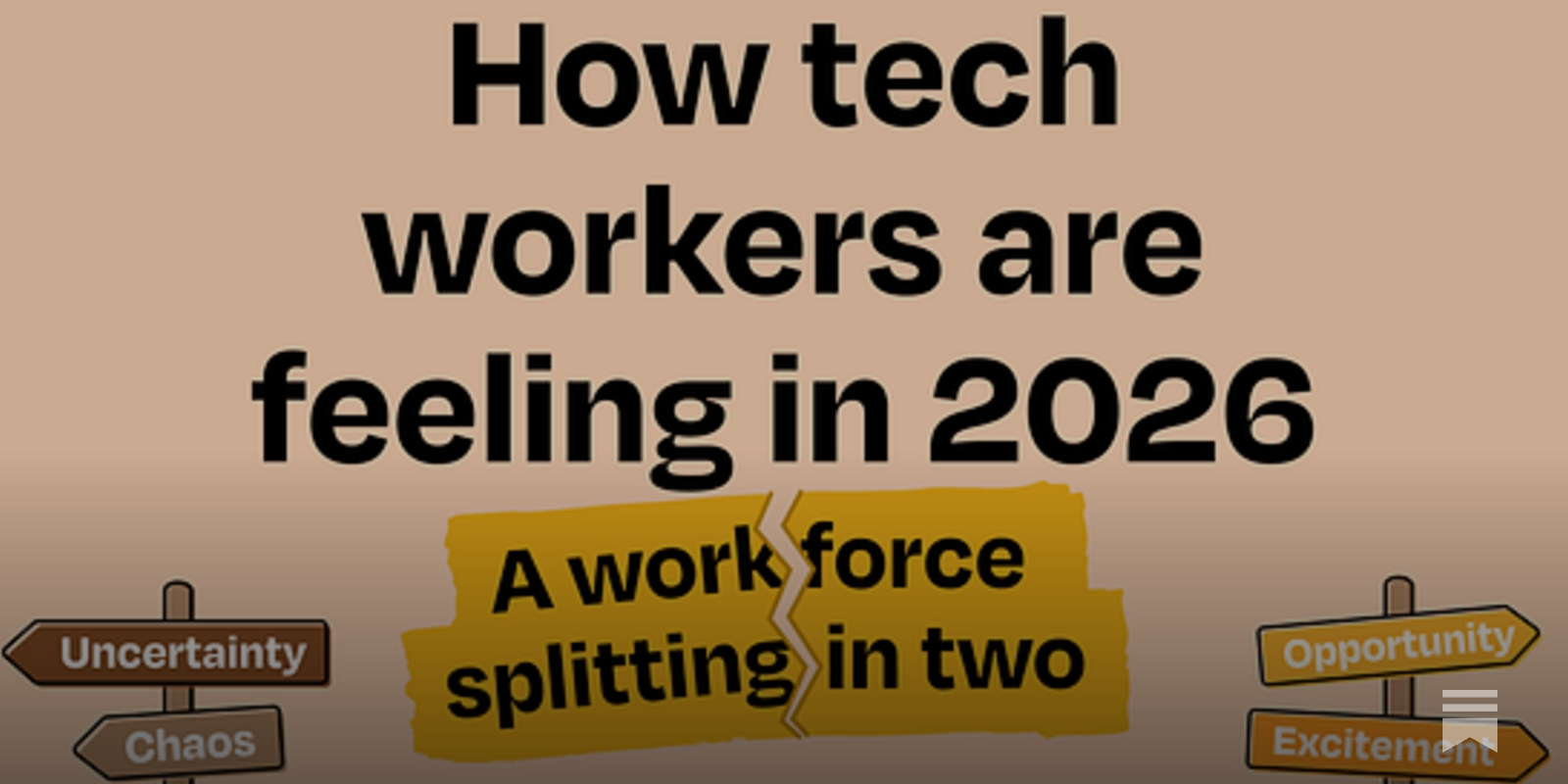
How tech workers are feeling in 2026: a workforce splitting in two
Results from our second annual tech worker sentiment survey

As diversity increases, people paradoxically perceive social groups as more similar
With globalization and immigration, societal contexts differ in sheer variety of resident social groups. Social diversity challenges individuals to think in new ways about new kinds of people and where their groups all stand, relative to each other. However, psychological science does not yet specify how human minds represent social diversity, in homogeneous or heterogenous contexts. Mental maps of the array of society’s groups should differ when individuals inhabit more and less diverse ecologies. Nonetheless, predictions disagree on how they should differ. Confirmation bias suggests more diversity means more stereotype dispersion: With increased exposure, perceivers’ mental maps might differentiate more among groups, so their stereotypes would spread out (disperse). In contrast, individuation suggests more diversity means less stereotype dispersion, as perceivers experience within-group variety and between-group overlap. Worldwide, nationwide, individual, and longitudinal datasets ( n = 12,011) revealed a diversity paradox: More diversity consistently meant less stereotype dispersion. Both contextual and perceived ethnic diversity correlate with decreased stereotype dispersion. Countries and US states with higher levels of ethnic diversity (e.g., South Africa and Hawaii, versus South Korea and Vermont), online individuals who perceive more ethnic diversity, and students who moved to more ethnically diverse colleges mentally represent ethnic groups as more similar to each other, on warmth and competence stereotypes. Homogeneity shows more-differentiated stereotypes; ironically, those with the least exposure have the most-distinct stereotypes. Diversity means less-differentiated stereotypes, as in the melting pot metaphor. Diversity and reduced dispersion also correlate positively with subjective wellbeing.

Dissecting the Google Employee’s Anti-Diversity Manifesto, Piece-by-Piece
Part 1: A narrative on the Google Anti-Diversity Manifesto

I'm addicted to being useful
When I get together with my friends in the industry, I feel a little guilty about how much I love my job. This is a tough time to be a software engineer. The job was less stressful in the late 2010s than it is now, and I sympathize with anyone who is upset about the change. There are a lot of objective reasons to feel bad about work. But despite all that, I’m still having a blast. I enjoy pulling together projects, figuring out difficult bugs, and writing code in general. I like spending time with computers. But what I really love is being useful.

Improving Diversity Hiring In Tech | TechCrunch
I see a lot of articles written by well-intentioned people about how tech companies want to attract more diverse candidates. Usually, I don’t get more than three sentences in before I read about how the organization is making an effort to attract talent from historically black colleges and universities.

The Open Source Identity Crisis
As the diversity in tech movement gains traction, open source faces an identity crisis.

technological diversity
Technological diversity is the opposite of technological monoculture. It refers to the diversity of artifacts (software and hardware) as well as that of ideas, philosophies, paradigms, techniques, languages, mental models, etc.

I got into tech six years ago because I figured I could have an outsized impact on making a less harmful, more empowering world for workers and marginalised people. Only this year, I started connecting IRL with people who think this way. Here I tried to write about the ways that's transformed me.

DWeb, Culture and Resistance
meri.garden