

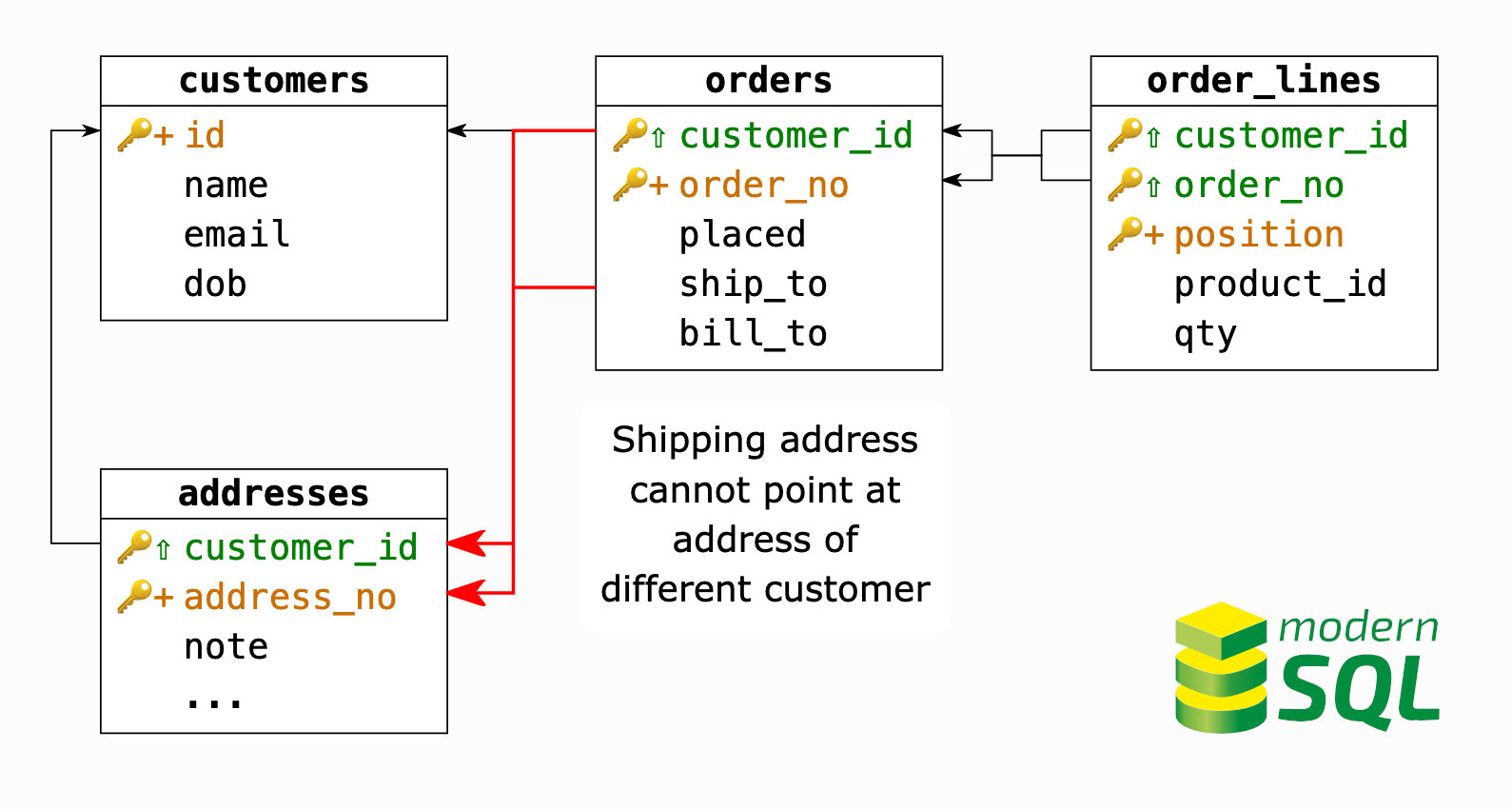
Structured primary keys prevent contradiction and perform better than surrogate keys
Composite ML-DSA for use in X.509 Public Key Infrastructure
This document defines combinations of US NIST ML-DSA in hybrid with traditional algorithms RSASSA-PKCS1-v1.5, RSASSA-PSS, ECDSA, Ed25519, and Ed448. These combinations are tailored to meet regulatory guidelines. Composite ML-DSA is applicable in applications that uses X.509 or PKIX data structures that accept ML-DSA, but where the operator wants extra protection against breaks or catastrophic bugs in ML-DSA, and where EUF-CMA-level security is acceptable.
Relational lenses | Proceedings of the twenty-fifth ACM SIGMOD-SIGACT-SIGART symposium on Principles of database systems
As part of the Digital Library's transition to Open Access, new features for researchers are available in the Premium Edition. Click here to learn more.

Composing schema mappings: Second-order dependencies to the rescue: ACM Transactions on Database Systems: Vol 30, No 4
A schema mapping is a specification that describes how data structured under one schema (the source schema) is to be transformed into data structured under a different schema (the target schema). A fundamental problem is composing schema mappings: given ...

A Categorical Unification for Multi-Model Data: Part I Categorical Model and Normal Forms
Modern database systems face a significant challenge in effectively handling the Variety of data. The primary objective of this paper is to establish a unified data model and theoretical framework for multi-model data management. To achieve this, we present a categorical framework to unify three types of structured or semi-structured data: relation, XML, and graph-structured data. Utilizing the language of category theory, our framework offers a sound formal abstraction for representing these diverse data types. We extend the Entity-Relationship (ER) diagram with enriched semantic constraints, incorporating categorical ingredients such as pullback, pushout and limit. Furthermore, we develop a categorical normal form theory which is applied to category data to reduce redundancy and facilitate data maintenance. Those normal forms are applicable to relation, XML and graph data simultaneously, thereby eliminating the need for ad-hoc, model-specific definitions as found in separated normal form theories before. Finally, we discuss the connections between this new normal form framework and Boyce-Codd normal form, fourth normal form, and XML normal form.

Build Your Own Database
A step-by-step guide to building a key-value database from scratch.
tassis/atfield-core
Framework-agnostic AT Protocol utilities for identity resolution and public record reads.
Cambria | Proceedings of the 8th Workshop on Principles and Practice of Consistency for Distributed Data
This summary was generated using automated tools and was not authored or reviewed by the article's author(s). It is provided to support discovery, help readers assess relevance, and assist readers from adjacent research areas in understanding the work. It is intended to complement the author-supplied abstract, which remains the primary summary of the paper. The full article remains the authoritative version of record. Click here to learn more.
Graceful database schema evolution: the PRISM workbench: Proceedings of the VLDB Endowment: Vol 1, No 1
Supporting graceful schema evolution represents an unsolved problem for traditional information systems that is further exacerbated in web information systems, such as Wikipedia and public scientific databases: in these projects based on multiparty ...

STAR: ordered key-value archive format #21
Hello! I'd like to propose new work for DASL: the [STAR](https://tangled.org/microcosm.blue/star/tree/main/v1-star) (/STAR-lite) archive format. I originally made STAR as a stricter, simpler, safer, more efficient alternative to CARs for atproto public repository exports. Its v0 now has several library implementations and has at least two production producers and half a dozen consumers in the Atmosphere, but is very atproto-coupled. STAR is [being considered](https://github.com/bluesky-social/proposals/pull/114) as the standard format for [atproto spaces](https://github.com/bluesky-social/proposals/tree/main/0016-permissioned-data) repo exports. After iteration with @dholms.at and @bnewbold.net, STAR's spaces-compatible v1 is becoming a more general-purpose format for ordered key-value data, and I think, a potentially good fit with DASL. Following the DASL governance [steps for proposing new work](https://dasl.ing/governance.html#:~:text=Proposing%20New%20Work): ## What will be implemented A specification ([in progress](https://tangled.org/microcosm.blue/star/tree/main/v1-star)), reference implementations, test vectors. ## Who wants it Data exports in atproto is one established use-case. People have been motivated to request public archives in STAR-lite format from [hubble](https://web.hubble.microcosm.blue/): 260M STAR-lite archives served vs 6M CAR. Repositories compress to a bit under half the size compared to CARs, which translates directly into faster network backfill rate in many cases (this is not exactly apples-to-apples: STAR-lite omits the MST entirely since it's deterministic from the data and cheap to reconstruct). More on the pain it addresses [here](https://pckt.blog/b/data-service-diaries/war-on-cars-5xa5v73). The atproto spaces protocol proposes an LtHash set as its canonical data integrity structure instead of a MST: flat key-value with no tree or DAG structure at all to benefit from CAR's CID indexing, fitting more naturally (and without the incompressible CID overhead) into something like STAR. ## Fit with existing primitives STAR-lite builds on DRISL/DASL-CBOR, and uses `varint`-prefixed framing like DASL-CAR. Where DASL-CAR fits DAG-shaped data well, STAR-lite is a more natural fit for flat key-value data. ## Confirm willingness to serve as an editor I confirm! ## Other criteria not covered above Implementation: there is currently a v0 reference [rust](https://crates.io/crates/star-lite) + a third-party Objective-C implementation. I will be adding v1 support to the rust library soon. I think there will be more implementations, especially if it gets adopted by atproto spaces. Community Support: Existing growing uptake of the v0 format, possible standardized use in atproto-spaces, [active evolution](https://bsky.app/profile/bad-example.com/post/3mwc5n4f4gk24) based on feedback. --- Atmosphere post: https://bsky.app/profile/did:plc:lulmyldiq4sb2ikags5sfb25/post/3mwohvqxhpc2h Upcoming CID Congress presentation at https://luma.com/8w8swmx2
n0-computer/iroh-docs
Multi-dimensional key-value documents with an efficient synchronization protocol.
Mutual intelligibility for schema idiolects.

GitHub - idiolect-dev/idiolect: Mutual intelligibility for schema idiolects.
github.com@iame.li what's your thoughts on this, re: choice of cryptographic keys in the standardized form of atproto

