


Intan Suwandi is a frequent contributor to Monthly Review. This article is adapted from her book, Value Chains: The New Economic Imperialism, winner of the 2018 Paul M. Sweezy-Paul A.... READ MORE
Imperialist appropriation in the world economy: Drain from the global South through unequal exchange, 1990–2015
Unequal exchange theory posits that economic growth in the “advanced economies” of the global North relies on a large net appropriation of resources and labour from the global South, extracted through price differentials in international trade. Past attempts to estimate the scale and value of this drain have faced a number of conceptual and empirical limitations, and have been unable to capture the upstream resources and labour embodied in traded goods. Here we use environmental input-output data and footprint analysis to quantify the physical scale of net appropriation from the South in terms of embodied resources and labour over the period 1990 to 2015. We then represent the value of appropriated resources in terms of prevailing market prices. Our results show that in 2015 the North net appropriated from the South 12 billion tons of embodied raw material equivalents, 822 million hectares of embodied land, 21 exajoules of embodied energy, and 188 million person-years of embodied labour, worth $10.8 trillion in Northern prices – enough to end extreme poverty 70 times over. Over the whole period, drain from the South totalled $242 trillion (constant 2010 USD). This drain represents a significant windfall for the global North, equivalent to a quarter of Northern GDP. For comparison, we also report drain in global average prices. Using this method, we find that the South’s losses due to unequal exchange outstrip their total aid receipts over the period by a factor of 30. Our analysis confirms that unequal exchange is a significant driver of global inequality, uneven development, and ecological breakdown.
What will be scarce?
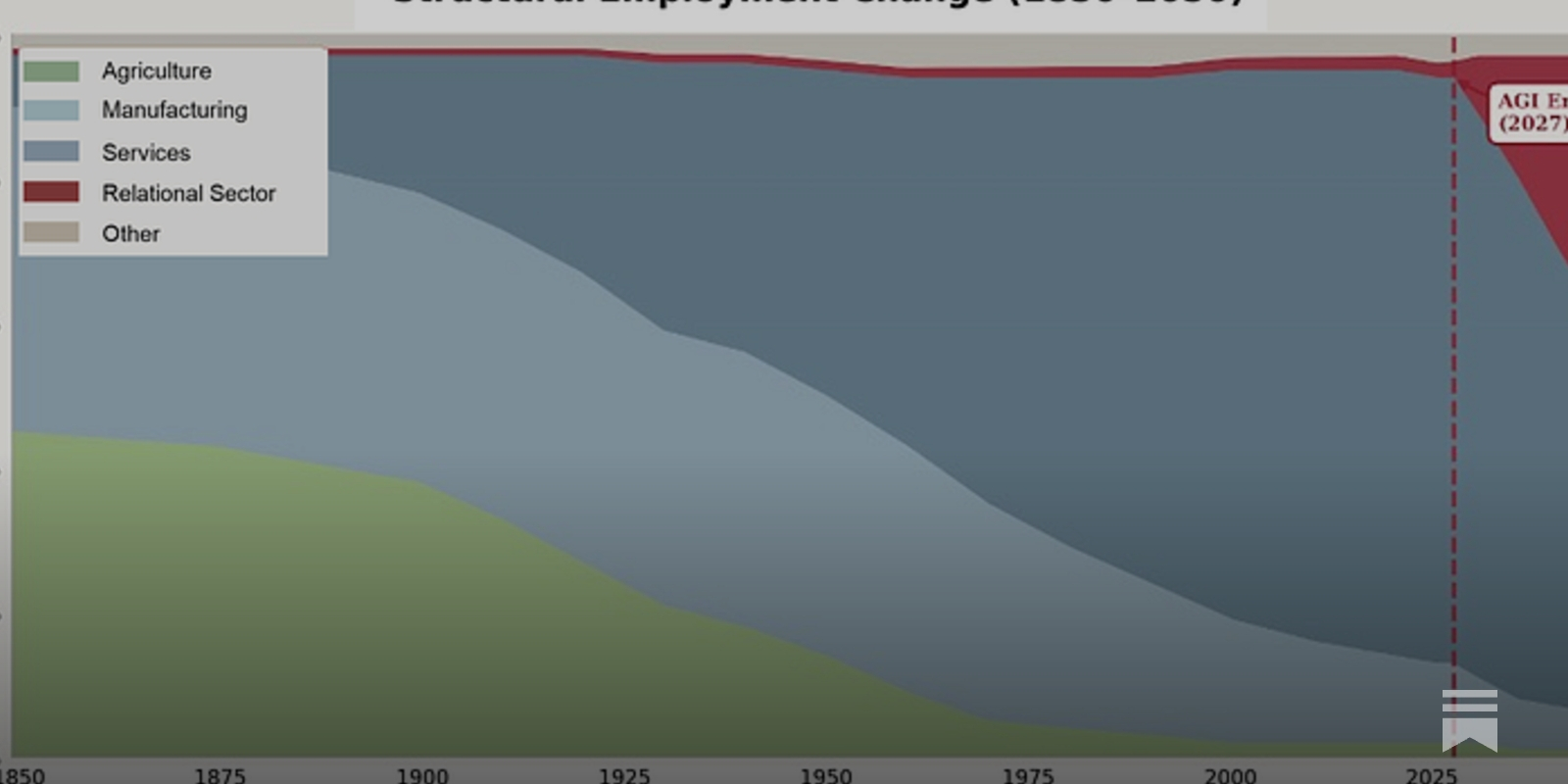
The economics of structural change and the post-commodity future of work
Une note sur les déficits commerciaux et l’industrie
Traduction française du billet de blog "A note on trade deficits and manufacturing. Some perspective on the eve of trade war" de Paul Krugman

Unequal exchange of labour in the world economy
Researchers have argued that wealthy nations rely on a large net appropriation of labour and resources from the rest of the world through unequal exchange in international trade and global commodity chains. Here we assess this empirically by measuring flows of embodied labour in the world economy from 1995–2021, accounting for skill levels, sectors and wages. We find that, in 2021, the economies of the global North net-appropriated 826 billion hours of embodied labour from the global South, across all skill levels and sectors. The wage value of this net-appropriated labour was equivalent to €16.9 trillion in Northern prices, accounting for skill level. This appropriation roughly doubles the labour that is available for Northern consumption but drains the South of productive capacity that could be used instead for local human needs and development. Unequal exchange is understood to be driven in part by systematic wage inequalities. We find Southern wages are 87–95% lower than Northern wages for work of equal skill. While Southern workers contribute 90% of the labour that powers the world economy, they receive only 21% of global income.

Commodity prices, the business cycle, and inflation: International evidence, 1851-1913
Commodity prices played a critical role in the surge and decline of inflation since 2020. This column studies the relationship between commodity prices, consumer prices, and the business cycle for 15 economies in the years prior to World War I. It finds a strong positive relationship between inflation and commodity prices, even when focusing on commodities that are unlikely to have been in the consumer basket. Demand-induced increases in commodity prices, linked to the global business cycle, have a stronger effect on inflation.

CMV: The labor theory of value is flawed
72 votes, 407 comments. This might be an obscure topic, however, in some—largely Marxist circles— the approach seems to motivate much of the dialogue…
Capitalism and Its Critics: A History
A Financial Times Most Anticipated Book of 2025A sweeping, dramatic history of capitalism as seen through the eyes of its fiercest critics. At a time when artificial intelligence, climate change, and inequality are raising fundamental questions about the economic system, Capitalism and Its Critics provides a kaleidoscopic history of global capitalism, from the East India Company and Industrial Revolution to the di...
Global labor arbitrage
Global labor arbitrage is an economic phenomenon where, as a result of the removal of or disintegration of barriers to international trade, jobs move to nations where labor and the cost of doing business are inexpensive and/or impoverished labor moves to nations with higher paying jobs.

Invisible Exploitation: How Capital Extracts Value Beyond Wage Labor - Monthly Review
Eva Swidler is an environmental political economist and social historian. She teaches at Goddard College and the Curtis Institute of Music. The Marxist analysis of work under capitalism has long... READ MORE

The New Gulf War: Epic Fubar Goes Global
Why there is much more at stake here than rising prices

L’incontournable trilemme de l'économie mondiale
Traduction française de Dani Rodrik (2012), « The inescapable trilemma of the world economy »
.png)
Les tarifs douaniers et la pauvreté dans le monde
traduction française du billet de blog "Tariffs and poverty around the world" de Paul Krugman

(PDF) The Precariat and Class Struggle *
PDF | The world economy is in the midst of a Global Transformation that is producing a new global class structure. A new class is emerging – the... | Find, read and cite all the research you need on ResearchGate

annotations: Les mécanismes de la malédiction des ressources
traduction française du billet de blog "The economic nature of the resource curse: Mechanisms" de Daron Acemoglu & James Robinson
Le dollar et le déficit commercial américain
traduction française du billet de blog "The dollar and the trade deficit" de Paul Krugman
