

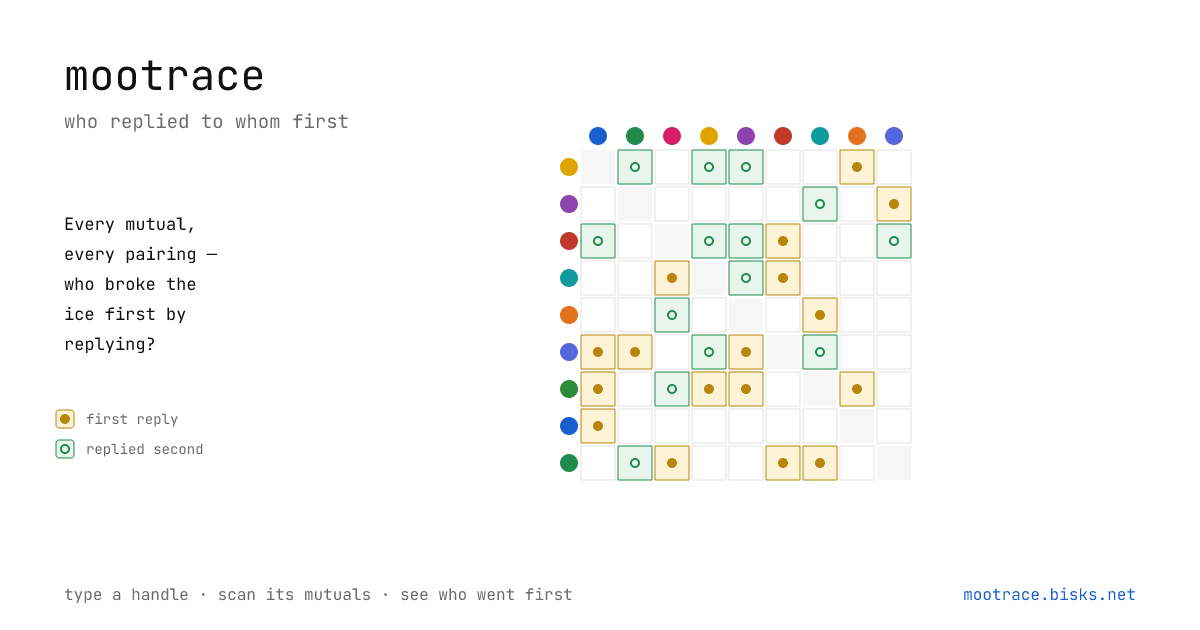
A grid of a handle's mutuals — every pairing shows who replied to the other first.
mootfluence — your influential25 rank, among your moots
See where you rank on influential25's live nomination board — not against the whole network, just your own moots (mutual follows). Then turn your top-ranked moots into a real starter pack.

Local-First with grjte and Goblin Oats
In this episode, Anna Rose and Nico Mohnblatt speak with Goblin Oats from Tonk and grjte from Bain Capital Crypto […]

When Machines Talk To Themselves
Drop me a 💡 on the linkedin post if this is interesting. OpenClaw/Clawdbot/Moltbot have sprung into view this week. Now they are having large-scale conversations and collaborations with each …

Mnemonic convergence in social networks: The emergent properties of cognition at a collective level
Significance Human memory is highly malleable. Because of this malleability, jointly remembering the past along with another individual often results in increased similarity between the conversational partners’ memories. We propose an approach that examines the conversation between a pair of participants as part of a larger network of social interactions that has the potential to reveal how human communities form collective memories. Empirical evidence indicating that dyadic-level conversational alignment processes give rise to community-wide shared memories is presented. We find that individual-level memory updating phenomena and social network structure are two fundamental factors that contribute to the emergence of collective memories. , The development of shared memories, beliefs, and norms is a fundamental characteristic of human communities. These emergent outcomes are thought to occur owing to a dynamic system of information sharing and memory updating, which fundamentally depends on communication. Here we report results on the formation of collective memories in laboratory-created communities. We manipulated conversational network structure in a series of real-time, computer-mediated interactions in fourteen 10-member communities. The results show that mnemonic convergence, measured as the degree of overlap among community members’ memories, is influenced by both individual-level information-processing phenomena and by the conversational social network structure created during conversational recall. By studying laboratory-created social networks, we show how large-scale social phenomena (i.e., collective memory) can emerge out of microlevel local dynamics (i.e., mnemonic reinforcement and suppression effects). The social-interactionist approach proposed herein points to optimal strategies for spreading information in social networks and provides a framework for measuring and forging collective memories in communities of individuals.


Emmett Shear: Alignment Protocols
AT Mot — a daily word game on atproto
Guess the daily 5-letter word in English or French. Built on the AT Protocol — your data is yours.
OStatus Community Group
OStatus is a suite of protocols that lets people on different social networks interact. This group will develop the next version of the protocol.
The Future of Group Messaging
An analysis of modern messaging, and the evolutionary next steps.
LLMs and people both learn to form conventions -- just not with each other
Humans align to one another in conversation -- adopting shared conventions that ease communication. We test whether LLMs form the same kinds of conventions in a multimodal communication game. Both humans and LLMs display evidence of convention-formation (increasing the accuracy and consistency of their turns while decreasing their length) when communicating in same-type dyads (humans with humans, AI with AI). However, heterogenous human-AI pairs fail -- suggesting differences in communicative tendencies. In Experiment 2, we ask whether LLMs can be induced to behave more like human conversants, by prompting them to produce superficially humanlike behavior. While the length of their messages matches that of human pairs, accuracy and lexical overlap in human-LLM pairs continues to lag behind that of both human-human and AI-AI pairs. These results suggest that conversational alignment requires more than just the ability to mimic previous interactions, but also shared interpretative biases toward the meanings that are conveyed.

didlev — who is closest to your DID?
Pulls all your Bluesky mutuals and ranks them by Levenshtein distance between their DID and yours.
one of the most radical actions the @npmx.dev community took was talking with every single human being who joined our chat server. more than 500 people were welcomed, encouraged to join our open conversations, ask for guidance, share their own ideas, and jump into action when they see opportunities
